



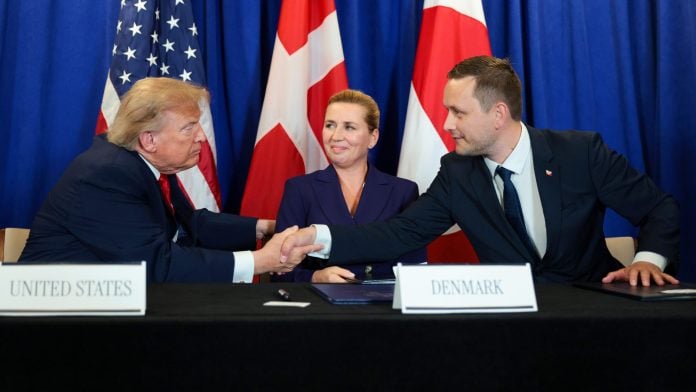
Greenland’s new security deal with the US presents an opportunity to unlock American spending on the Arctic island, potentially boosting an economy still heavily dependent on subsidies and fish.
The accord signed in New York on Tuesday includes an agreement on two new US bases and states that contracts by the US should go to local businesses “to the maximum extent possible.” That’s raising hopes that spending on infrastructure and other activities could generate business for local companies and help establish defense as a new industry.
“We want it as a pillar of the economy,” said Christian Keldsen, chief executive officer of the Greenland Business Association. “The beauty of defense activity is that there’s an exchange: it’s money coming into our society from the Danish or US government, while we provide something in return.”
An additional benefit is that if local companies get contracts, “then we’re creating Greenlandic jobs and building Greenlandic skills,” Keldsen said.
The potential windfall comes as Greenland confronts a much bigger economic challenge. With gross domestic product of just $3.3 billion, the territory relies heavily on fishing and almost a billion dollars a year in subsidies from Denmark. Denmark’s annual block grant alone accounts for roughly half of government revenue and a fifth of GDP.
That dependence has long complicated ambitions for greater economic independence on the island that’s a semi-autonomous territory within the Kingdom of Denmark. In a report earlier this month, Greenland’s Economic Council warned that an aging population, shrinking workforce and narrow economic base will put increasing pressure on the economy.
“What could make Greenland economically self-sustaining remains very unclear and is heavily influenced by everything happening geopolitically,” said Torben M. Andersen, an economics professor who chairs the council. “There is still a way to go.”
For now, the economy is picking up. After three years of growth below 1%, the council expects output to expand 1.3% in 2026 and 1.5% next year, helped by higher cod prices and catches that have offset declines in shrimp and Greenland halibut volumes. Cod catches have roughly doubled over the past five years, helping push seafood exports toward record levels.
But the rebound also illustrates Greenland’s economic risks. Fish and shellfish account for more than 90% of total exports, according to Statistics Greenland, leaving the economy heavily exposed to swings in prices and fish stocks.
“Our economy becomes more vulnerable if we don’t diversify it,” Keldsen said. “It really hurts when you’re standing on just one leg.”
Efforts to branch out into tourism and mining — long seen as potential routes to greater economic independence — also face significant constraints. Tourism, which accounts for about 5% of GDP, has grown rapidly in recent years, pushing hotels and air travel to maximum capacity during the peak summer season. Further expansion will require more infrastructure and a longer tourist season.
Mining has an even longer road ahead. Greenland’s vast but tricky-to-exploit mineral resources have become central to the geopolitical competition surrounding the island, yet years of exploration have translated into little commercial activity. Only two mines are currently operating, and several projects with permits have been unable to secure financing. The council says foreign investment is a prerequisite for broader development of the industry.
“It’s just extremely difficult to get commercial investors to bite,” Søren Bjerregaard, head of securities, balance of payments and financial statistics at Denmark’s central bank, said at a recent presentation of the council’s findings in Nuuk, describing the industry’s development as “disappointing.”
Even a surge in investment, however, would leave Greenland confronting another constraint: a shortage of workers. The population is projected to fall to about 53,100 in 2040 from 56,700 today, while the workforce is expected to contract by about 7% due to lower birth rates and net emigration to Denmark.
In response to these challenges, the Economic Council is calling for reforms to increase labor supply and productivity, improve education levels and rein in public spending. Without changes, the fiscal deficit could reach about $70 million a year by the late 2030s. Closing the longer-term fiscal gap would require a permanent improvement equivalent to 8.4% of GDP, it estimates.
“There are a number of structural factors that, over time, hinder the economy from becoming more self-sustaining,” Andersen from the Economic Council said.
The US deal won’t remove those constraints, but it could help create better conditions for the investment Greenland needs to broaden its economy, he said, particularly by drawing a line under months of political turmoil.
Disclaimer: This report is auto generated from the Bloomberg news service. ThePrint holds no responsibility for its content.
Also Read: Trump’s Greenland deal changes little. His bullying can change US-Denmark ties