





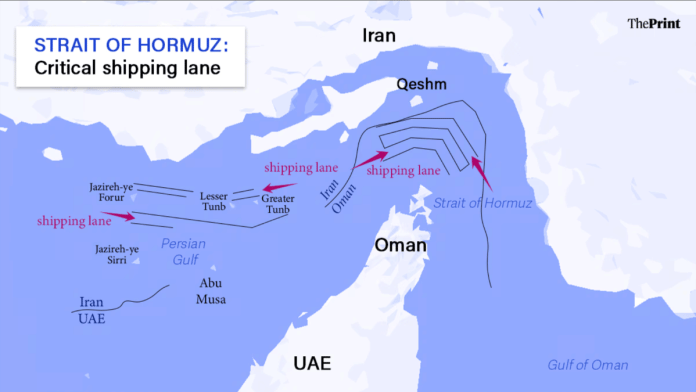


New Delhi: The Strait of Hormuz may have opened after the US-Iran peace agreement but the massive shipping disruptions caused by the conflict have forced Gulf oil producers to explore alternative export routes and expand existing pipelines to bypass one of the world’s most critical energy chokepoints.
Shipping has resumed through Hormuz, but energy analysts say the crisis has underlined an important lesson for Gulf producers: overdependence on it poses a strategic risk to the region.
Serving as the primary export route for Gulf countries, including Saudi Arabia, Iraq, Kuwait, Qatar, the UAE and Iran, the Strait of Hormuz handles roughly a fifth of global oil supplies. Energy analysts say Saudi Arabia and the UAE have expedited efforts to strengthen alternative export corridors, with discussions around new pipelines and capacity expansion gathering pace after the conflict.
“Discussions around new pipelines or additional capacity have been expedited due to the war,” said UK-based Naveen Das, senior analyst at global data and analytics firm Kpler.
Das said Saudi Arabia is actively discussing additional capacity on its East-West Pipeline, while the UAE is expected to add to its existing Abu Dhabi Crude Oil Pipeline (ADCOP) with another pipeline going online as early as next year, adding additional 1.5 million barrels per day (mbpd) of export capacity.
The UAE has operated the ADCOP since 2012, transporting crude from the Habshan oilfields to Fujairah on the Gulf of Oman. The pipeline currently has a capacity of 1.5 mbpd. “More discussions in other countries are taking place, with investment decisions likely to be approved, meaning that the export landscape from the region by 2030 could look vastly different,” Das added.
Saudi Arabia’s primary alternative to Hormuz is its East-West Pipeline, which transports crude from oilfields in the eastern region to the Yanbu port on the Red Sea coast. During the recent crisis, Riyadh announced that it had expanded the pipeline’s capacity from 5 mbpd to 7 mbpd.
However, Natalia Katona, an Abu Dhabi-based commodity analyst said the bottleneck lies at the Yanbu export terminal capacity rather than the pipeline itself. Currently, Yanbu port has a loading capacity of around 4 mbpd. According to Katona, refineries on Saudi Arabia’s Red Sea coast consume 1.8 mbpd supplied through the East-West Pipeline. This effectively leaves about 5.2 mbpd (pipeline capacity of 7 mbpd minus refinery consumption of 1.8 mbpd) available for exports, hence exceeding Yanbu’s current loading capacity by 1.2 mbpd.
She expects Riyadh’s next step will be to expand Yanbu’s terminal infrastructure to raise loading capacity to between 5 and 6 mbpd.
The UAE, meanwhile, after walking out of OPEC+ in May 2026 due to dissatisfaction over its production quotas, is planning to expand output alongside its exports. With a new pipeline under construction, Katona said the UAE plans to double the capacity of its pipeline network by passing Hormuz from about 1.5 mbpd to around 3 mbpd. This would allow Abu Dhabi to export significantly larger volumes of crude during any future disruptions in the Strait of Hormuz.
The UAE’s efforts align with its post OPEC+ strategy of developing export infrastructure outside Hormuz. As previously reported by ThePrint, Abu Dhabi has been positioning itself to move a larger share of crude exports through Fujairah, reducing dependence on the strait and enhancing energy security for its customers.
Analysts also point out that while existing Hormuz bypass infrastructure largely focuses on crude oil, the region has increasingly become a major exporter of refined petroleum products. However, there is still no dedicated bypass infrastructure for refined fuel products. “What is still missing across the region is a dedicated bypass for refined products,” Katona said. “I won’t be surprised if either Saudi Arabia or the UAE, or both, eventually build one.”
Options limited for other Gulf exporters
Kuwait, Qatar and Bahrain face geographical constraints that make any large-scale Hormuz bypass routes difficult. Katona expects these countries to focus on expanding storage facilities and improving risk-management systems in the near term.
According to Katona, while Kuwait could eventually seek access to Saudi or UAE pipeline networks because of its close ties with both countries, Iraq’s position is more challenging.
The country has resumed limited exports through Turkey’s Kirkuk-Ceyhan pipeline, providing some relief during the West Asia conflict. However, the current arrangement is set to expire on 27 July due to political differences. “Ankara [Turkey] does not want to extend the current Kirkuk-Ceyhan pipeline agreement after 27 July without clearer rules following the Kurdish export dispute and the $1.5-billion arbitration award against Turkey,” Katona said.
Apart from Turkey, Baghdad also explored moving crude via trucks to Syria, but analysts say neither routes could replace roughly 3 mbpd that Iraq used to export from the Basra terminal before the conflict. “The most likely short-term measure that Iraq will take is to boost its storage capacity, which is by far the lowest among its Gulf neighbours,” Katona said.
While Hormuz is likely to remain critical for Gulf energy exports for years to come, the latest conflict has accelerated plans to ensure that any future conflict does not leave Gulf producers with limited options to export their products.
(Edited by Nardeep Singh Dahiya)
Also Read: How the Strait of Hormuz oil crisis is really going to cost India