





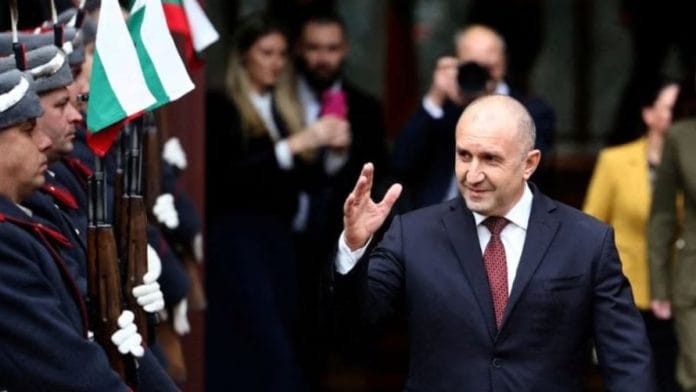


Sofia/New Delhi: After years of revolving governments and political deadlock, Bulgaria’s 19 April parliamentary election has delivered a decisive break with the past. Voters have handed a commanding mandate to former President Rumen Radev who will now be Prime Minister. At final count, Radev’s party Progressive Bulgaria won 45.5 percent of the votes, resulting in 131 seats. To form a government, a party needs 121 of the 240 seats in Parliament.
In comparison, the largest opposition coalition GERB–SDS (acronym for Citizens for European Development of-Bulgaria and Union of Democratic Forces) won 13.4 percent of the vote and 39 seats. Of the 25 groupings that ran, only five gained the minimum 4 percent of the vote necessary to enter Parliament.
The absolute majority win could stabilise domestic politics but raises larger questions about Bulgaria’s role within the European Union (EU) and North Atlantic Treaty Organization (NATO), and the direction of Europe’s evolving geopolitical balance given that Radev is seen as sympathetic to Russia and openly critical of aspects of EU policy.
Bulgaria, a small Balkan state with its capital in Sofia, fell under Soviet influence in 1944, abolishing its monarchy under the Tsar or King, and adopting a Communist one-party system. It was a founding member of the Warsaw Pact in 1955—a Soviet-led military alliance of Eastern European Communist states. After the 1991 collapse of the Soviet Union, Bulgaria transitioned to a multi-party democracy and market economy. It joined the NATO in 2004 and the EU in 2007. Old economic issues and corruption persist, however.
‘Chronic instability’
Under its 1991 Constitution, Bulgaria is a parliamentary democracy, meaning the government is formed by the party or coalition that commands a majority in Parliament. In practice, the Prime Minister leads the government, while Parliament passes laws and approves them.
The President plays a more limited role but can call elections and appoint caretaker governments during political crises. This has become increasingly important as governments have repeatedly collapsed. The core issue has been fragmentation. No party has been able to win a clear majority, forcing coalitions between rivals with little shared agenda. These alliances have often broken down quickly.
Since 2021, Bulgaria has held eight elections, reflecting repeated failures to form stable governments. The last election in October 2024 led to a minority government being formed under the GERB–reformist coalition consisting of three parties plus external support and yet made the government with the exact 121 seats required. The differing ideologies created mistrust and caused the rotation governing deal the grouping hinged upon to collapse, triggering government failure and new elections.
Deep divisions, anti-corruption conflicts, and fragmented Parliaments led to repeated elections and caretaker rule— a temporary government until elections were held. Analysts describe this as ‘chronic instability’ driven by polarised politics and weak party cohesion.
Corruption has further eroded trust. Public protests have targeted political elites and alleged links between business interests and governance, an issue that dominated the latest campaign. This mix of instability, corruption concerns, and ineffective governance created a strong demand for decisive leadership.
Also Read: India-EU agenda can fundamentally alter global geopolitics—if Europe stands up to Trump
Radev and the 2026 election
Rumen Radev, a 62-year-old who served as President from 2017, had resigned in January, nearly a year before his term was due to end and formed a political party to contest the parliamentary elections.
Radev has long presented himself as a vocal opponent of the failing governments. In 2025, he even supported the anti-corruption protests in the country that ultimately led to the downfall of then Prime Minister Rosen Zhelyazkov. He ran for prime minister to, as he vowed during his campaign, dismantle the “corrupt, oligarchic model of governance from political power”.
As a result, he registered a three-party political alliance called Progressive Bulgaria (PB) on 2 March. PB was declared a party at a founding congress in Veliko Tarnovo on 17 April.
Against this backdrop, Radev’s three party coalition, Progressive Bulgaria, is set to form a majority government for the first time in recent Bulgarian history.
Policy direction
Economic concerns played a central role. Rising prices, inflation, and inequality pushed voters towards promises of welfare support and stronger state involvement. Radev’s campaign also emphasised national sovereignty, arguing that Bulgaria should prioritise domestic interests when dealing with EU policies.
On the economy, his campaign addressed these concerns. Bulgaria has faced sustained price pressures, with concerns growing around its adoption of the euro in January this year. Radev has criticised the euro transition, warning it could worsen inflation and reduce economic sovereignty, and had proposed a referendum on the issue.
He has proposed expanding welfare support, raising pensions, and increasing state involvement in sectors such as healthcare while also pledging to curb the influence of powerful business groups. However, there is uncertainty about how these measures will be implemented within fiscal limits and EU obligations.
On foreign policy, Radev has indicated that Bulgaria will remain part of the European Union but take a more assertive stance. He has criticised EU energy policies and decisions that increase costs for citizens. He faults the EU for “[falling] victim to its own ambition,” citing a need for pragmatic leadership instead. He supports continued membership of NATO but opposes deeper involvement in the Ukraine conflict, particularly military support.
His approach to Russia is centred on economic pragmatism. Radev is often described as “pro-Russian”, but the reality is more complex. He has opposed EU sanctions on Russia and opposed sending military aid to Ukraine. He has also argued for restoring energy ties with Moscow, which were disrupted after Russia invaded Ukraine.
Energy remains a key issue, as Bulgaria has historically relied on Russian gas. Re-engagement in this area is likely to be a priority, though it may create tensions within the EU.
At the same time, Bulgaria remains a member of both the European Union and NATO. These memberships place clear limits on how far any government can shift its foreign policy, especially since Bulgaria depends heavily on EU funding and trade.
According to Dr Dimitar Bechev, professor at Oxford School of Global & Area Studies and an authority on Russia, Balkans and European politics, while there will be adjustments, there is limited potential for the monumental change being purported currently.
He notes: “Bulgaria will be more stable compared to the last 5 years when it was run by a succession of fractious coalitions and caretaker Cabinets. There will be rhetorical shift towards restoring ties with Russia too. But in practical terms—e.g. in the energy field—I don’t expect a radical turn. During the period of instability, Bulgaria actually integrated deeper into the EU—adopting the euro and joining Schengen. There are European guardrails in other words.”
The next Viktor Orbán?
Radev’s rise has led to comparisons with Viktor Orbán, who had often clashed with EU institutions. There are similarities. Both emphasise national sovereignty, question EU policies, and appeal to voters dissatisfied with mainstream politics. Both have taken more cautious positions on sanctions against Russia.
However, key differences remain. Radev’s approach is more focused on economic issues such as welfare and inflation than on identity politics. He may introduce friction within the EU, but is unlikely to fully replicate Orbán’s confrontational approach due to Bulgaria’s economic dependence.
Why this matters for India
Although Bulgaria is a relatively small country, the implications extend beyond its borders. India is seeking deeper trade and strategic ties with the EU, and internal divisions within the bloc can affect negotiations and policy coordination.
Bulgaria’s stance on Russia is also relevant. India maintains close relations with Russia while engaging with Western partners. A wider range of views within the EU could shape discussions on sanctions and global governance.
Geographically, Bulgaria’s position near the Black Sea makes it relevant for trade routes and connectivity, areas of growing importance for India.
Kushagrata Goel is a TPSJ alum, currently interning with ThePrint.
(Edited by Nardeep Singh Dahiya)