



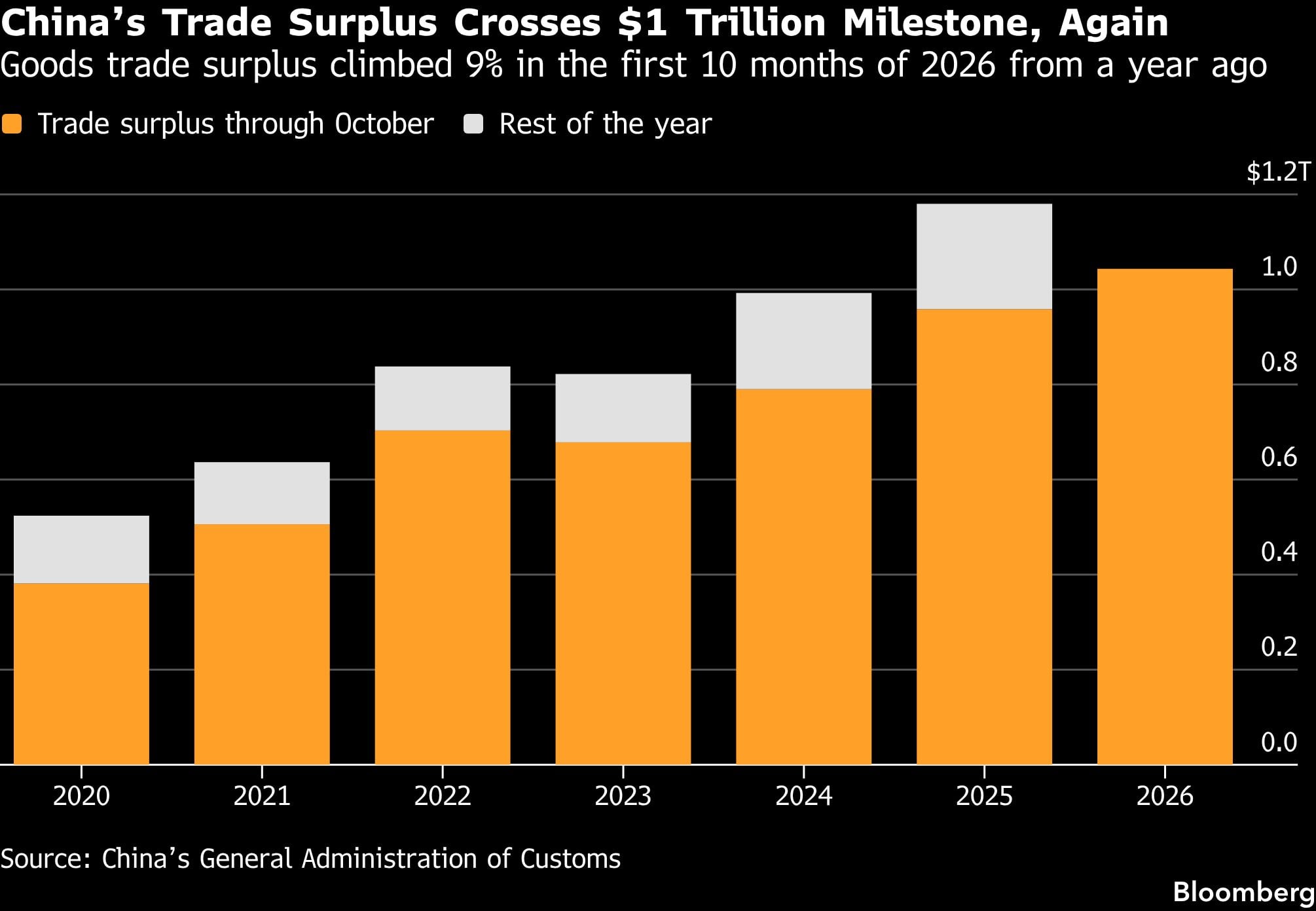
China’s trade surplus ballooned to just over $1 trillion for the year despite the biggest surge in imports since 2021, with an increasingly lopsided relationship with the European Union accounting for nearly a third of the overall imbalance.
Imports spiked far more than forecast and advanced almost 42% last month from a year earlier, data released by China’s General Administration of Customs showed on Tuesday. Shipments abroad rose slightly more than 35%, leaving the surplus for October at $105.3 billion, the smallest since May.
Through the first 10 months, China’s surplus is nearly 9% bigger than during the same period of last year, when it reached a record $1.2 trillion. In October, China exported $33.4 billion more to the EU than it imported from the bloc, bringing the year-to-date difference to more than $310 billion.
China’s trade surplus “underscores the resilience and competitiveness of its export sector despite a more challenging global trade environment,” said Hao Zhou, chief economist at Guotai Junan International Holdings Ltd.
The entrenched imbalance in the flow of goods around China will stay high on the agenda of its biggest trading partners, with European leaders planning measures to manage what they deem to be economic security risks and tighten loopholes to better protect the bloc’s single market.
Top Beijing officials like Vice Premier Ding Xuexiang have pushed back by saying China would be importing more products if there weren’t restrictions on some high-tech items, saying it offers a market for countries and businesses around the world.
“Robust export and import growth in October again underscores the importance of tech manufacturing to China’s economy. It also highlights a vulnerability for a recovery that lacks support from domestic demand. The tech sector depends heavily on sales of AI-related hardware in foreign markets and, to a large extent, also operates as a processing hub. A drop in external demand — for example, if US data-center investment slows — could hit exports, a key engine of growth.”
Exports have soared this year thanks to surging global demand for AI hardware that’s also traded across Asia. While China’s imports also climbed, they still lag behind sales abroad, with gains largely confined to a few narrow products like gold in a sign of little rebound in domestic demand.
Rising concerns over the sustainability of the AI buildout boom are starting to cloud the outlook of China’s double-digit gains in exports. Chips and computer parts alone accounted for 40% of the year-on-year increase in Chinese export value so far, reflecting their soaring prices as a result of a building frenzy around data centers.
China’s export strength goes beyond AI hardware, however. In volume terms, growth came from a broad range of high-tech products, ranging from the “New Three” sectors promoted by China’s leadership — solar panels, electric vehicles and batteries — to industrial robots, according to a Goldman Sachs Group Inc. analysis.
In contrast, much of AI-related trade likely consists of assembling imported inputs and then re-exporting them, which limited its impact on the trade balance, Goldman Sachs economists found.
A rebound in China’s crude oil purchase is behind the surprising growth in imports. China imported nearly 42 million tons of crude in October, the highest amount since March. As oil prices climbed, the value of those imports hit a four-year high. Similarly, purchases of refined petroleum also jumped.
There were expectations that China’s state-run refiners would only start to replenish their oil stockpiles by increasing imports.
For exports, gains in high-tech goods accelerated to 67% last month from a year ago, the fastest since early 2021. Sales of chips and computers both soared at a triple-digit pace.
Shipments to the EU, the US and the Southeast Asian nations in the Asean group remained strong, growing at over 20%, 30% and 40% on year, respectively. Exports to the Netherlands, the UK and Brazil picked up strongly, according to the preliminary data, with sales to South Korea growing at a record pace.
(Updates with additional data details throughout. An earlier version of this story corrected the month in second paragraph.)
Disclaimer: This report is auto generated from the Bloomberg news service. ThePrint holds no responsibility for its content.