





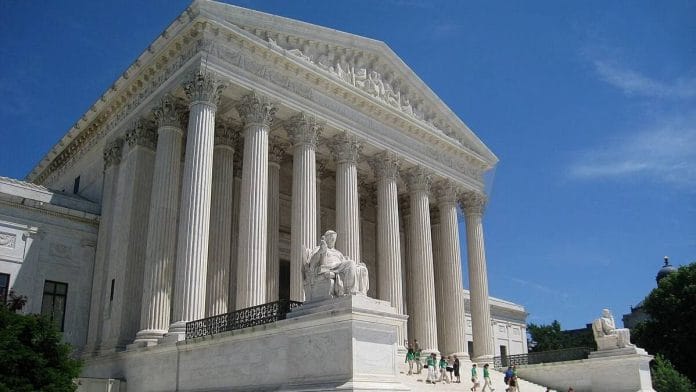


New Delhi: The United States Supreme Court Tuesday blocked President Donald Trump’s executive order banning birthright citizenship for the children of undocumented immigrants and certain temporary foreign visitors. The court’s decision, a stunning rebuke to the president, is a significant loss of face for the Trump administration even though other rulings this week delivered it a series of triumphs.
The US Supreme Court has released a flurry of decisions near the end of its term, but none is quite as important or long awaited as its ruling on birthright citizenship.
On 20 January, 2025, the very first day of Trump’s second term, he signed an executive order to end the automatic granting of American citizenship, known as birthright citizenship, for the children of undocumented immigrants and parents temporarily visiting the US. Trump’s efforts at curbing birthright citizenship, which he calls “birth tourism”, is part of his administration’s broader crackdown on both legal and illegal immigration.
The president’s recently rejected executive order stated that no department or agency of the US government should issue citizenship documentation to a child born in America, when the mother of the child was in the US unlawfully and the father of the child is not a US citizen or a green card holder at the time of the birth, or when the mother’s presence is lawful, but temporary, and the father of the child is not a US citizen or a green card holder at the time of the birth.
The second circumstance in the directive defined a “temporary” status as someone who is “visiting the United States under the auspices of the Visa Waiver Program” or an individual who is “visiting on a student, work, or tourist visa”.
This is especially relevant for over a million Indians in the US who are on temporary visas—including the hundreds of thousands of Indians who hold H-1B visas, L-1 intra-company transfer visas, and F-1 student visas. More than one million Indians remain stuck in the employment-based green card backlog, while continuing to live and work in the US on temporary legal status.
Trump’s order reflects his administration’s belief that birthright citizenship is “a disgrace”, with US Vice-President J.D. Vance previously describing it as “the dumbest immigration policy in the world”.
According to Pew Research Center data, approximately 9 per cent of US births in 2023 were to undocumented or temporary lawful immigrant mothers. If it was upheld by the Supreme Court, Trump’s order would have impacted thousands of babies born in the US each year who fit the specific criteria outlined in his directive.
Also Read: The US birthright citizenship dilemma—What makes a citizen?
What is birthright citizenship?
Birthright citizenship is the constitutional right that grants American citizenship to children born on US soil. It is founded on the principle that people born in the US are American citizens from the moment of birth—regardless of their ancestry, race, religion, or parents’ immigration status.
The right is guaranteed by the 14th Amendment to the US Constitution, adopted in 1868, which states: “All persons born or naturalized in the United States, and subject to the jurisdiction thereof, are citizens of the United States and of the state wherein they reside.”
In the majority opinion, Chief Justice John G. Roberts Jr. wrote: “Citizenship, then and now, was the right to have rights — to freely participate in our political community. The framers of the 14th Amendment extended that promise to ‘every free-born person in this land’.”
“We keep that promise today,” he declared.
Roberts noted that the Supreme Court had already upheld birthright citizenship in its 1898 United States v. Wong Kim Ark ruling, where the court read the 14th Amendment to grant citizenship to the US-born son of Chinese nationals. “What the Court held in Wong Kim Ark was simple: the Citizenship Clause incorporated the common law and granted citizenship to nearly all children born in the United States,” Roberts wrote.
“Not surprisingly, then, in the 128 years since, we have repeatedly understood the rule of Wong Kim Ark to guarantee citizenship to all children born in the United States and subject to its power. We see no reason to depart from that view today,” he explained.
Implications for the Indian community
The ruling is significant for the Indian population in the US, who make up the second-largest immigrant group in the nation, one of the fastest growing immigrant groups in the country.
An estimated 3.2 million Indian immigrants reside in the US, with around 5.2 million people in the US identifying as Indian in 2023, according to Pew Research Survey estimates from the US Census Bureau data. The data further reveals that Indians are the third-largest undocumented population in the US, after Mexico and El Salvador, with an estimated population of 725,000 Indian immigrants residing in the US.
American immigration and citizenship policy are not only closely watched, but also close to the hearts of the millions who make up the Indian community in the US. While many Indians face years-long waits for green cards, and eventually citizenship, the ruling offers reassurance that any children born to them in the US will automatically be granted American citizenship at birth.
Members of the Indian diaspora have come out in support of the court’s decision. US Congressman Raja Krishnamoorthi, an Indian-born naturalised US citizen and one of the most prominent Indian American lawmakers in Congress, responded to the Supreme Court’s ruling in a statement on Tuesday. “Today’s decision reaffirms a fundamental constitutional principle: every child born in the United States is an American citizen,” he wrote.
“The Supreme Court’s decision makes clear that those constitutional rights cannot be rewritten by executive order because the Constitution, not the President, governs the rights of the American people,” Krishnamoorthi affirmed.
Chintan Patel, executive director of Indian American Impact, which works to increase Indian American political representation and civic engagement, welcomed the ruling. “The ruling is a profound affirmation of who belongs in America. Indians and South Asian immigrant families are among those most directly threatened by Trump’s executive order,” he told IANS.
“Today the Supreme Court looked at those families and said, ‘Your children are Americans. They belong here,” Patel said.
On Tuesday, Trump wrote on Truth Social that the ruling was “too bad for our country,” and asserted that it could be “easily” addressed by Congress with legislation. Trump called on Congress to get to work on such legislation “today” in order to end the “expensive and unfair” birthright citizenship, in a separate X post on Tuesday.
Nonetheless, the Supreme Court’s decision leaves one of the oldest principles of American citizenship intact, ensuring that children born on US soil continue to be recognised as American citizens.
(Edited by Nardeep Singh Dahiya)
Also Read: What Indian-Americans are saying about US birthright citizenship verdict