


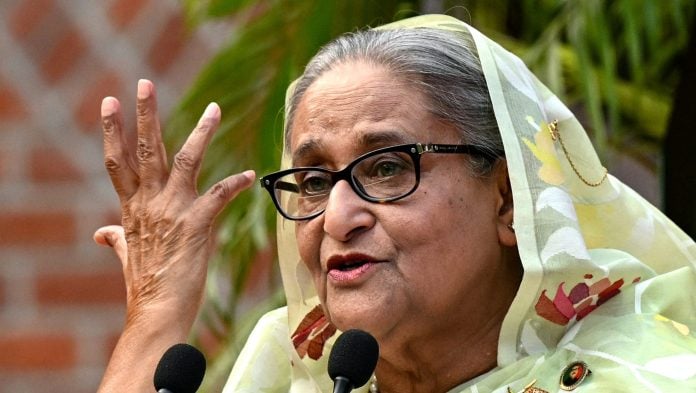
Dhaka/New Delhi: Bangladesh would not have become independent without the sacrifices of freedom fighters, and people would have had to endure “kicks from the boots of the Pakistani military” had the country not achieved independence, deposed prime minister Sheikh Hasina has said.
Hasina made the remarks on Saturday in an audio-only virtual address via Zoom at the 98th episode of the Bangladesh Awami League’s ‘Dayamukti’ live series.
Hasina has been staying in New Delhi since fleeing Bangladesh in August 2024 following a violent student-led uprising that led to the collapse of her government.
Her comments coincide with fresh violence in Bangladesh and come days after her announcement to return home on December 16, the day Bangladesh celebrates its victory over Pakistan in the 1971 Liberation War, fought under the leadership of Hasina’s father, Sheikh Mujibur Rahman.
The remarks also come at a crucial juncture when Hasina seems to be trying to restore her political relevance.
According to analysts, she is trying to put the ruling BNP government in a difficult position by projecting herself as a courageous leader willing to face imprisonment or death, and demonstrating solidarity with her Awami League party colleagues and supporters.
Calling on people to unite against the authorities, she said in her address, “We must stand together against them. If we are to live, we must live with dignity.”
“Today they are eliminating freedom fighters one by one,” said Hasina in her address, without naming any individual or group.
Alleging torture and custodial deaths, Hasina said prisoners were denied medicines and medical treatment and subjected to further torture until they died.
She also alleged that their relatives were not properly informed when they were taken to hospitals.
Questioning the treatment of freedom fighters, she asked, “What could be more heinous than this?”
Hasina alleged that a freedom fighter had been killed and his body hung from a tree, without sharing specific details.
She said Bangladesh would not have achieved independence without the freedom fighters and that those in the country would have had to endure the brutality of the Pakistani military had independence not been achieved.
“They would have had to suffer kicks from the boots of the Pakistani military,” she said.
Recalling the contribution of Mujibur Rahman, Hasina said the “Father of the Nation” had dedicated his life to the people of Bangladesh and given them an independent territory and a national identity.
“He was working to change the fortunes of the people of this country, but he was not given that opportunity,” she said.
Hasina said that if Mujibur Rahman had been alive, Bangladesh would have become a developed country within 10 years of independence.
Following Bangladesh’s independence in 1971, Mujibur Rahman returned from Pakistani imprisonment in January 1972 and became its first prime minister, having earlier served as its first president. He became president again in January 1975 following a constitutional change.
On August 15, 1975, Mujibur Rahman was assassinated along with most of his family members in a military coup at his residence in Dhaka. His daughters, Sheikh Hasina and Sheikh Rehana, survived as they were in West Germany at the time. Hasina was 27 years old when her father was killed.
Criticising the current authorities, Hasina, in her virtual address, alleged that community clinics through which her government had provided medical services to people were being shut down.
She said the clinics had provided services to mothers and expectant mothers and accused those in power of taking the country towards destruction.
Hasina also alleged that the authorities wanted poor people to remain poor while expanding interest-based businesses.
The ousted prime minister said that human life has become the cheapest thing in Bangladesh, while the prices of essential commodities, electricity and gas have risen.
Bangladesh is currently governed by the Bangladesh Nationalist Party (BNP), with its chairman Tarique Rahman serving as prime minister, who took charge after elections in February.
Rahman is the son of former president Ziaur Rahman, a military officer who joined the rebellion against Pakistani forces and broadcast a declaration of independence on March 27, 1971, explicitly on behalf of Mujibur Rahman. He also commanded the Z Force, one of the principal military formations of the liberation forces.
The political legacies of the two families subsequently became central to Bangladesh’s bitter political divide. Ziaur Rahman founded the BNP in 1978, while Mujibur Rahman’s daughter Sheikh Hasina went on to lead the Awami League.
After Ziaur Rahman’s assassination in 1981, his wife Khaleda Zia took charge of the BNP and emerged as Hasina’s principal political rival. The two women initially joined hands in the movement against military rule, but later became fierce opponents, with their rivalry dominating Bangladesh’s politics for more than three decades.
Khaleda Zia, who served as prime minister three times, died on December 30, 2025, aged 80.
Questioning the government’s decision to ban the Awami League, Hasina said in her address that the party could not be eliminated.
“How will they finish the Awami League? Is the Awami League some insignificant party? They have no right to ban the Awami League,” she said, describing those in power as “illegal usurpers of power”.
The Awami League’s political activities remain banned in Bangladesh, a restriction first imposed in May 2025 under the interim government which succeeded Hasina’s 15-year rule that ended in August 2024 after massive protests. The ban was upheld by the BNP government, which took charge in February this year.
Hasina has been living in India since fleeing Bangladesh on August 5, 2024, following a student-led uprising.
In November 2025, Hasina was sentenced to death in absentia for crimes against humanity over the 2024 crackdown on protesters. Hasina has refused the allegations.
Bangladesh has been seeking her extradition from India, while New Delhi has maintained that Dhaka’s request is being examined through a legal process. The issue has emerged as a source of tension between the two countries, with Dhaka insisting that Hasina be returned under a bilateral extradition treaty.
Hasina said she intends to return to Bangladesh on her own and surrender before a court.
Her lawyers had earlier approached the Bangladesh mission in New Delhi seeking a fresh passport and national identity card to facilitate her return. The Bangladesh government rejected her request for fresh travel documents earlier this month, which triggered unrest in the country.
This report is auto-generated from PTI news service. ThePrint holds no responsibility for its content.