





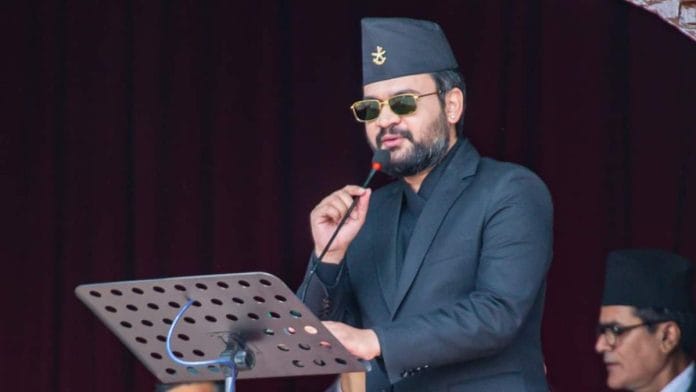

New Delhi: Communal violence that began in Sunsari district of Nepal earlier this week spilled into the country’s Madhes region Thursday, taking the death count to three amid a nationwide curfew and a delayed first-time address by Prime Minister Balen Shah. The prime minister, who hails from the Madhes region, the smallest and most densely populated southeastern province of the country that is bordered by India’s Bihar on its south, is now under fire over his apparently late reaction to the developing situation.
The violence, which began Sunday night in Sunsari district of Koshi, spread across the Madhes region by Thursday. The province of Koshi, to the north and east of Madhes, also borders Bihar.
The unrest, according to reports, began when Hindus in Sunsari, a district of the Koshi province, were proceeding toward the Koshi Barrage with holy water as part of a Bolbam procession, the Nepal equivalent of India’s Kaawad Yatra. The procession featured loud devotional music, which the local Muslim community objected to. What began as a verbal disagreement escalated into a violent confrontation, with people from both communities armed with sticks, stones, and bamboo poles confronting each other.
Online misinformation reportedly led to escalation of tensions in the region. Personnel from the Nepal Police and Armed Police Force were deployed to control the situation. After warning shots and tear gas failed to disperse the crowd, security forces opened fire with live ammunition; a 30-year-old, Om Prakash Mehta, was fatally shot.
The unrest soon spread beyond Sunsari. By Thursday, protests and clashes had erupted in Golbazaar and Lahan in Siraha district, where a teenager, Ganesh Yadav, was killed.
The family of Om Prakash Mehta then refused to collect his body from the hospital, demanding that he be declared a martyr, that the government provide compensation and those responsible for the shooting be prosecuted before his funeral rites.
Amid escalating violence, Shah addressed the nation on Thursday evening, calling the unrest “a most sensitive and delicate moment” as he sought to project confidence in the state’s response, promising that an investigation ordered by the Ministry of Home Affairs would be ‘completely impartial and transparent” and that anyone found responsible would face legal consequences.
“The government is committed to bringing to justice whoever is found guilty,” Shah said.
The prime minister said the government had convened an all-party meeting and launched consultations with elected representatives, civil society leaders, religious figures and local community elders in an effort to prevent further violence. He said Home Minister Sudan Gurung had travelled to the affected districts with senior security officials, while the National Security Council had reviewed the deteriorating security situation.
Much of Shah’s address focused on calling for restraint as rumours and inflammatory content continued to spread online. He also framed the unrest as a threat to Nepal’s long-standing tradition of religious coexistence.
In what appeared to be his clearest political message, Shah also warned against collective blame. “It can never be justified to hold an entire community responsible for a tragic incident in one part of the country and spread retaliation to other parts of the nation,” he said.
Nepal President Ramchandra Paudel too expressed deep concern over the violence Thursday, calling on the public to preserve social and religious harmony, communal peace and national unity. “Goodwill, reconciliation and brotherhood are the defining characteristics of the Nepalese people in our multicultural, multiethnic and multiracial society,” he said in a statement.
Shah’s silence has raised questions. Local reports noted that his comments came only after the home minister reached the affected zone days after the violence broke out, and after ruling party chairman Rabi Lamichhane had already begun convening meetings that the Prime Minister’s Office had delayed. Although restrictive orders were imposed in Sunsari the day after the initial fatalities, the home minister did not visit the district until several days later, and Shah issued a statement on Facebook two days after the violence.
Former parliamentarians like Suman Shrestha have criticised the deployment of the Army, asking the prime minister to take provincial Members of Parliament into the fold. “Deploying army is not a solution in this case. Federal MPs, provincial MPs, and local representatives are the messengers of peace at this moment – ask them for help!” she wrote on X.
“As the saying goes, ‘When brothers fall out, the fools plunder.’ Therefore, at this juncture, without any ifs or buts, the government, political parties, and patriotic citizens from all ethnicities, religions, and communities must unite as one to immediately avert this looming crisis—there is no alternative,” former prime minister Baburam Bhattarai said.
(Edited by Nardeep Singh Dahiya)
Also Read: Nepal is reimagining its relationship with China. What this means for India