





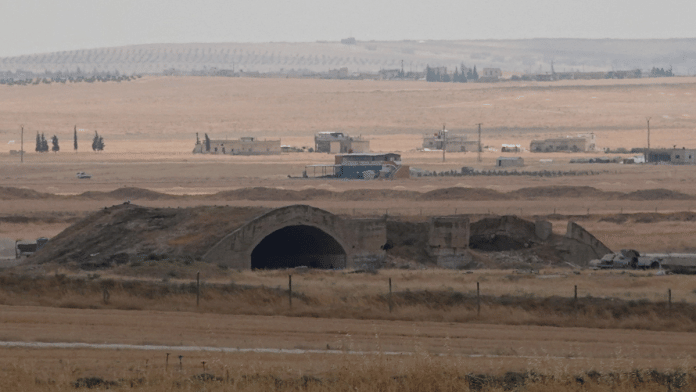

New Delhi: Israel bombed the Abu al-Duhur airbase near Aleppo in northwestern Syria on Tuesday, drawing condemnation not only from Syria but also Turkey and the US.
Turkey and Syria called Israel’s airstrikes a violation of the country’s sovereignty while the US termed it “an unnecessary escalation”.
Israeli Prime Minister Benjamin Netanyahu’s office said the attacks were necessary as Syria was on the brink of violating a “status quo agreed with Israel on security matters” by allowing Turkish troops to be deployed at the airbase.
It also said that Syria had ignored consistent warnings that such a deployment would pose a threat to Israel’s national security, adding that Israel would not tolerate threats to its safety. Turkey did not confirm if its troops were stationed at the airbase.
The strikes came amid rising tensions between Israel and Turkey over Syria. Turkey has become one of Syria’s primary allies since the fall of former president Bashar al-Assad on 8 December 2024. Turkey has been helping train Syria’s army, rebuild state institutions and infrastructure, while also providing military and diplomatic support.
The base has not been operational since September 2012 due to the Syrian civil war. According to The Syrian Observatory for Human Rights, Turkey had been rehabilitating the Abu al-Duhur airbase in Syria and a Turkish delegation had visited the base hours before the strikes.
In this backdrop, ThePrint takes a look at the strategic importance and history of the Abu al-Duhur airbase.
Also read: Appeasement has a bad name in India. Time is ripe to use it in foreign policy
The strategic importance
The base is about 70 km east of the Turkish border. It is also strategically significant because it is located near the borders between Idlib, Aleppo and Hama provinces.
Once a military airfield, it witnessed one of the longest sieges of the Syrian civil war, lasting about three years from 2012 to 2015.
We are deeply concerned that the confirmed Israeli airstrikes on Abu al-Duhur Airbase constitute an unnecessary escalation that does not advance regional stability.
The Al-Sharra government has neither adopted a predatory posture nor maintained proxy forces. It has, in fact,…
— Ambassador Tom Barrack (@USAMBTurkiye) August 18, 2026
MiG-23, MiG-21 fighter jets and L-39 aircraft operated out of the base during former president Assad’s rule.
The base was the last stronghold of the Syrian Armed Forces in an otherwise hostile Idlib governorate during the early years of the civil war. It was also a strategic point connecting the cities of Aleppo, Hama and the capital Damascus.
The Airbase during civil war
When the armed uprising began in Syria in 2011, rebel forces did not storm the airbase immediately, as it was relatively far from the regime’s main sphere of influence in eastern Idlib and from Damascus. The rebels slowly moved in around the roads and villages around the airbase, gradually isolating the facility.
As Assad lost control over rural areas in northern, eastern and southern Syria, his government became increasingly reliant on air power.
The government was initially dependent on land forces after the uprising began in 2011, but the Assad regime became increasingly reliant on the air force as opposition Free Syrian Army rebel forces made unexpected gains in Idlib and Aleppo, and cut off means of communication and transport with roadside bombs and ambushes from April 2012 onwards.
However, the rebels managed to counter the air force’s operations with anti-aircraft guns, towed air defence artillery guns and man-portable air defence systems.
They also tried to overrun airbases, including Abu al-Duhur, in a bid to reduce the number of aircraft launched against them and to take advantage of aircraft limitations during takeoffs and landings.
By 2012, FSA forces began targeting the Abu al-Duhur airbase. Between August and September that year, two MiG-21s were lost. The rebels claimed to have shot down one of them. There was no official confirmation though.
On 22 September 2012, FSA rebels carried out a coordinated attack on the airbase and prevented Syrian Army reinforcements from reaching it. The airbase was effectively, though not completely, besieged.
The rebels, led by Jamal Maarouf, eventually rendered the base useless by firing on the airport’s runway from established positions to the west of the airport, paralysing aircraft that tried to take off or land at the facility.
The Institute for the Study of War classified the airbase in 2013 as “under siege” or “contested” and unavailable for air force operations.
In 2014, heavily armoured units moved from the airbase and captured Haymat ad Dayir and Mustarihah villages north of the airbase before retreating.
In January 2015, the rebels, now fighting under the banner ‘Army of Conquest’ — including the FSA, the Turkistan Islamic Party and Al-Nusra, Al Qaeda’s Syrian front – attacked Tal Salmo village in an attempt to open a new front south of the base. The attack was foiled after two days of incessant fighting between Assad forces and the FSA.
The rebels eventually captured the village, which was significant because it was close to the main gate of the airbase and contained water wells that Assad’s forces in the airbase consumed through canals.
The same month, an Antonov aircraft carrying 30 Syrian soldiers and five Iranian military experts was allegedly shot down while trying to land at the base. The Al-Nusra claimed responsibility for the attack.
It was also reported that Al-Hamidiyeh village near the airbase had also come under rebel control. In February, the Al-Nusra claimed that it had shot down a helicopter over the airbase.
In August 2015, the rebels failed to breach the base after sending two suicide bombers to its western gates, as guards destroyed their vehicles.
A month later, rebels used the cover of a heavy sandstorm and finally breached the base after intense fighting that killed 56 soldiers and dozens of rebels.
And Assad’s forces had to withdraw, putting an end to the almost three-year siege. It was the last major base held by Assad’s forces in Idlib to fall.
After taking over, the Al-Nusra rechristened itself Hay’at Tahrir al-Sham in 2017.
Syrian army wrests control from rebels
The tables turned again in early 2018, when the Syrian Army seized control of the airbase from rebel forces, marking the first military facility the government managed to wrest from the opposing forces.
Syrian government forces launched a major offensive into Southeastern Idlib from Hama and Aleppo. The campaign was supported by the Russians and the Iranians.
While government forces found themselves isolated during their defeat in 2015, Russian and Iranian backing helped them get back the base.
“After a string of special operations, units from our armed forces in coordination with allied fighters succeeded in their military operation and took control of the Abu Duhur military airport in Idlib province,” the army had then declared in a statement.
After years of violence and fighting, the airbase no longer functioned at full capacity and lost its eminence.
However, the base fell again to Ahmed Al-Sharaa’s Islamist militant rebel group Hayat Tahrir al-Sham (HTS) during the offensive that toppled Assad’s government in December 2024, said a UN Security Council Report. Sharaa serves as the current President of Syria.
(Edited by Sugita Katyal)
Also read: What led to Trump-Saudi rift & how it’s redrawing strategy in Middle East | Cut The Clutter
Israel should occupy the adjoining parts of Syria and Lebanon and establish a buffer zone manned by the IDF there.
That is the only way future attacks by entities like Hezbollah and others can be prevented. A vast buffer zone would also ensure sufficient retaliatory time if the Islamists were to try anything nasty.