


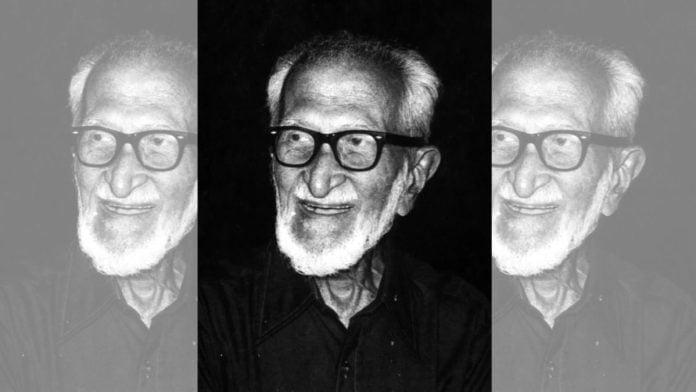
New Delhi: Decades before birdwatching became a fascination for those with high-end telephoto lenses, it was a far less glamorous pursuit for one Indian ornithologist. Salim Ali followed his passion armed with nothing but his worn-out field notebooks and binoculars.
Known as the “Birdman of India”, Salim Moizuddin Abdul Ali was the first to conduct systematic bird surveys in the country. For the birdwatchers during his time and for those who came after him, his field guide, The Book of Indian Birds (1941) and the 10-volume magnum opus, Handbook of the Birds of India and Pakistan (1968-74) that he authored with Dillon Ripley were the only maps to navigate India’s bird-landscape.
Ali’s last student, Tara Gandhi, 77, has seen the changing birder landscape in India. According to her, birders today are focused on taking photos, identifying species, and making lists of the birds they have spotted. Ali was different. His core interest was in understanding a bird’s relationship with its environment.
“He would always tell us not to be dogmatic. He would ask us to observe things carefully and note the bird as it is and not to imagine what it was doing,” Gandhi told ThePrint.
Ali’s students have meticulously maintained field notebooks documenting the birds observed during nearly every field trip over the past five decades, she added.
The naturalist made a science out of ‘observation’. He would comb through every piece of existing literature on Indian birds published until his time and then calibrate it with his own observations. This enormous body of knowledge he amassed went into shaping the contents of Handbook of the Birds of India and Pakistan.
Also read: Neither wholly Persian nor Indian. Delhi event dissects the culture forged under Mughals
Hunter-turned-birder
Born on 12 November 1896, Ali was initially an avid hunter who shot birds and collected specimens for his research. The transition from a hunter to a conservationist happened when he realised that unrestrained hunting was unsustainable.
“He did not give up hunting out of emotional guilt. He disapproved of what he called the massacre of waterfowl by the British but did believe in sustainable hunting for food,” said Gandhi.
When Gandhi applied to study field ornithology under Ali in 1968, he initially turned her down because there were hardly any women in the field at the time. However, when she applied again 14 years later, he accepted her and closely followed her research even though he was in his late 80s at the time.
Stalwarts of India’s birding community recall Ali as a disciplinarian mentor. Dr S. Subramanya, an entomologist-ornithologist and a former faculty member at the University of Agricultural Sciences, Bengaluru, who worked with Ali in 1980-81, remembers how Ali shaped his career. When Ali found out that Subramanya had a background in agriculture and entomology, he urged him to pursue his studies by combining his interests in agriculture, insects, and birds.
Both Gandhi and Subramanya agree that if there is one thing about Ali that India needs today, it is the deep respect that political leaders at the time had for his expertise on conservation.
Jawaharlal Nehru and Indira Gandhi always paid attention to Ali’s recommendations. He was even briefly nominated to the Rajya Sabha. According to Ali’s autobiography, when the ornithologist first published The Book of Indian Birds, he sent an autographed copy to Nehru, who was in Dehradun jail at the time. Nehru sent the book as a birthday present to Indira, who herself was at Nainital jail. His influence played a key role in setting up sanctuaries such as Keoladeo National Park in Bharatpur, the Silent Valley in Kerala, and Ranganathittu in Karnataka.
“He would be devastated by the habitat loss today. The real estate boom, the wetland degradation, and the shifts in land use have changed the structure and ecology of Bengaluru lakes that once sustained large bird numbers. Now, we are waking up to the decline in birds like the Indian Roller, the state bird of Karnataka, that was once common in the state,” Subramanya told ThePrint.
Gandhi and Subramanya remember their mentor as more than just a bird enthusiast and conservationist. He was a lover of poetry and an artist with a pencil in hand. Despite being so well-known in his field, he remained approachable until his last days. Ali died at the age of 91 in Mumbai on 20 June 1987.
“If you wrote him a letter, he would always reply promptly. He never, ever left a letter unreplied,” said Subramanya.
(Edited by Prasanna Bachchhav)