


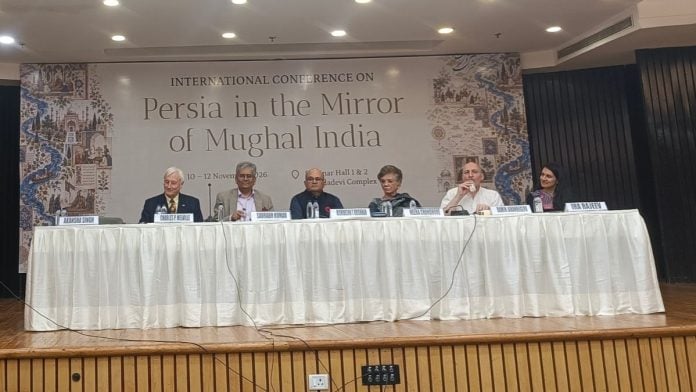
New Delhi: Long before India became a modern nation-state, its cultural landscape was being shaped by ideas, aesthetics and traditions that travelled from Persia. From Mughal architecture and miniature paintings, the encounter between the two civilisations produced a shared cultural inheritance that was neither wholly Persian nor exclusively Indian.
This exchange was the focus of Persia in the Mirror of Mughal India, a conference inaugurated at the India International Centre in New Delhi Tuesday, where political scientist Neera Chandhoke argued that India’s plural identity was built through centuries of cultural interaction.
“The act of thinking can create disjunctures in the laws of nature. Without thinking, we allow the ruling class to rule as it wishes. And if you criticise those in power through the act of thinking, that very act becomes a challenge to political authority. Hence, the words that we hear circulating around India today,” she said.
Chandhoke said this shared history was also a reminder that cultures do not merely compete or clash; they borrow, adapt and create something new together.
“We value it because it provides a wonderful context for the art of thinking,” she said.
Speakers, including former Indian ambassador to Iran Saurabh Kumar and British academic Charles Melville, discussed how Persian influences met indigenous traditions to shape India’s architecture, art, and language.
“Old Persian and Sanskrit are derived from a common root,” Kumar, who spent around 3.5 years in Tehran, said.
Chandhoke added that India is a plural society and historically constituted by a number of cultures.
“We are not products of one culture in India. Culture in South Asia, as in most other countries, is inextricably bound up with religion, hierarchy and gender issues,” she said. “We think of Indian culture as converging in a rich tumult of philosophy, shaped by shared themes of peace, harmony and tolerance.”
What different cultures gave India
Among the many things India got from other cultures was magnificent architecture.
Nowhere, Chandhoke said, is the coming together of two cultures and aesthetics more apparent than in the art and architecture under the Mughal emperors.
According to her, the Mughal style was constantly underpinned by a strict geometrical structure, in accordance with the art of the Islamic world and this had a direct impact on India.
“While the principles of Mughal style are commonly found throughout the Islamic world, the patterns used in India are different. They can be distinguished from those found in the buildings and art of other Mughal territories through their expression in indigenous materials, textures and colours,” she said.
As the Mughal Empire expanded to cover the southern regions of India and the Deccan peninsula, it encompassed a vast territory that incorporated a broad range of regional building forms and practices.
From Gujarat and Rajasthan in the west came columns, halls and jharokhas, or elaborate balconies, chhajjas, or angled overhangs, domes created out of corbelled rings of stone blocks, and perforated stone screens known as jaalis. Rooftop pavilions with corbelled domes, called chhatris, were derived from central India and Rajasthan, she explained.
“Typically Indian in origin and usage, these elements were adopted by the Mughals for their own civic and religious monuments,” she said.
Art is sheer beauty
Chandhoke said Mughal architecture was a product of Indian craftsmen working with local materials, even if Persian-trained masters were in charge.
Mughal-era rulers also paid attention to Indian crafts and to people working within indigenous traditions, using local materials and techniques, especially in weaving.
These included block-printed cloth from Ujjain, gold-threaded work from Chennai, woven woollen shawls from Kashmir, and brilliantly coloured floor cloths made along the Coromandel Coast through an intricate process of dyeing, printing and painting known as Kalamkari.
“The tradition of Mughal miniature painting and architecture is an integral part of our shared traditions, bringing different influences together to produce glorious artistic and architectural beauty,” Chandhoke said.
She also said art is neither solely Hindu nor solely Muslim.
“Art is sheer beauty. It belongs to us. It is a part of our tradition and a part of our shared legacy. When civilisations meet, they do not only destroy each other,” she said. “They learn from each other, assimilate elements of each other, and produce a shared culture and a shared legacy.”
(Edited by Stela Dey)