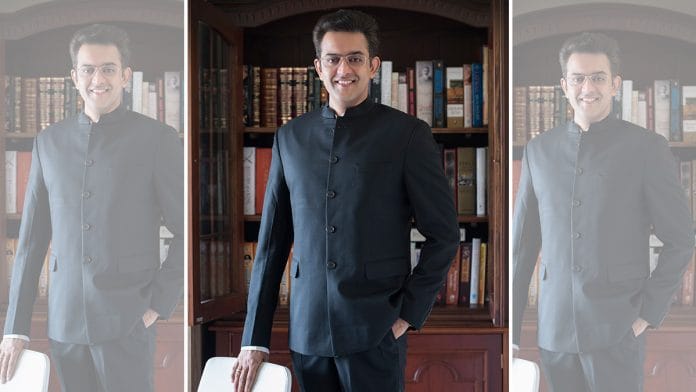

New Delhi: Vinayak Damodar Savarkar, the founding ideologue of Hindutva, wouldn’t have found any place in today’s politics, Vikram Sampath, historian and author, said.
Speaking to ThePrint’s Editor-in-Chief Shekhar Gupta on Off The Cuff, Sampath, author of ‘Savarkar, A Contested Legacy’, a two-part biography on Savarkar, said the freedom fighter had many differences of opinion with the RSS and its second Sanghsarchalak, M.S. Golwalkar.
“Savarkar was never part of the RSS. He had once said that if there was ever an epitaph of a Sarsanghchalak it would have only three lines: He was born. He joined the RSS. He died. No other singular achievement in his life,” Sampath said.
Replying to a question on what would Savarkar’s place be in the politics of today’s RSS and BJP, Sampath said, “Savarkar would not have a place in today’s politics which is so person-centric in all parties.”
Savarkar ignored by historians
Sampath said due to Savarkar’s implication in the assassination of Mahatma Gandhi and dominant ‘Marxist’ ideology in India’s historiography, Savarkar has been rudely ignored by Indian scholars.
“Savarkar is a very contentious figure, but he’s hardly been academically, or in a scholarly manner been analysed and studied. His work is largely in Marathi, which a lot of mainstream historians did not even access. The last biography of his was written in the 1960s, when he was still alive, by Dhananjay Keer. Since then till now, though, he is a part of election manifestos of political parties, he is a part of rallies, there are defamation cases, all of this happening all the time,” Sampath said.
“I am amazed by the singular lack of interest in him among historians, his opponents as well as proponents,” Sampath added.
Savarkar’s implication in the murder of Gandhi rendered him a “persona non grata” in political circuits of the dominant ‘Marxist’ bend of Indian historiography, he said.
“For the longest time, after Independence, there’s been just one shade of ideological history that has been allowed to rule the roost, which I name it as the Marxist historiography, which ruled the roost, and which ensured that anybody who was talking or writing anything different, gets cancelled there, they lost their livelihoods,” Sampath said.
Also read: Pew India survey takes us back to one more thing Gandhi, Savarkar differed on
Savarkar’s mercy petitions highlighted out of context
Sampath said the ‘mercy’ petitions filed by Savarkar were like modern-day bails, written in language and format suitable to the times, and that many revolutionaries had filed such petitions but only Savarkar’s are highlighted, and often out of context.
Some revolutionaries who filed similar petitions include Ramprasad Bismil, Bal Gangadhar Tilak, and Sanchindra Nath Sanyal, Sampath said.
“If you’re given the agency of a petition, that doesn’t mean you’re a (British) stooge. He was released from Ratnagiri in 1924 on two conditions, one was, you’re not going to participate in politics for five years. And the second is you are going to be confined to Ratnagiri and not move anywhere out. Now, if he had become a stooge by then, at the end of the five years, he should have been released by the British because somebody was on your side, it’s always good to let them free, or once you get him into the government,” Sampath said.
(The headline has been updated to reflect what Vikram Sampath said more accurately.)
Also read: How Karl Marx’s grandson fought for Savarkar against British in International Court of Justice