


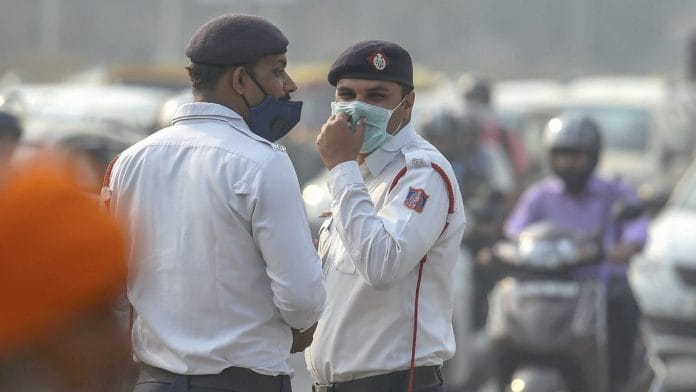
New Delhi: As Delhi’s air quality deteriorates each winter, the N95 mask becomes a familiar sight on roads, at traffic signals and on public transport. But does wearing one actually protect you from the fine particles that make the city’s air dangerous?
The short answer is yes, to an extent. A genuine N95 respirator can filter out a large proportion of airborne particles, including PM2.5. But the protection it offers depends on more than the label printed on the mask. How it fits, whether it is genuine and how consistently it is worn all matter.
What makes an N95 different?
An N95 is a filtering facepiece respirator designed to fit closely over the nose and mouth. Under the US National Institute for Occupational Safety and Health (NIOSH) standard, it is tested to filter at least 95 per cent of airborne particles under specified laboratory conditions.
Its filter material uses an electrostatic charge to capture particles as air passes through it. This makes it different from ordinary cloth or surgical masks, which are not designed to provide the same level of filtration or form a tight seal around the face.
Fine particulate matter such as PM2.5 can penetrate deep into the lungs. A N95 can reduce the amount of these particles a person breathes in while travelling or spending time outdoors.
India also has its own standard for filtering half masks, IS 9473:2002, which covers respiratory protective devices designed to protect against particles. Buyers should look for credible certification rather than relying only on marketing claims.
Why does the fit matter?
Even a high-filtration mask cannot offer its expected protection if air leaks around its edges.
An N95 should cover both the nose and mouth, with the nose clip moulded firmly and the straps positioned correctly. A gap around the nose, cheeks or chin allows unfiltered air to enter.
Facial hair can also interfere with the seal. NIOSH guidance says tight-fitting respirators need a clean-shaven area wherever the mask makes contact with the skin.
The mask should be worn throughout the period of exposure. A loose fit, frequent removal or a damaged respirator can reduce the protection it provides.
N95, KN95 and cloth masks: What’s the difference?
N95 respirators are designed to filter at least 95 per cent of airborne particles under standard testing conditions. They are particularly useful against fine particulate matter such as PM2.5, which can penetrate deep into the lungs. However, as stated before, their effectiveness depends heavily on how well they fit the face.
KN95 masks, which follow Chinese filtration standards, are designed to filter at least 95 per cent of airborne particles too. While their filtration requirements are broadly comparable to those of N95 respirators, differences in testing standards, manufacturing quality and fit can affect their actual performance.
Cloth masks, on the other hand, generally offer much less reliable protection against fine particulate pollution. Their filtration capacity varies depending on the fabric, number of layers and construction. Most ordinary cloth masks are not designed or tested to filter very small airborne particles to the same standards as certified respirators.
The key distinction: An N95 or a certified KN95 can significantly reduce exposure to fine particles when worn correctly, while an ordinary cloth mask should not be considered an equivalent substitute.
What can an N95 not protect you from?
An N95 filters particles, not gases or vapours. This is an important limitation in a city where pollution is a mixture of particulate matter and gaseous pollutants, including nitrogen dioxide, sulphur dioxide and ozone.
It is therefore not a complete shield against Delhi’s polluted air. Nor does a filtration rating of 95 per cent mean that every wearer will receive 95 per cent protection in everyday conditions. The laboratory rating assumes controlled testing, while real-world protection depends heavily on fit and use.
The World Health Organization has also cautioned that evidence on the health benefits of respirators among the general public in real-world conditions remains limited. This does not mean a properly fitted respirator cannot reduce particle exposure, but it does mean masks should not be treated as a substitute for reducing pollution at its source.
For someone who has to commute or work outdoors during a pollution episode, an N95 can be a useful way to reduce exposure to fine particles. But cleaner air ultimately depends on cutting emissions, not simply on what people wear over their faces.