



New Delhi: As India gears up for its first bullet train, the Mumbai-Ahmedabad corridor is unveiling several new technologies to safely run trains at up to 320 kmph. The National High-Speed Rail Corporation Limited, or NHSRCL, is using advanced Japanese Shinkansen technology to meet safety and comfort standards for the 508-kilometre corridor.
Twelve years after the Modi government announced a bullet train in India and signed a formal agreement with Japan in 2015, NHSRCL released a video giving the first glimpse of the infrastructure of the high-speed trains. The project is expected to be complete by late next year.
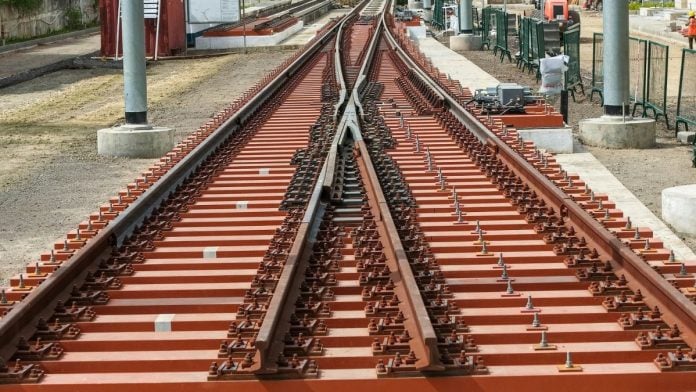
Engineering features like movable crossings (swing-nose crossings) and canted turnouts have been deployed to allow smooth track-switching. This helps to provide a continuous, gap-free rail surface, lowering vibration at high speeds and maintaining track banking while reducing sudden lateral forces and passenger discomfort.
“Ever wondered how Bullet Train tracks switch at high speed? Answer lies in a network of switching devices called point machines and movable track components called turnouts. Together they help Bullet Trains in changing tracks especially near depots and stations,” NHSRCL posted on X with a video explaining how track changes work at such high speeds.
What is a swing-nose crossing?
A swing-nose crossing, also known as a moveable-point frog, is a specialised railway track component that eliminates the gap found in standard track switches. On regular railway tracks, when two lines intersect at a switch (turnout), there is a permanent gap where the wheels of a train cross from one rail to another. At high speeds, hitting this gap causes severe vibration, loud noise, and rapid mechanical wear.
A swing-nose crossing solves this by introducing a movable piece of rail that shifts dynamically to create a single, continuous path.
For bullet trains, eliminating the gap removes the risk of a wheel derailment or severe impact jolts while crossing tracks at ultra-high velocities. It reduces component wear and tear because there is no impact collision between the wheel and a fixed gap. Hence, the lifespan of both the train’s wheels and the track infrastructure is extended.
The swing-nose crossings also reduce noise levels and eliminate the violent shaking or “thumping” sensation passengers would otherwise feel inside the cabin during track changes.
“Beyond the dual point machines, the system incorporates independent, redundant detection and verification layers. Separate detection circuits continuously monitor correct final position of the switch rails, correct final position of the movable crossing, and secure mechanical locking of both components,” NHSRCL said in a statement, adding that when all independent checks confirm the turnout is correctly set and locked, the interlocking release the route.
Also read: Allahabad University VC Sangita Srivastava is 1st to be reappointed. What made it possible
What are canted turnouts?
A canted turnout is a specialised track-switching system where the track’s banking, or cant (superelevation), is deliberately maintained right through the switching section where the tracks diverge.
On a standard, straight railway line, both rails sit completely flat. When a train hits a curve, the outer rail is elevated slightly higher than the inner rail. This slope—called banking or cant—helps counteract the centrifugal forces pushing the train outward, keeping it stable.
On traditional train networks, the track switches (turnouts) are kept completely flat, meaning a train has to slow down drastically before switching lines to avoid severe lateral shaking. A canted turnout solves this problem for bullet trains.
It allows high-speed trains to switch tracks efficiently without needing to decelerate aggressively beforehand. The Passengers inside the train do not feel a violent sideways jerk motion when the vehicle shifts lines.
“The Mumbai–Ahmedabad High-Speed Rail project represents a significant step in India’s transportation journey. It is creating the knowledge, capabilities and industrial ecosystem needed for future expansion. India is drawing on the experience gained through this landmark corridor. It is establishing a scalable approach for future high-speed rail expansion. This approach can support upcoming high-speed rail routes across the country. As new corridors are developed, this foundation will help enhance connectivity. It will also help reduce travel times and contribute to long-term economic growth,” the Ministry of Railways said in a statement.
Also read: 13 rape, sexual assault cases reported across Delhi-NCR since September began
What are the other Japanese technologies?
Apart from swing-nose crossings and canted turnouts, the Mumbai-Ahmedabad High-Speed Rail (MAHSR) project is also introducing other Japanese technologies, such as 2×25 kV Overhead Electrification and Japanese J-Slab Ballastless Track Technology.
Japanese J-Slab Ballastless Track Technology is the pre-cast concrete slab track system developed for the Japanese Shinkansen (bullet train) network. Unlike conventional railway tracks that rest on piles of crushed stone (ballast), the J-Slab system uses a multi-layered concrete design engineered specifically to withstand extreme forces generated by trains travelling at 320 km/h.
Meanwhile, 2×25 kV Shinkansen Overhead Electrification (also known as the 2×25 kV Auto-Transformer feeding system) is an advanced power transmission technology engineered specifically for heavy-duty, high-speed rail corridors. It resolves the issue of power degradation when multiple high-speed trains draw immense electrical current simultaneously.
“The MAHSR Project is being developed using Japanese Shinkansen technology and operational practices. The corridor incorporates advanced systems for traction, electrification, track infrastructure, and operations,” the Ministry of Railways said in the statement.
‘Indian Railways undergoing complete overhaul’
In early September, Railway Minister Ashwini Vaishnaw said that the testing for the bullet train on the Mumbai-Ahmedabad corridor will begin in May-June next year. He said that the train will then be inaugurated after four months of testing.
“The bullet train project is being developed with the vision of an Atmanirbhar Bharat. When you ride the bullet train from Vadodara, you will reach Mumbai in just an hour and a half,” he said.
The usual train journey time from Vadodara to Mumbai is approximately five to six hours for standard express trains, covering a distance of about 370 to 390 kilometres.
Vaishnaw added that the Surat-Vapi section of the bullet train corridor is expected to be completed by December this year.
The Indian Railways is undergoing a complete overhaul, he said, adding, “We are reforming and modernising everything—from operating systems and reservation systems to old construction protocols.”