



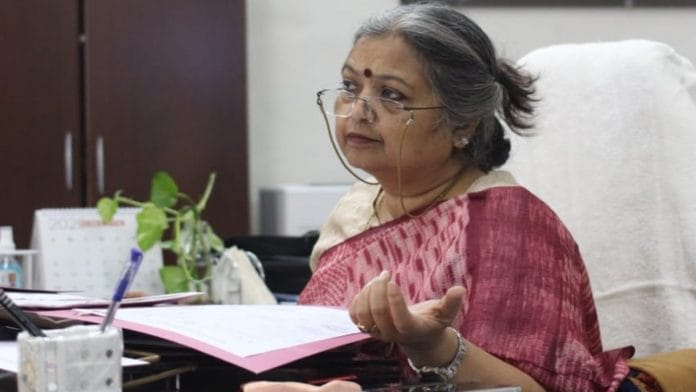
New Delhi: For the first time in the history of Allahabad University, professor Sangita Srivastava has been reappointed as the vice-chancellor for a second term. The unprecedented move that extends her tenure by another five years comes after an amendment to the university’s long-established rules.
Srivastava was first appointed as the VC in November 2020. At the time, the university’s rules said that a vice-chancellor could serve for five years but could not be appointed for another term. Clause 4 of Statute 2 of the University of Allahabad Act, 2005 states that the VC may serve for five years or until the age of 65, whichever is earlier, and “shall not be eligible for re-appointment”.
However, the university had started the process of changing this rule more than a decade ago. According to the Official Gazette, the Executive Council made the amendment in 2010, and the President approved it in 2025.
The amendment proposed to increase the upper age limit for the VC from 65 to 70, and allowed an incumbent VC to be reappointed.
Although Srivastava’s first term ended on 29 November 2025, the education ministry allowed her to be reappointed. The 22 September order, which was signed by Under Secretary Rajesh Kumar, said that her new term would be effective from 16 September 2026 and would continue for five years or until she turns 70, whichever is earlier. Srivastava is currently 62 years old.
“It is not just about one vice-chancellor or one university. There is a pattern of centralisation,” said a senior professor from Allahabad University on the condition of anonymity. “Decisions are being taken in a way that leaves little room for consultation or dissent.”
Rules for reappointment
Allahabad University became a central university in 2005. The original rules, under the original Statute 2(4), said that the VC had a five-year term and could not be reappointed. The upper age limit was 65.
The amended statute changed both provisions. It now allows a VC to be reappointed for another term and raises the upper age limit to 70.
Coincidentally, the amendment became effective only shortly before her first term ended.
This isn’t as simple as it seems. The UGC’s 2023 regulations say that a vice-chancellor of a central or state university should not be appointed for a second term in the same institution. These rules allow a person who has already served as VC to be appointed to the position in another university—though it is subject to certain conditions.
The reappointment has raised concerns about centralisation in the university among several faculty members.
At the same time, central universities have their own rules and statutes. Allahabad University’s amended statute specifically allows reappointment.
Also read: 13 rape, sexual assault cases reported across Delhi-NCR since September began
Allahabad University not the first
This isn’t an isolated incident, and Allahabad University is not the first central university to have a provision allowing a VC to serve another term. Delhi University is a recent example. Its statutes were amended in 2023 to allow the VC to be reappointed. In July 2026, professor Yogesh Singh was reappointed for another five-year term.
Other universities—including Central University of Punjab, Central University of Jharkhand, Central University of South Bihar, and Central University of Gujarat—have also made amendments to existing rules to make room for a VC’s reappointment.
There have also been cases where a VC was allowed to continue after their five-year term ended, but a successor was yet to be found. At Jawaharlal Nehru University, for instance, the education ministry allowed then-VC Mamidala Jagadesh Kumar to continue in office after his term ended in January 2021, citing Statute 3(4) of the JNU Act, 1966, which allows a VC to remain in office until a successor is appointed and takes charge.
But Allahabad University is different in one respect: Srivastava is the first VC in the university’s history to actually get a second full term.
Also read: CJP’s 3 demands after ECI row: Resign, freeze SIR, put on hold upcoming polls
Srivastava’s tenure
The university has said that teachers, employees, and students welcomed Srivastava’s reappointment. But there have also been continuing demands from student groups over facilities and administration. Some students and faculty members have raised more serious allegations, including claims of selective recruitment and action against professors.
On 22 September, a day before Srivastava’s reappointment was announced, the ABVP unit at the university submitted a memorandum seeking improvements in hostels, libraries, healthcare, drinking water, canteens, sports facilities, and placements.
“Students are complaining about fee hikes and the fact that elections are not being held, while professors have also raised concerns about how the administration functions. It gives you a sense that everything is being decided from the top. This is not limited to Allahabad University; you can see the same pattern in universities elsewhere as well,” said the senior professor.
The administration has highlighted its record during Srivastava’s first term, including faculty and non-teaching appointments and the university receiving an A+ NAAC grade.
However, her tenure has seen repeated disputes with students and faculty. A major fee hike approved in 2022 led to months of student protests, hunger strikes, and torchlight marches. In February 2024, an Allahabad University student accused an assistant professor of rape, sexual harassment, and criminal intimidation, following which police registered an FIR and student groups sought action. The same year, the university’s Executive Council approved an advisory restricting teachers and non-teaching employees from speaking to the media or writing about the university on social media without the VC’s approval.
(Edited by Prasanna Bachchhav)
Dear Print, where are the concerns raised by the faculty of the UoA? Why do you resort to fake reporting?