



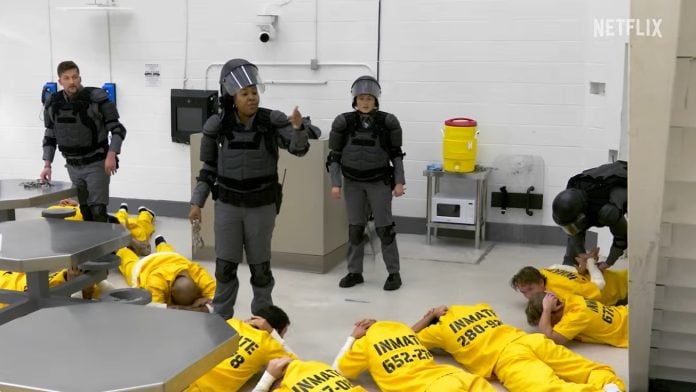
New Delhi: Netflix has revived one of psychology’s most controversial experiments.
Netflix has released the trailer for The New Stanford Prison Experiment, a six-part unscripted series which is set to premiere on October 21. It is based on Philip Zimbardo’s Stanford Prison Experiment conducted between 15 and 20 August 1971.
The trailer shows 30 participants being placed inside a real prison and randomly assigned as either guards or prisoners.
What follows is a rapid escalation into tension, with prisoners pushing back against guards, emotional breakdowns, and some guards even admitting they went too far.
The series revisits a question first tested more than 50 years ago: to what extent can power and social roles change human behaviour?
The original experiment
In August 1971, Stanford psychologist Philip Zimbardo and his team recruited male students at Stanford University for a prison experiment. The main objective was to explore the psychological impact of authority and powerlessness in a prison environment.
More than 70 men responded to an advertisement about the “psychological study of prison life.” Zimbardo’s team selected 24 applicants based on their physical and mental wellness. The participants received $15 a day and were divided randomly into equal numbers of guards and prisoners.
Each prisoner was made to wear a uniform and carry a chain padlocked around their ankle. The guards were dressed in khaki uniforms with a whistle around their necks. The participants were expected to remain there for up to two weeks.
Why did the experiment end?
On the second day itself, the prisoners staged a rebellion that was later put down by the guards. Guards then created a system of rewards and punishments to manage the prisoners.
Over the course of the experiment, some of the guards reportedly became cruel and tyrannical, and they subjected prisoners to psychological abuse, including humiliation, isolation, and sometimes even depriving them of food and water.
Push-ups were a common part of physical punishment imposed by the guards to punish prisoners. A lot of the prisoners became depressed and disoriented.
Considering these reasons, the experiment was terminated after just six days.
Also Read: American prisoners are now calling voters to campaign for Republican candidates
Findings of the experiment
The study was widely presented as showing that ordinary people could become abusive when given power and placed in a prison-like environment.
Despite its early termination, Zimbardo’s interpretation showed that situations and institutional roles can exert powerful effects on human behaviour.
Why is the Stanford experiment controversial?
The study is controversial for two connected reasons: how it was conducted and what it claimed to demonstrate.
Researchers who later examined the experiment’s records questioned whether the guard’s behaviour was as spontaneous as the study’s records suggested.
A 2019 analysis of archival material by researcher Thibault Le Texier found evidence that the study’s researchers gave guards instructions about how they were expected to behave and treat the prisoners, suggesting the researchers’ expectations may have encouraged the hostile behaviour.
There are also ethical concerns. Zimbardo admitted that during the experiment he had sometimes felt more like a prison superintendent than a research psychologist. Critics suggest that this compromised his ability to act as an impartial researcher, one who became emotionally invested and delayed halting the experiment.
Another prison study
In 2002, psychologists Alex Haslam and Stephen Reicher conducted the BBC Prison Study, involving participants assigned to guard and prisoner roles. It involved 15 participants and was conducted in a mock prison built inside a studio at Elstree, Hertfordshire, in England
However, this study reached very different conclusions. The guards did not become tyrants, and the prisoners eventually organised and challenged them.
Their findings challenged the idea that people automatically conform to the behaviour associated with their assigned role.
Why is Netflix doing it again?
The new Netflix series moves the action from a campus to a working prison. Executive producer Jane Lipsitz said a real prison carries a history and sense of confinement you can’t recreate on a set.
Reaction to the Netflix trailer has been largely critical. When it was first reported, people on X responded with disbelief, and some branded the revival unethical.
One user wrote, “I’m sorry but WHAT. like what in the actual???”
“Our reality is a never-ending parody and it ain’t even a funny one,” wrote another.
Clay Ramsay, who was Prisoner 416 in the original 1971 study, told Newsweek he fears the show could blur the line between entertainment and science.
However, the creators say that the experiment is being conducted with safeguards including psychological screening, access to psychologists, and a mechanism allowing participants to leave.