







Welcome to The First Metro. I am Manasi Phadke, a thoroughbred Mumbaikar, and once every fortnight, I try to bring you a glimpse of India through Mumbai-tinted glasses. Trust me, the hues seem different.
A ‘Nayak’ in Thane has been putting up a fine performance since April, an ‘Arjuna’ launched itself into its new role last week, and a ‘Mavala’ (soldier) fighting its second battle in South Mumbai.
This is the latest blockbuster that Mumbai is scripting, titled ‘Paatal Lok’ (the world under) in the words of Sanjay Mukherjee, commissioner of the Mumbai Metropolitan Region Development Authority.
Mumbai has long exhausted at-grade solutions to ease its traffic. The coastal road, built by pushing the coastline back, was an exception. And majorly the last phase of major infrastructure creation in the city was above the ground, in the sky, with elevated roads, cable-stayed and double-decker bridges, and roads on stilts.
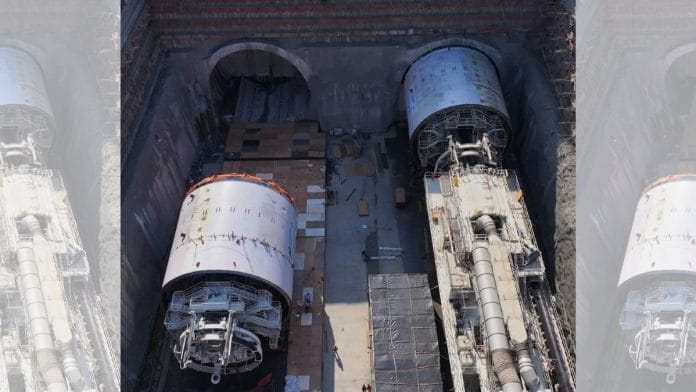
Now, Nayak, Arjuna, Mavala, and many other named and unnamed Tunnel Boring Machines (TBMs) are driving the next wave of transport infrastructure creation in Mumbai. The northern extension of the coastal road, planned from Versova to Dahisar, also has twin tunnels of 3.9 kilometres each. There’s a tunnel being bored between Thane and Borivali under the Sanjay Gandhi National Park. Another, between Orange Gate and Marine Drive, is trying to connect the coastal road with the Eastern freeway. The Goregaon-Mulund link road also has twin tunnels under construction.
The under-construction Mumbai-Ahmedabad bullet train also involves a 21-km long tunnel between Bandra Kurla Complex and Shilphata in the Mumbai Metropolitan Region, including an under-sea tunnel that will be seven kilometres long.
The MMRDA has planned a fully underground Metro line of 17.4 kilometres from Wadala to Gateway of India that will require significant tunnelling. And further, the agency is also in the process of preparing a detailed project report for an integrated tunnel network running below Mumbai spanning 70 kilometres.
I have listed the major ones on which active planning or execution is underway.
Officials overseeing all of this tunnelling work in Mumbai vouch for how a TBM is one of the safest technologies, and although expensive, is best suited for a dense city like Mumbai.
But, while TBMs are shaping Mumbai’s transport infrastructure boost this decade, from everything that I have gathered during my many interactions with various engineers working on projects that involve TBMs, one thing is certain: The economy of TBMs is a complex one.
It involves heavy reliance on foreign manufacturers, long waiting times, multiple checks, high costs, and even a dependence on India’s diplomatic relations with China at any given time, considering several companies have manufacturing or assembly units there.
To begin with, almost all projects require TBMs that are tailor-made.
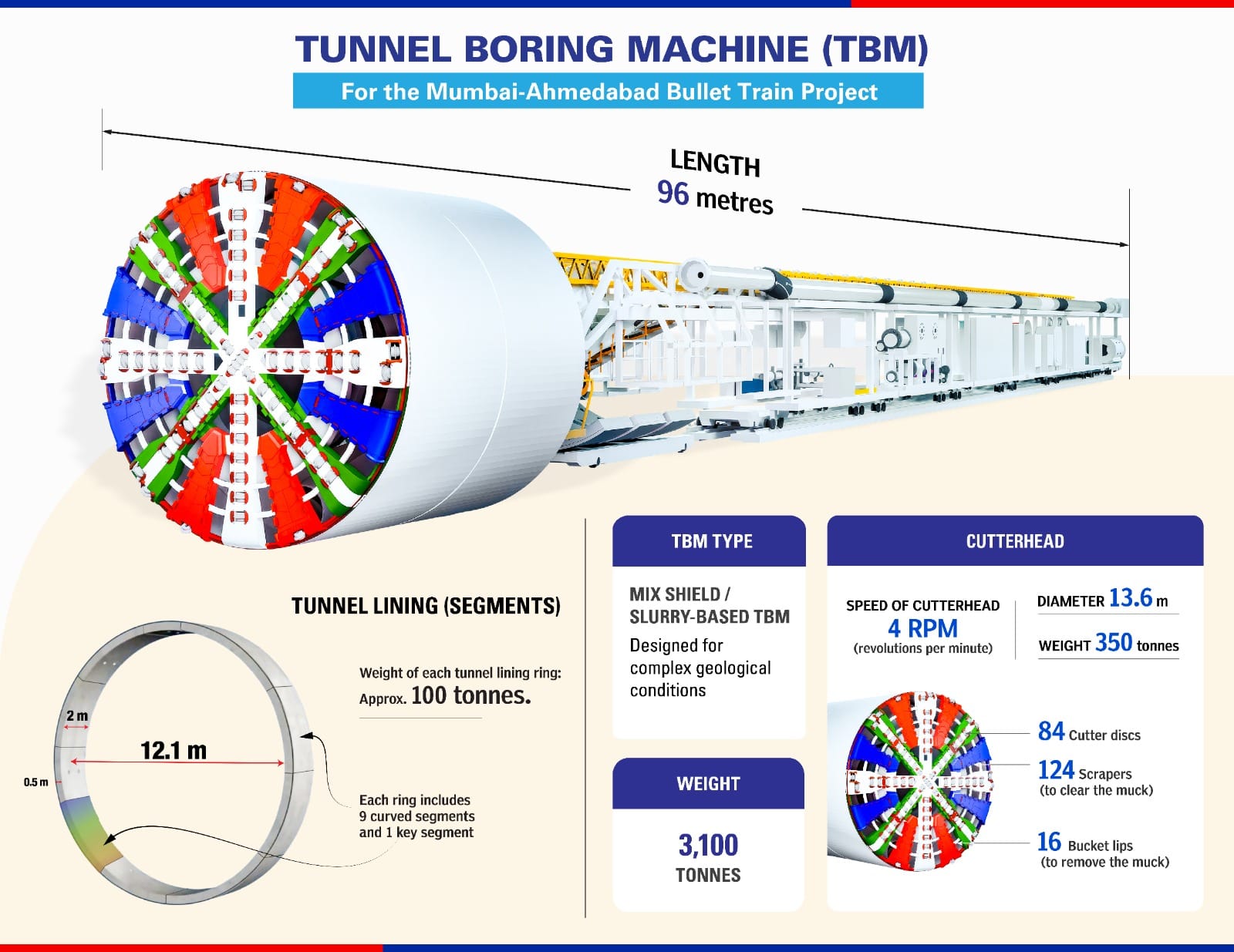
The National High Speed Rail Corporation Limited (NHSRCL) is using two TBMs with a diametre of 13.6 metres for the tunnel portion of the Mumbai-Ahmedabad bullet train. Nayak and Arjuna, the two TBMs launched at the Thane-Borivali tunnel site, have a diametre of 13.34 metres. The TBM being used at Orange Gate-Marine Drive site has a diametre of 12.19 metres.
Different projects have different requirements, an engineer in the Mumbai civic body, who was working on the coastal road project, was explaining to me once.
The Orange Gate-Marine Drive TBM is a slurry shield, one that is typically used for tunnelling close to the coast and can take into account all kinds of geological variation—water pressure, mist condition. The Thane-Borivali TBM is a single-shield one that breaks stone. The requirement for most Metro projects, however, is standard and pretty uniform.
For others, it takes 12-15 months to manufacture TBMs with specific diameters, followed by more time for the various parts to be delivered. The entire process can take up to 18 months.
Once the parts arrive in Mumbai, engineers have to assemble them. One engineer working on the Thane-Borivali project described the process of assembling the parts like playing Tetris—the 1980s video game, where blocks of different shapes and angles drop, and the player has to drag and place them at where they most perfectly fit. Another engineer working on the coastal road project said, “The pieces came in 60-70 containers. It was like a puzzle that we had to solve and create a story out of.”
In this case, the story has four chapters: the four parts of the TBM—cutter head, shield and two gantries. The assembly takes about three to four months more.
The very first non-Metro tunnel dug inside Mumbai’s city limits was the twin tunnels forming part of the Eastern Freeway under the hill near the Bhabha Atomic Research Centre. It was not a TBM tunnel though. That tunnel was built by administering controlled blasts and drilling through the ground.
When I was actively covering the infrastructure beat for The Indian Express, this was the only “Pataal Lok” project in an era of elevated roads and flyovers. The team of engineers at MMRDA had called a few of us to witness an important day in their lives—the second of the two tunnels was about to achieve daylight. Only one large piece of solid rock remained between them and the other side of the tunnel. With one button press, it would turn to smithereens, flooding the big dark burrow with some of Mumbai’s bright afternoon light.
The engineers at the site suggested that IAS officer Ashwini Bhide–then posted as Additional MMRDA Commissioner and was directly supervising the Eastern freeway project—push the button that would lead to the controlled blast.
Other than her, I was the only woman at the site, and somewhere along the discussion of exactly what time would be auspicious to push the button, and how it should be done, everyone present decided that both the ladies in the group should share the honour.
I was overwhelmed with excitement. I knew that for many years to come, I would point at the tunnel and tell whoever was in the car with me—and willing to listen—about the day I helped bring this tunnel to life in my own small way.
Bhide ma’am and I both made our way forward, and she asked me to actually push the button on the switchboard once she got clearance from her engineer. The moment I did, the ground vibrated and the sound of breaking boulders reverberated through the structure. Suddenly, a few streams of blazing light dispelled some of the darkness.
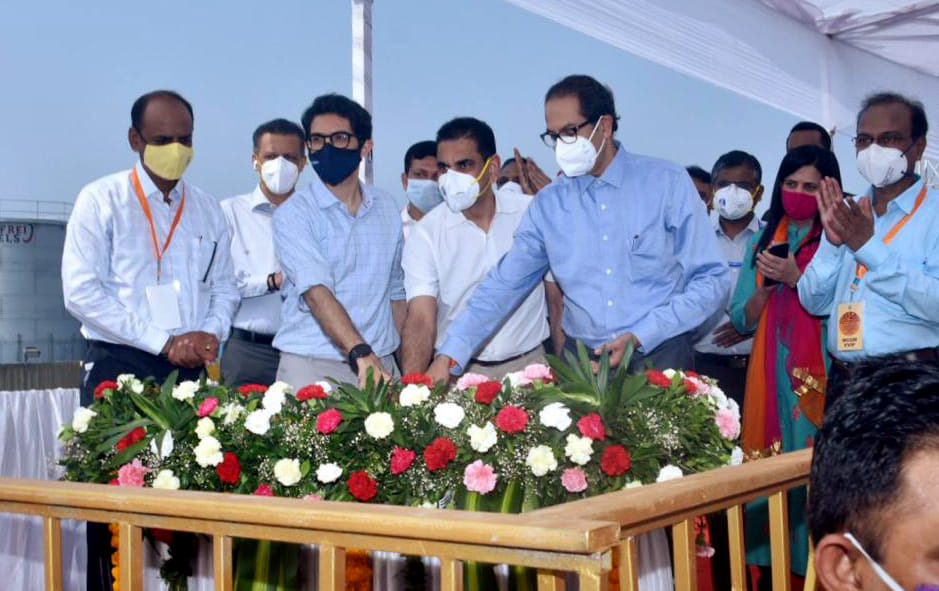
I haven’t had such good luck with TBM tunnels though. That was 14 years ago. Since then, infrastructural developments have turned into advertisements for the political establishment of the day, and all major developments, including ‘achieving daylight’, are done with either the CM or the deputy CM doing the honours and delivering a long-ish media byte to television reporters.
Also Read: The Mundhe phenomenon
The launch of the Arjuna TBM at the Thane-Borivali tunnel site was also a political spectacle with Chief Minister Devendra Fadnavis and other ministers present to push buttons and make speeches.
Coming back to the economy of TBMs, while officials say that they are extremely safe and best suited for Mumbai’s requirements—long deep tunnels in congested areas, often near the coast or even under water bodies—there are several associated challenges.
To begin with, they are expensive. One official pegged the cost of getting one TBM manufactured, transported and assembled at Rs 200-250 crore, enough to build a major piece of urban infrastructure, such as a short flyover or a hospital. Also, given the demand for TBMs across India, orders need to be planned well ahead of time with a significant cushion to ensure the machine is available when needed and projects don’t run into delay on account of late delivery of machines.
Foreign manufacturers often have their plants in China, and sometimes the swiftness with which shipment materials are cleared depends on global conditions and India’s diplomatic ties with China at that point, officials say. The bullet train project, they say, had famously faced delays in getting hold of its two TBMs, which were stuck for clearance from Chinese authorities a couple of years ago.
There has been a sincere attempt to reduce dependence on imports where TBMs are concerned. In 2007, Herrenknecht set up the first TBM assembly facility in Chennai, and has since expanded to set up a manufacturing facility as well. The company has also had preliminary talks with CM Fadnavis about possibly setting up a manufacturing facility in Maharashtra, government sources have told me. A few other foreign TBM makers are also looking at India.
Officials, however, say that manufacturing in China is still cheaper than in India, though the cost gap has dropped by about 20-30 percent gradually.
In one of my conversations with Ashwini Bhide, now the municipal commissioner of Mumbai, she spoke about the need for agencies to collaborate and plan better, standardising the TBM requirement for road projects as much as possible so that the machines can be reused, and agencies can save valuable public money and time.
The Mavala has been a shining example of the same. It was procured for the coastal road project, and is still boring holes under Mumbai. This time, it is for the Orange Gate-Marine Drive tunnel.
Otherwise, in most cases, as the diametre of the TBM changes, it becomes impossible to retrofit the cutter head and the shield.
Another fun fact: Mavala was the first time a TBM in Mumbai had a name. Officials have said that it was Bhide’s idea, when she was additional municipal commissioner in BMC and handling the coastal road project.
It personalised the machine. It helped instil a sense of familiarity with the equipment that was playing a crucial role in handing Mumbai one of its biggest infrastructure developments in decades. Not every TBM has a name, but some officials like Sanjay Mukherjee have borrowed the practice.
The Nayak at work on the Thane-Borivali tunnel directly translates to the ‘hero’ or the ‘chief’. And while the TBM is indeed playing a pivotal role, it has been named after a butterfly, the ‘moduza procris’, found in the Sanjay Gandhi National Park. The tunnel will go under the national park.
Similarly, the Arjuna has been named after a tree species, also found in the national park.
The Nayak and Arjuna have started work on the Thane end of the Thane-Borivali tunnel. Two more—unnamed so far—will be deployed later at the Borivali end.
That’s the story of Mumbai’s Pataal Lok in a nutshell. Hope we make it to the end credits soon.
Also Read: Mumbai: Of white (fault)lines & identity politics