





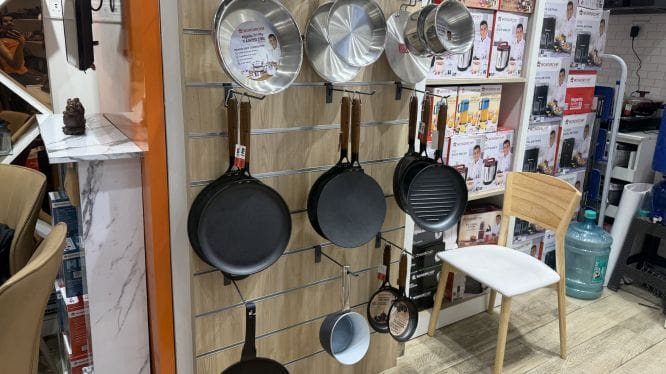


At a Reliance Jio Mart in Noida’s Sector 18, black cast iron and bright ceramic pans and kadhais find the front rows of the cookware section. The non-stick pans, not long ago the preferred purchase, are now stacked up at the backside. But this wasn’t always the case.
Non-stick cookware entered Indian kitchens as the poster child of ‘healthy cooking.’ It required less oil, made cooking dosas and chillas easy, and eliminated the hassle of food sticking to the surface. They became a status symbol and soon, a staple in the average kitchen. But that kitchen hierarchy is now changing.
It now finds itself at the center of a health debate, with research linking its use to cancer and other concerns. Several studies, over the years, have pointed to the health risks linked to PFOA, or Perfluorooctanoic acid, a chemical used in Teflon non-stick coatings, which brings non-stick cookware under scrutiny. But manufacturers have found their way around by switching to diversify their offerings even as they defend the cookware.
“The West has moved to ceramic because of environmental reasons. When non-stick coating wears off and gets washed away, it enters the environment and takes up to 100 years to break down. While ceramic coatings once scraped off take 25 to 30 years to decompose,” said Ravi Saxena, CEO, WonderChef.
In the West, scrutiny of the non-stick industry intensified in the early 2000s, particularly after the Environmental Protection Agency launched investigations into PFOA around 2004–2006. The debate has also entered formal policy with regulatory actions such as the EPA’s 2010/2015 PFOA Stewardship Program, urging major manufacturers to phase out the use of chemical.
The non-stick cookware market in India is valued at around Rs 1,500 crore, and nearly 40 per cent of sales come from local players.
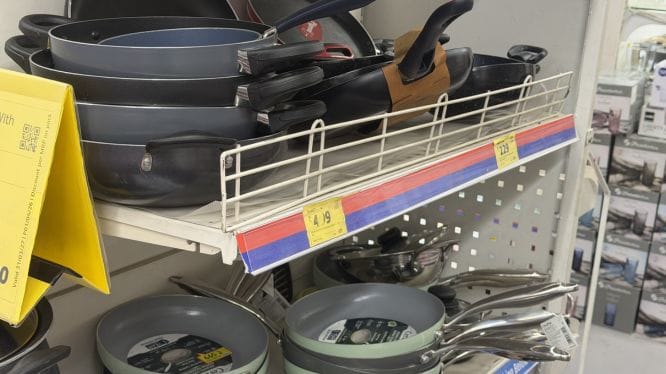
The branded market is dominated by manufacturers such as Prestige, Hawkins and WonderChef. The chatter around the safety of nonstick cookware, brands admit, have stagnated sales if not led to a decline in the last two years. Much of this slowdown is being attributed to the growing narrative of social media health influencers who frequently highlight a possible link between non-stick cookware and cancer, as well as other health problems.
But brands have been innovative in the face of a sustained campaign against non-sticks by diversifying their portfolios into ceramic, cast iron, stainless steel, and appliances to milk the anti-non-stick cookware movement.
“In this mess, created due to misinformation from content creators and YouTubers, our business isn’t affected because we have ceramic, cast iron and steel as well in our portfolio,” added Saxena, who co-founded WonderChef in 2009 in collaboration with celebrity chef Sanjeev Kapoor.
The brand started with non-stick cookware and pressure cookers.
Also read: IIMs are getting richer from executive courses. Indians want to upskill quickly
Not an enemy
Hyderabad-based nutritionist Nida Fatima Hazari gets at least one question every week from her clients about non-stick cookware. But unlike many health influencers on Instagram and YouTube, her view isn’t rigid. She doesn’t see non-stick as the villain it’s often made out to be.
Non-stick cookware, she says, is generally safe if used correctly, on low to medium heat, and only when the pan is in good condition.
Hazari points out that non-stick cookware offers real, practical benefits. It requires less oil, is easy to clean, and makes everyday home cooking simpler, all of which support healthier eating habits.
Emerging research shows that microplastics and nanoplastics are now widespread in environment, coming from multiple sources, not just food. Kitchen tools, including non-stick cookware, may quietly add to this exposure over time.
According to Hazari, the real risk with non-stick cookware arises not from normal use, but from misuse, like overheating an empty pan, cooking frequently on high heat, or continuing to use scratched and peeling cookware.
These practices can break down the coating and release fumes that may cause temporary flu-like symptoms. Her advice is simple, “replace damaged pans and use non-stick mindfully.”
Tramontina India CEO Aruni Mishra echoes a similar sentiment to Hazari. According to him, the conversation happening around non-stick is essential but the peg is incorrect. Tramontina is a 115-year-old global houseware brand from Brazil that entered the Indian market in 2024.
Mishra emphasizes that high-quality non-stick cookware, when manufactured well and used correctly, is safe for everyday cooking. The real concerns, he says, arise from two key areas: “poor-quality products and improper usage.”
“The real conversation isn’t non-stick vs safety – it’s quality and usage. High-quality non-stick cookware is safe when used correctly. Most concerns stem from poor-quality products – coatings that chip easily, exposing base metals – or misuse, like overheating or dry heating,” he said.
Like other major players in the market, including WonderChef and Prestige, Tramontina has also diversified its product range in response to changing consumer preferences. The brand offers everything from ceramic-coated and triply stainless steel cookware to cast iron and enamelled options.
“We have ceramic-coated and triply stainless steel to cast iron and enamelled cookware, because Indian cooking demands versatility, not a one-size-fits-all approach,” Mishra said.
At the same time, he acknowledges that the industry itself bears some responsibility for the confusion consumers face today. While some manufacturers, like Saxena of Wonderchef, prefer to avoid aggressive marketing battles to counter misinformation, Mishra called out the communication gap.
“Misinformation spreads quickly, but the industry hasn’t always made the science simple or accessible. Today, transparency isn’t optional, it’s expected,” he admitted. Brands need to take the onus of clearly explaining the science behind non-stick products to consumers. And doing it in a way that’s easy for the average person to understand. By addressing concerns directly and transparently, the industry can better respond to customer doubts.
Also read: Foreign universities in India are selling half-baked dreams. ‘Can’t even get you internships’
Good non-stick vs bad non-stick
A non-stick pan might look simple on the outside, but the difference between one that lasts for years and one that starts peeling in months lies in how it is made. And, every step counts.
It all begins with the aluminium base. Good-quality pans use virgin aluminium, which is pure and free from impurities, while many cheaper options rely on reprocessed aluminium, metal that has already been used, melted down, chemically treated, and reused.
The problem with reprocessed aluminium is that traces of chemicals and compounds can remain even after cleaning. When the pan is heated, these residues can react and release gases, which form tiny bubbles beneath the coating. Over time, this causes the surface to wrinkle, blister, and eventually peel away.
Equally important is how the aluminium is prepared before the coating is applied. In a standard manufacturing setup that meets benchmarks, the surface goes through a rigorous multi-step cleaning process involving hot water washing, chemical treatment, rinsing, salt cleaning, and air drying to ensure that no grease or oil remains.
This is crucial because even a small amount of residue can prevent the coating from bonding properly.
“However, in many factories, this step is often rushed or simplified, sometimes reduced to just wiping the surface with a cloth, which is not enough to remove embedded grease from the shaping process,” Saxena said.
The problem with reprocessed aluminium is that traces of chemicals and compounds can remain even after cleaning. When the pan is heated, these residues can react and release gases, which form tiny bubbles beneath the coating
After cleaning, the surface is typically sandblasted to create a slightly rough texture, much like sanding a wall before painting. This roughness helps the coating adhere better
“In lower-end manufacturing, this is often done manually using spray guns, which leads to uneven layers, thicker in some areas, thinner in others, resulting in inconsistent performance and durability,” said the WonderChef CEO. “In our factories, we have robotic arms programmed to apply the coating with precision, ensuring a uniform thickness across every pan.”
Finally, the coated pans must be baked at high temperatures, around 400 degrees Celsius, for about 45 minutes in controlled ovens where the temperature remains constant throughout. This step is essential to properly cure the coating and bond it securely to the metal. If the temperature fluctuates or the baking is not done correctly, the coating will not adhere as it should, leading to early wear and tear.
As for safety concerns, Saxena pointed out that no “direct link” has been established between non-stick coatings and health issues.
“If there were, such products would have already been phased out globally. It is also worth noting that most coatings, including so-called ceramic ones, rely partly on petroleum-based compounds, since even materials like sand require chemical binders to form a functional coating,” he added.
Also read: ASI’s ghost campus in Noida—grand new Rs 289-cr facility, 15 students, no faculty
Fear is real
Despite growing concerns, non-stick cookware hasn’t disappeared from Indian kitchens. Loyal users still stick by it, sometimes out of habit, sometimes out of practicality. Many who switch to alternatives like cast iron or steel find themselves returning, frustrated by food sticking to the surface or the increased use of oil.
When Suman Sachdeva saw some videos on her family WhatsApp group, linking non-stick cookware to cancer, she decided to get rid of non-sticks in her kitchen. But the change didn’t last.
She eventually bought a new non-stick Prestige pan for shallow frying tikkis, making parathas, and cooking eggs.
“I have reduced how much I use it. With cast iron, you end up using much more oil. My husband is a heart patient. His cholesterol levels have been a constant headache,” she said, shopping with her husband at Market 99.
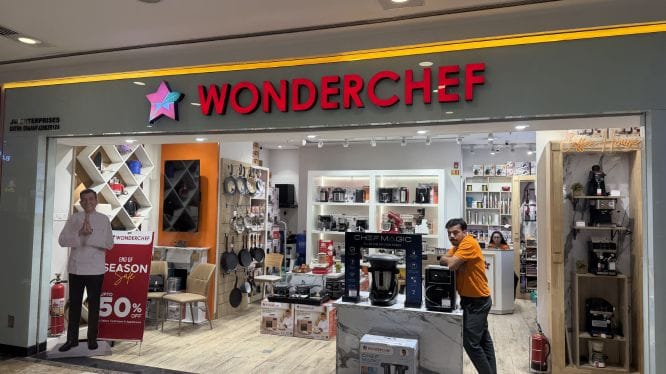
At a WonderChef store in DLF Mall of India, this shift in consumer sentiment is visible on the ground. It is one of the oldest and most popular WonderChef stores in Delhi NCR. Dimple, who has worked here for four years, says customer preferences have changed in the past two years.
“Right now, cast iron makes up about 40 per cent of sales, ceramic 30 per cent, steel 20 per cent, and non-stick just 10 per cent,” she said.
The fear, she admitted, is real. So the store’s first approach is education. They try to reassure customers about the materials and manufacturing processes used in their products. But ultimately, the choice lies with the buyer.
(Edited by Anurag Chaubey)