


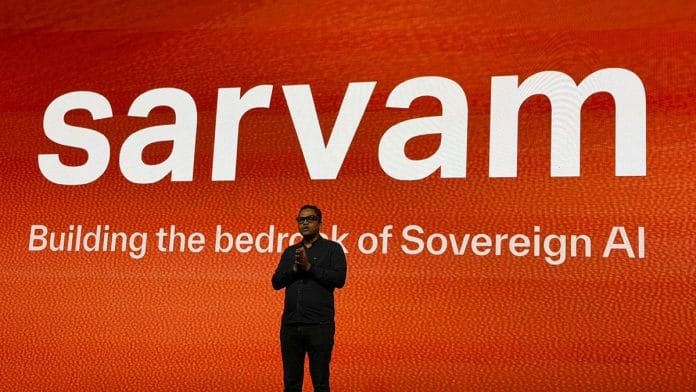
New Delhi: It was in July this year that Sarvam co-founder Pratyush Kumar told a packed hall in Bengaluru about a suggestion he kept hearing: Sarvam should stop training its own Artificial Intelligence (AI) and build on Kimi K3, the latest model from China’s Moonshot AI.
“This is absolutely the wrong thing to do,” Kumar said. “You cannot bet the country’s future on fair access to open models.”
By 16 November, when Sarvam launched Token Factory, a platform that sells businesses access to AI models running on its GPUs in India, things seem to have changed. Moonshot’s Kimi is on the Sarvam price list, as are DeepSeek, Z.AI’s GLM and Alibaba’s Qwen. Six of the 12 models on offer are Chinese. Sarvam says DeepSeek’s V4.1 Flash alone handles more than 450 billion tokens a day.
Picked by the government to build India’s sovereign AI model, Sarvam has spent a week defending the move. On Sunday, it published what the state had spent on it, said the new business runs on chips it bought itself, releasing an upgraded model of its own. Kumar wrote on social media platform X that some of the narratives against Sarvam “appear manufactured”.
Then and now
Kumar has been one of the strongest voices for Indian AI independence, and critics have been holding him to his own words.
In June, Anthropic suspended its Fable 5 and Mythos 5 models for foreign users under a US export directive. Kumar responded: “For AI users, it is clear that you should not confuse access with ownership, or adoption itself as advantage.” He warned that tools with “external control loops” leave users vulnerable.
The token factory was no sudden turn. At the India AI Impact Summit in New Delhi in February, Sarvam unveiled its 30B and 105B models along with Pravah, a ‘token factory’ that would offer a variety of models. Kumar said then it would make AI available to everybody at a fraction of the cost. In the same July speech, he also said India should “absolutely be using the best models out there, both closed-source, frontier, open-source”, while training its own.
Sarvam now distinguishes between using a model and depending on one. Training an AI model takes months and thousands of specialised chips called GPUs. Running it afterwards is called inference, and that is where the money is. Companies bill by the token, a piece of text about three-quarters of a word long.
A Chinese open-weight model can be downloaded and run on Sarvam’s GPUs in India with no line back to Beijing. Sarvam says requests do not reach the model’s developer. It also says it has no commercial agreement, data-sharing arrangement or royalty deal with DeepSeek, Z.AI or Moonshot.
“Today, India consumes a few trillion tokens a day and imports the majority of them,” Kumar wrote on Sunday. Banks, insurers and hospitals often cannot send data abroad, he said. Sarvam claims its prices match or undercut US providers such as Fireworks, Baseten and Together.
Soumen Mandal, principal analyst at Counterpoint Research, says the traffic numbers show what buyers want. “It suggests that customers are prioritising model performance, affordability and availability over the model’s origin,” he says. Hosting DeepSeek, he says, will help Sarvam “generate revenue and learn from leading AI models, enabling it to develop better sovereign AI models for India”.
Also Read: Funding for Indian AI firms doubles to $1.6 billion in first nine months of 2026, highest in 7 years
Public money
The sharpest criticism is over the subsidy Sarvam has used. “India’s poster child for sovereign AI is at the center of a debate,” says Neil Shah, vice-president of research at Counterpoint Research. “The backlash is sharp because Sarvam was among the first startups to receive subsidised compute under the IndiaAI Mission.”
Under the Mission, which the Ministry of Electronics and IT (MeitY) runs, Sarvam got discounted access to 4,096 Nvidia H100 GPUs. Sanchit Monga, chief executive of US-based inference firm RunAnywhere, wrote on X that Sarvam was “mostly serving Chinese models from India GPUs”, calling it a hosting business. Srikanth Lakshmanan, founder of CashlessConsumer, said one company should not become India’s gateway to AI.
Sarvam has now given a figure. Six months of GPU time under the Mission cost ₹247 crore, and the government paid ₹98.68 crore of it, about 40 per cent. That access ended in March. The models trained on it were released free on Hugging Face and the government’s AIKosh platform. Kumar says the money did not come to Sarvam directly but went to the cloud firms renting out the GPUs, as it did for about 20 startups. “The token factory is running on GPUs privately procured by Sarvam,” he says.
For comparison, in June Sarvam raised $234 million, about ₹2,000 crore, from private investors at a $1.5 billion valuation.
Adarsh Ranjan, a research analyst at Carnegie India who works on AI policy and compute, says there is a difference between selling Chinese models and providing the infrastructure to run them. “What Token Factory is doing is processing the queries that users run on those models, effectively providing access to affordable computing infrastructure for running AI applications and workloads,” he says.
He says the IndiaAI Mission should have a robust approval process for the projects it subsidises, with clear conditions on how public support is used. “However, beyond those specific projects, the Mission cannot prescribe what a private company can or cannot do commercially,” he says. Restrictions may be needed in sensitive areas such as defence, national security or healthcare, he adds, but not “blanket limitations on a company’s wider commercial activities simply because it has received government support for a separate project or application”.
Sarvam’s defenders say the business case is simple. Hemant Mohapatra of Lightspeed India, an investor in Sarvam, says foreign companies already earn well by hosting models, Chinese ones included, on Indian GPUs. He added that demand is growing as computing capacity becomes harder to get. Technology entrepreneur Nikhil Pahwa put it more bluntly. “They’re a business, and they have to work in shareholder interest,” he wrote. Sarvam’s nationalist pitch won it GPUs, he argued, but it is not bound to deliver more than its contract requires.
Others take a middle position. Nischal Jain, co-founder of Egma AI, says companies have to make money and that he understands both sides. But Sarvam carries a symbolic weight that other startups do not, he says, as India’s answer to the US and China.
Sarvam is not the first Indian firm to serve Chinese models from Indian servers. Ola’s Krutrim has hosted DeepSeek since January 2025.
Shah says the demand is real. “The ground reality is that Indian enterprises want frontier AI capabilities, but they require strict local data residency,” he says. “Until an indigenous model can match the reasoning capabilities of a DeepSeek or an OpenAI, Indian companies have to choose between lagging behind globally or localising foreign models. Sarvam is simply monetising that gap.”
Ranjan is clear that hosting is not the same as sovereignty. “Hosting foreign models on Indian infrastructure will certainly not constitute sovereign AI,” he says. But it lets an Indian company capture value in the AI market while demand for inference grows quickly. India still has gaps in advanced chips and frontier models, and those will take time to build, especially on the hardware side. “In the meantime, this is a useful way to participate in the growing AI market, provided Indian providers can offer competitive pricing and performance,” he says. Running inference locally also cuts latency and ensures data is processed in India, “even if the underlying model is foreign”.
Defence, banks and the new model
The row has also drawn attention to a deal Sarvam signed in October. Under a memorandum of understanding with Headquarters Integrated Defence Staff, part of the Ministry of Defence, Sarvam will build AI applications for the Army, Navy and Air Force. A firewalled division called Chanakya will do that work using Sarvam’s own models, not Chinese ones on Token Factory.
Mandal expects the Chinese models to struggle with exactly those kinds of customers. “Even if Chinese models are hosted on Indian servers, there will be concerns over data security, model vulnerabilities and potential access to sensitive information,” he says. He expects limited take-up in banks, defence and other critical sectors, and said India-China relations could add to the scrutiny.
Ranjan points to a technical reason for caution. Most Chinese models are open-weight but not open-source. Open-weight means the trained model is released for anyone to download and run. Open-source would also share the training data and code, which allows independent checks on how the model was built. “Without that, it is difficult to tell if a model has malicious code or a backdoor,” he says, adding: “Running it on servers in India keeps the data here, but it doesn’t remove that risk.”
Sarvam’s own terms may also be a hurdle. It deletes customer data only on request. By default it can use that data to improve its models unless the customer opts out.
Sarvam’s answer to the charge that it has stopped building its own AI came on Sunday. Sarvam-105B-1711 is an update of the February model, priced at ₹10 per million input tokens and ₹25 per million output tokens. The company says it is better at following instructions, using tools and handling Indian languages. It also says one Nvidia B200 chip now produces about 6,000 tokens a second, twice the earlier rate. A compressed version runs on a single workstation card, which would let a bank or a ministry run Sarvam’s assistant, Indus, without data leaving the building.
The model is free to download. Kumar says models for images, speech and phones would follow within two weeks. He says Sarvam is also working to bring newer training chips into India “for training our next generation of much larger models”.
Mandal says the gap with the frontier remains wide in reasoning, coding and agentic work. Closing it, he says, “will require continuous investment in advanced compute infrastructure, high-quality training data, reinforcement learning, model architectures and talent, rather than focusing solely on GPU procurement”.
The inference business is also crowded. JarvisLabs, L&T, E2E Networks and Utho Cloud are building rival token factories, and OpenAI and Anthropic now host some of their models in India. “It will be difficult to scale this business model, as competitors can easily replicate it,” Mandal says, declaring that “high token volumes do not necessarily translate into profitability”.
“Right now, India’s ‘Sovereign AI’ strategy is less about owning the intelligence, and more about controlling the infrastructure and keeping the data on home soil,” says Shah.
MeitY and the IndiaAI Mission did not comment.
Kumar ended Sunday’s post on cost. Labs abroad spend hundreds of millions of dollars to train a model from scratch, and billions to reach the frontier. “We are determined to climb that ladder from India,” he wrote.
(Edited by Nardeep Singh Dahiya)
Also Read: UP’s AI platform tender allows private AI models, sets rules on government data use