


New Delhi: Days after Sarvam AI faced criticism for offering Chinese AI models on its new commercial platform, MeitY Secretary S. Krishnan said Wednesday that the ministry does not see any misuse of support the Bengaluru startup received under the IndiaAI Mission.
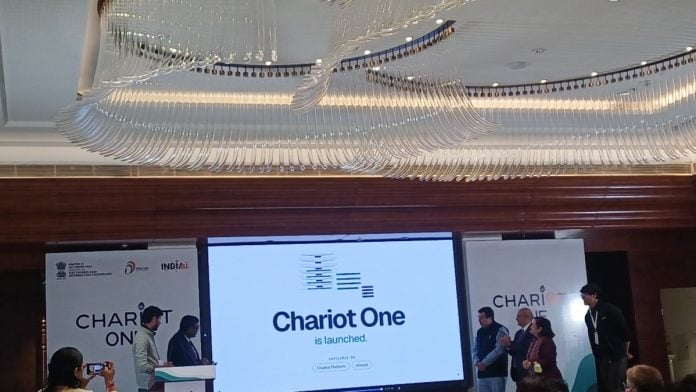
“Based on what Sarvam has told us, based on the experience that people have, we do not see any misuse of the support, which the IndiaAI Mission has provided to Sarvam in the service that they are now offering,” Krishnan told reporters on the sidelines of the launch of Chariot One, the audio native model developed by the Indian AI frontier lab Chariot.
Last week, Sarvam launched Token Factory, an inference platform that offers several AI models through a single API and runs them on computing infrastructure in India. The platform lists Sarvam’s own model alongside open-weight models such as DeepSeek, Kimi, GLM and Google’s Gemma.
Users on social media questioned why a company chosen to build India’s sovereign AI model was selling access to Chinese models. Co-founder Pratyush Kumar said Token Factory runs on GPUs the company bought itself, without government support. The company has also said its subsidised compute under the IndiaAI Mission ended in March 2026.
Krishnan said that Sarvam had built a 105-billion-parameter model and other models with support from the IndiaAI mission, and that the government is “continuing to support them as they work towards a 1 trillion parameter model”. Sarvam, he said, had told the ministry it planned to build a “harness” that combines several open-source and open-weight models, including its own, to sell AI services to Indian customers.
“I don’t think there is any contradiction between what they are doing for the IndiaAI Mission and working towards the frontier model which will come in due course,” Krishnan said, adding, “After all, AI companies also require a revenue model.”
In July, Sarvam said it was building a trillion-parameter model from scratch in India. It said the model should be ready within six months.
Krishnan said other startups have approached the ministry with similar harnesses. He added that the government uses such services internally, built on open-weight models, “because what it ensures is that the data does not leak out of the country”.
He also said the IndiaAI Mission now needs to move from subsidising compute for training models to supporting inference, the cost of running models for users. “So far what we have provided for is training access. Now we need to shift towards how we can support inference,” he said, adding that the ministry would have to work out a scheme for it.
Also Read: Design, develop & deploy: Sarvam signs 5-year MoU with MoD to build AI for Army, Navy, IAF
Chips and US curbs
Asked about trust in the supply of AI chips, Krishnan said that IndiaAI Mission’s compute platform had never relied only on Nvidia GPUs and also offers AMD and other chips. He said the latest US export controls were “mainly targeted at China” and had no significant impact on India. “The restrictions on supply of chips to data centres is not to Indian data centres, and I think India is seen as a trusted partner,” he said.
Complying with the interim final rule (IFR) issued by the US Commerce Department on 16 November, which took effect on 19 November, exporters now need licences to ship advanced AI chips to Singapore, Indonesia, Brazil, Malaysia and Thailand. Data centres anywhere that use US chips above a set computing threshold also need a licence to serve companies based in China or Macau. That includes data centres in India.
Krishnan said he was in the Bay Area last week, where India signed the San Francisco Declaration and was recognised as a founding member of Pax Silica. India and nine other countries signed the declaration on 15 November. India joined the US-led Pax Silica initiative in February, during the AI Impact Summit in New Delhi.
Semiconductors, exports
More than 200 companies have registered on the ISM 2.0 portal and are preparing applications, Krishnan said. Only applications that are complete in every respect will be considered. Union Minister Ashwini Vaishnaw launched the portal on 6 November. The second phase of the semiconductor programme has an outlay of Rs 1,27,500 crore.
Krishnan credited the Electronics Components Manufacturing Scheme (ECMS) for the rise in exports. According to data from the Ministry of Commerce, electronics exports rose 44 percent to $31.97 billion in April-September. Smartphone exports rose 35.8 percent to $18.17 billion over the same period.
In his remarks Wednesday, the MeitY secretary also said the AI regulation paper was in its final stages: “We’ll bring it out shortly.”
In October, Vaishnaw had said MeitY would publish a consultation paper on regulating AI within a month. Krishnan said the government has not set up any committee on the existential risks of AI, but keeps track of how the debate is developing.
(Edited by Amrtansh Arora)
Also Read: India has built a sovereign AI model. Almost everything underneath is rented