




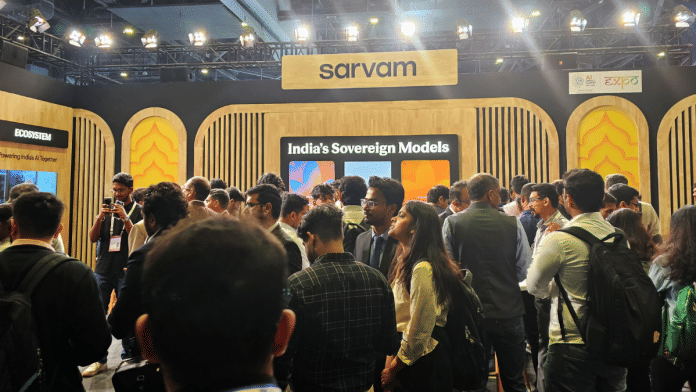

In February 2026, in a hall in Delhi, India unveiled its sovereign artificial intelligence models. Sarvam, the company the government had chosen to build the country’s own foundation model, released two of them, trained on Indian languages and Indian data by an Indian team using Indian government compute, and made available for anyone to use. Some of the most powerful people in global AI were in the room. It was a real achievement, and it deserved applause.
But here’s the part the applause skipped over.
Every one of those models was trained on roughly 4,000 Nvidia chips that India cannot manufacture. Those chips carry memory made by three companies, none of them Indian. They are designed with software from two companies in the United States, etched by machines from a company in the Netherlands, and packaged by one company in Taiwan. The model at the top is genuinely sovereign. Almost everything underneath is rented.
Sovereignty in layers, where it matters
Sovereignty in AI is not something a country either has or lacks. It is a property of each layer of a very tall stack, and it inverts as you go down. The layer that earns the headlines, a national model, is the cheapest to reach and the least decisive. The layers that actually determine a country’s fate — memory, chips, and the machines that make those chips — sit at the bottom, where almost no one can build and the suppliers shrink toward one. You can cook a sovereign dish. Owning the kitchen and growing the ingredients is another matter entirely.
Consider who controls the tap. Two companies dominate the frontier of AI chips: Nvidia and AMD. Both design their chips in the United States and manufacture them in Taiwan. And access is a lever. As of early 2026, Nvidia’s most capable exportable chip can be sold to China only under a managed arrangement, with 25 per cent of every sale routed to the US government, licences granted case by case, and a volume cap. Read that again. Access is not blocked. It is metered, licensed and priced, and the terms can change with a policy memo. Whoever controls the tap sets the terms of your AI programme.
This is the uncomfortable fact beneath the whole enterprise. The leverage over the deep layers of AI sits overwhelmingly in one place. It is not that a single country controls the world, but that the chokepoints cluster in one bloc, with the US at its enforcement center, able to reach through its allies. It meters the chips. It reaches into the Netherlands and Taiwan because their crown-jewel companies operate inside an allied control regime whose rules can extend even to foreign-made goods built with American tools. It owns the chip-design software outright. Dependency, in other words, is latency. It sits there quietly, costing nothing, until the day someone decides to turn it into leverage.
India has already seen a version of this. In 2025, a major American software provider abruptly suspended services to a large Indian company to comply with foreign sanctions that did not legally bind the company itself, freezing the firm’s day-to-day operations until a court stepped in. The dependency had been invisible right up to the moment it was used.
Sovereignty at any layer is meaningless if the layer beneath it can be withdrawn. A country’s independence is set by the least substitutable link in the chain, not by the model it announced at the top.
That may sound like a counsel of despair, but it’s not. No country needs to own every layer. There is a difference between running AI and building it. Running models at home, on imported or diversified chips, is far more achievable than manufacturing the frontier from scratch. For a nation’s daily needs, it may even matter more. India’s own semiconductor programme has, sensibly, aimed at packaging and assembly first, leaving a leading-edge fabrication plant—a ten-year, multibillion-dollar undertaking—for later. The goal is not to make everything, but to make sure nothing essential has only one owner.
Why India hasn’t joined the race
There is a demand-side twist worth naming, because it explains India’s caution. An Indian company that set out to build a frontier model would compete against the free tiers of the American labs and every Chinese open-weight release, all at or near zero price. No investor funds one of the most expensive artifacts in technology into a market where world-class substitutes are already available for free. China’s own frontier labs grew behind a large, effectively protected home market.
India runs an open one, with no such shelter. So India has, rationally, competed higher up the stack, where its languages, data, and vast services industry give it a real edge. Whether that restraint is wisdom or merely a habit of sitting out every hard race is a fair question, but the economics are not in doubt.
India has, in fact, lived this lesson already, in a different commodity: oil. Before February 2022, Russian crude was about 2 per cent of India’s imports. Steep discounts turned Russia into India’s largest supplier within a year, and then, after Washington sanctioned Russia’s two biggest oil firms in late 2025, Indian refiners pulled back and Russia’s share fell below a quarter. India now buys crude from around 40 countries, and the old OPEC bloc’s share recently hit its lowest level ever recorded. The single lesson every analyst draws from it is the one that transfers directly to AI: strategic autonomy is the ability to change suppliers without being punished for it.
But diversification has a floor, and this is where oil and chips part ways. Oil is fungible; there are 40 countries to buy it from. The deep layers of AI are not. There is just one lithography supplier, three high-bandwidth memory makers, and one dominant fabrication plant. You cannot diversify a monopoly. You can only build it yourself or do without. You diversify where a layer has many suppliers, at the top, the models, the clouds, and to a degree the chips. You build where the layer is a monopoly, which is exactly where India’s realistic ambitions should sit, in packaging, in assembly, and in chips tuned for its own languages, rather than in a leading-edge fabrication race it would lose.
Build support with an exit plan
Which leaves the hardest question: funding. If the problem is money, one fix is for the government to become the customer, promising to buy Indian AI for its own offices and public services so that investors finally have a reason to fund it. That is roughly how China did it, by shielding its home market and letting its own labs grow inside it.
But India has tried shelter before, and it went badly. For decades after Independence, India protected its industries from foreign competition, and they simply stopped improving. Cars, phones, everyday goods stayed dated and scarce, and that long stagnation helped push the country into the 1991 crisis. Protect an industry too much and you get a company that survives only because the state keeps buying and keeps rivals out, and would collapse the moment either stopped. That is not strength. It is dependence wearing a national flag, which is the opposite of sovereignty. So the support must be built to end. Help the industry get on its feet, set a firm date when the help stops, aim it only where India can compete, and never turn it into a permanent wall.
None of this is a case for cutting the country off. It is a case for building the capacity to stay open without being exposed, to keep more than one supplier for anything that could halt the nation, and to own outright the few layers whose loss would be fatal. You can cook without owning the farm. But a kitchen that grows none of its own ingredients is one closed border away from going dark. Real sovereignty is farming the few layers you cannot live without and being honest that you will keep buying the rest.
The winners of this decade will not be the countries that cooked the best model. They will be the ones that made sure no one could ever close their kitchen.
Kiran Gajendra is a US-based network and security architect, interested in technology, AI infrastructure, and geopolitics. Views are personal.
(Edited by Prashant Dixit)
It’s completely unnecessary to draw your attention to the use of AI in crafting your ideas and polish your writing. Do yourself a favor take the opportunity to read the content and expand your knowledge.
Fair to be skeptical, there’s a lot of low-effort AI content around. For what it’s worth, the argument, the research, and the framing here are mine, drawn from my day-to-day work in network and datacenter infrastructure. I do use AI tools to help tighten the language, and I’m upfront about that. Happy to discuss any specific point in the piece on the merits. I’d rather be judged on substance. Is there a point in the piece you think is wrong or overstated? That’s the conversation worth having.
thanks for writing an completely AI generated article using Foreign Models. At least do some work , nowadays can smell AI generated content from a mile.