



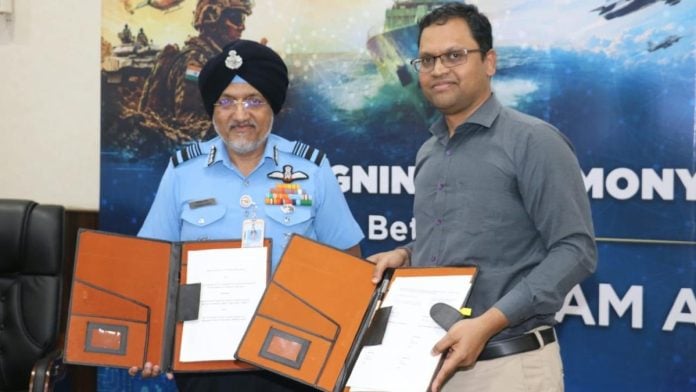
New Delhi: Bengaluru-based AI company Sarvam has signed a five-year memorandum of understanding (MoU) with Headquarters Integrated Defence Staff (HQ IDS), Ministry of Defence, setting up an umbrella framework for artificial intelligence projects across the Indian Army, Navy and Air Force.
HQ IDS announced the MoU on 26 October, and the company made it public Tuesday. In a post on X, the defence ministry said the two sides would collaborate “on AI applications, research, knowledge management, training and decision-support” across the three services.
HQ IDS was set up in 2001 following the recommendations of the Kargil Review Committee to coordinate planning and operations among the three services. The framework extends to the joint, tri-service and integrated organisations under it.
Under the pact, Sarvam will design, develop and deploy AI applications for the operational, training and decision-support requirements of the services and provide follow-on technical support, while HQ IDS will facilitate the engagement.
A significant step towards strengthening sovereign AI capabilities for India’s Defence Forces.
HQ Integrated Defence Staff and Sarvam #AI have signed a Memorandum of Understanding to collaborate on AI applications, research, knowledge management, training and decision-support… pic.twitter.com/GLKYWUDZMu
— HQ Integrated Def Staff (@HQ_IDS_India) October 26, 2026
According to the company, the services and joint organisations will get access to the same foundation models, agentic infrastructure, and geospatial and perception systems, so that doctrine and lessons from one service’s projects can feed into the next.
The focus areas are decision support, target acquisition and data fusion across the “sensor-to-shooter loop”—the chain from detecting a target to engaging it—with human oversight retained on operational decisions.
Sarvam said the AI layer would be built in India and deployed on sovereign infrastructure. Projects under the MoU include an “AI fabric” that connects the elements of India’s defence capabilities.
“Sarvam exists to build AI in India, for India,” said Pratyush Kumar, co-founder, Sarvam. He described working with the three services as “an honour and a privilege”, and thanked HQ IDS for its trust.
Neither side disclosed the financial terms, the number of projects or a timeline for deployment.
The work will be carried out by Chanakya, which Sarvam describes as its firewalled division for national security and defence. Sarvam announced Chanakya on 29 March this year, saying the team would work on on-premise deployments in air-gapped setups, multimodal data ingestion and agent-based workflows. Air-gapped systems are cut off from the internet, a requirement for classified military networks.
Chanakya will use Sarvam’s AI stack, including Sarvam 105B, a foundation model the company open-sourced in February. The model uses a Mixture-of-Experts architecture, in which only 10.3 billion of its 105 billion parameters are active at a time. It was launched at the India AI Impact Summit in New Delhi along with a 30-billion-parameter model, with support for 22 Indian languages.
The MoU builds on Sarvam’s work with a military training institution.
On 18 August, the Defence Services Staff College (DSSC), Wellington, launched DRONA 2.0, a generative AI platform for training, research and strategic studies that runs on Sarvam 105B along with open-source models.
DRONA, short for DSSC Resource Optimising Neural AI, was first launched on the college’s network on 16 June, 2025.
On 18 August, Lt Gen Manish Erry, Commandant, DSSC, launched the upgraded version in the presence of Sarvam co-founder Vivek Raghavan, and the two sides signed an MoU for further development of the platform and other AI applications. The system is hosted on a GPU server within the college’s secure network and was certified by HQ IDS and the Defence Cyber Agency after security audits.
Founded in 2023 by Raghavan and Kumar, Sarvam was selected in 2025 to build India’s sovereign AI model under the IndiaAI Mission. In June, it raised $234 million in the first close of its $300 million Series B round at a post-money valuation of $1.5 billion, with HCLTech investing $150 million as lead strategic investor. In August, it raised another $74 million from Nvidia, Activate, Glade Brook Capital and Gaja Capital to complete the round.
The company linked the latest agreement to the government’s push for ‘Atmanirbharta’ in defence and the indigenisation of defence equipment, which it said now extends to AI. The ministry’s work on military AI predates the pact: a 2019 executive order created the Defence AI Council and the Defence AI Project Agency, and an AI roadmap identifying 70 projects was drawn up for defence public sector undertakings.
Private firms have since moved into the space. According to startup data platform Inc42, 89 percent of Indian defence tech startups report integrating AI into their offerings, as demand rises for autonomous systems, surveillance and communications built in the country.
(Edited by Amrtansh Arora)
Also Read: Built in India, served in India—How unicorn Sarvam AI plans to inject its millions