



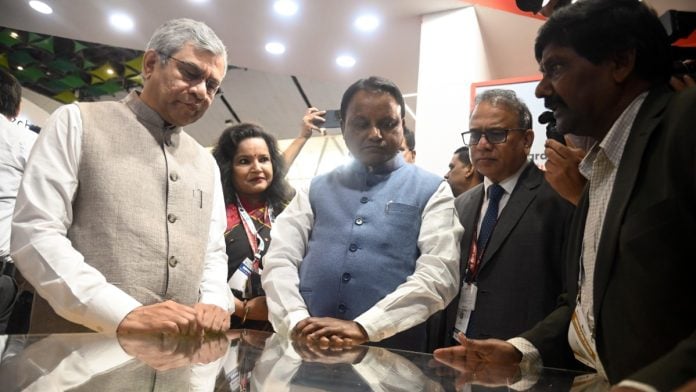
New Delhi: India will set up its first Precision Manufacturing Institute, along with a training model that will take a school-pass candidate through graded skill levels, Electronics and Information Technology Minister Ashwini Vaishnaw said Friday at SEMICON India 2026.
At a fireside chat on the second day of the conference at Yashobhoomi in Delhi’s Dwarka, Vaishnaw said precision manufacturing would act as a common base for semiconductors, mobile manufacturing, aerospace, aviation, defence and advanced electronics, with the proposed institute building the skills that all these sectors draw on.
The institute will run a five-level skilling model. The institute will run a five-level skilling model. A student who has passed high school will be able to take the first-level course spanning about 240 hours, after which the person can begin work in the sector, Vaishnaw said, adding that higher levels will build up to the standard of a B.Tech engineer.
Vaishnaw said the curriculum under Semicon 2.0 would shift from chip design towards system design, so students completing the course would be sought after by the industry. The design programme from the first phase, which runs across about 400 universities, would be upgraded to move students from chip design to systems design, he said.
The minister also said the target of training 100,000 technicians under the second phase could be raised, citing demand within the industry. Under the talent pillar, the government plans to train more than one lakh technicians, clean-room and factory-floor workers over five years through partnerships with industry and institutes, including Taiwan’s ITRI.
Under the first phase of the Semicon India programme, the government had aimed to train 85,000 design engineers over 10 years; Vaishnaw said 70,000 had been trained in four years.
The Semicon 2.0 frame
The comments came days after the Union Cabinet cleared the second phase of the Semicon India programme. Semicon 2.0 was approved by the Union Cabinet in July with an outlay of Rs 1,27,500 crore. It is built around six pillars: chip design, machines and materials, fabs, advanced packaging, research and development, and talent. The first phase was cleared in December 2021 with an outlay of Rs 76,000 crore. Twelve projects were approved under the first phase; three have begun commercial production.
On the first pillar, the government will target at least 200 chip-design startups and companies, against 105 in the first phase, of which about 20 raised venture funding worth around Rs 800 crore. Vaishnaw said the ten-fold target was set because the earlier funding rate had exceeded expectations.
He said the government had drawn up a two-decade roadmap for the sector because of its complexity, and expected the second phase to meet its targets ahead of schedule, as the first phase had finished in four years against a six-year target. “It’s like a classic S-curve. Once you are able to move on, initially you have to put in a huge effort. But then once that momentum begins, then the effort is much less,” he said.
Asked about risks, Vaishnaw pointed to debt in developed economies, saying a disorderly unravelling of accumulated global debt in the rich world could affect investments due to come in.
Turnout, MoUs, AI
The minister said the second day drew more than 16,000 students, with 48,000 registered across the event, and that MoUs and purchase orders had been signed.
He said feedback from country roundtables had raised issues on customs, transportation and permissions, which the government would work on with the industry. Large contingents came from Japan and Singapore, with Western countries also participating, he said.
On the sidelines, Vaishnaw said the government was working with the industry to find a regulatory approach for artificial intelligence, arguing that the technology’s user-safety dimension made regulation necessary alongside its benefits.
SEMICON India 2026, on the theme “Silicon to Systems: Building the Ecosystem,” runs until 19 September and has drawn more than 600 companies and delegations from over 50 countries.
(Edited by Amrtansh Arora)
Also Read: 6 pillars, 12 yrs & $13.5 bn outlay—Modi launches 2nd phase of chip mission at SEMICON India