



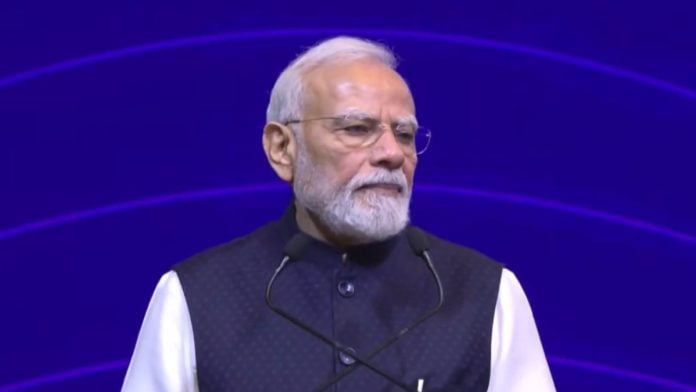
New Delhi: Prime Minister Narendra Modi Thursday launched the second phase of India’s semiconductor mission at SEMICON India 2026, raising the outlay to $13.5 billion from $8 billion and allowing foreign firms to partner with Indian startups, design houses and OCI-owned entities.
Opening the three-day conference at Yashobhoomi in Delhi’s Dwarka, Modi placed the chip push within a run of September milestones—the BRICS summit’s New Delhi Declaration, 7.8 percent GDP growth in the April-June quarter, the Global FinTech Fest in Mumbai and the commissioning of about 3,000 km of the Dedicated Freight Corridor. “SEMICON India being held amid such major achievements is another significant milestone,” he said.
On the semiconductor mission, Modi said: “India has launched the second phase of its semiconductor mission. While the first phase was valued at approximately $8 billion, we have set a target of $13.5 billion for the second phase.” He said the government had eased the rules. “Now, international companies can collaborate with our startups, Indian design firms, and OCI-owned entities. Whether it concerns policy, funding, or the regulatory framework, the Government of India is taking every necessary step to ensure the success of your projects,” he said.
The first phase, launched in December 2021, had an outlay of Rs 76,000 crore. The second, Semicon 2.0, cleared by the Cabinet in July, is budgeted at Rs 1,27,500 crore and runs over 12 years, against five for the first. Modi said the government wanted fabless firms—companies that design chips but do not manufacture them—to grow in India, and for intellectual property to be created in the country.
He traced the mission across editions of the conference: “Last year, we initiated discussions on pilot lines and test chips…and this year, we are talking about commercial production.” Three units approved under the first phase (Micron, Kaynes Semicon and CG Semi) have begun commercial production, so far in assembly, testing and packaging rather than wafer fabrication.
The Prime Minister’s address came alongside a set of investment announcements. Applied Materials—the US-based supplier of equipment, software and services used in semiconductor manufacturing—said it would invest $5 billion in the country over the next decade under a plan it called India Vision 2035, setting up a 140-acre research park and growing its India-based supply-chain capacity tenfold by 2035. “Inventions done here must scale globally,” said Prabu Raja, president of its Semiconductor Products Group.
Lam Research, the US-based firm supplying wafer-fabrication equipment and related services, said it would invest about Rs 10,000 crore to build its first silicon component manufacturing facility in India, covering silicon ingot production and processing for leading-edge chip nodes. “Lam Research plans to invest approximately Rs 10,000 crore in India to establish our first silicon component manufacturing facility,” CEO Sesha Varadarajan said.
Tata Electronics said it would sign 16 Memorandums of Understanding (MoUs) at the conference, its CEO Randhir Thakur said. The agreements involve suppliers across the value chain, including Nexperia and Besi from Europe; JSR, Fujifilm, Sumitomo, Sojitz and Ajinomoto from Japan; Kelington from Malaysia; Ascendas First Space from Singapore; and domestic firms such as L&T Semiconductors, Inox Air Products, the Semiconductor Laboratory and Gati Shakti Vishwavidyalaya. They follow an earlier agreement with Dutch lithography firm ASML, signed in May, for a front-end fabrication plant in Gujarat.
“The real beneficiary of the India Semiconductor Mission is this country’s youth. The factories we are building today will become your workplace tomorrow,” Thakur said, adding that Tata Electronics had created more than 1,50,000 direct jobs, with women making up 65 percent of its workforce.
Micron CEO Sanjay Mehrotra said the company would scale up assembly and testing at its Sanand plant in Gujarat, the first project under the mission and India’s first semiconductor assembly and test facility. “For decades, people have talked about India’s semiconductor potential…Potential does not ship products. What I see in India today is execution,” he said. Micron, in India for seven years and employing more than 7,000 people directly, said its output already exceeded the memory needed for India’s laptop market. “This year, we will assemble and test 10s of millions of chips at Sanand. Next year, hundreds of millions of chips,” Mehrotra said.
Ajit Manocha, president and CEO of the industry body SEMI, said the sector was set for “unprecedented exponential growth” and called India indispensable to the global chip supply chain.
Union Minister for Electronics and IT Ashwini Vaishnaw set out the second phase, built around six pillars: chip design, machines and materials, fabs, advanced packaging, research and talent. “In SEMICON 2.0 we would be targeting at least 200 startups and companies which design chips in India,” he said. He said 105 startups had taken part in the first phase, with about 20 receiving venture capital funding of around Rs 800 crore, and that a 3D packaging unit was coming up in Odisha. On training, he said India had trained 70,000 design engineers in four years against a 10-year target of 85,000, and that the second phase would target one lakh factory-floor and clean-room workers.
The fifth edition of SEMICON India, held from 17 to 19 September under the theme “Silicon to Systems: Building the Ecosystem,” is organised by the India Semiconductor Mission, MeitY and SEMI, with more than 600 companies from 52 countries taking part.
India imports close to 90 percent of the chips it uses, at an estimated $30 billion a year, and the government projects domestic demand rising to $200 billion by 2035.
(Edited by Amrtansh Arora)
Also Read: Indira Gandhi, Zail Singh and a fire in Mohali—the story of India’s chip dream that almost was