




India is in catch-up mode in the global semiconductor race. New projects are cropping up from shore to shore, with Gujarat, Tamil Nadu, Karnataka and Assam emerging as the country’s semiconductor manufacturing hubs.
And yet, the journey isn’t entirely new for India.
Long before the chip wars dictated global foreign policy, and decades before Taiwan, China and South Korea transformed into semiconductor titans, India had already dared to tread this path.
And then, in 1989, that dream went up in flames. Literally.
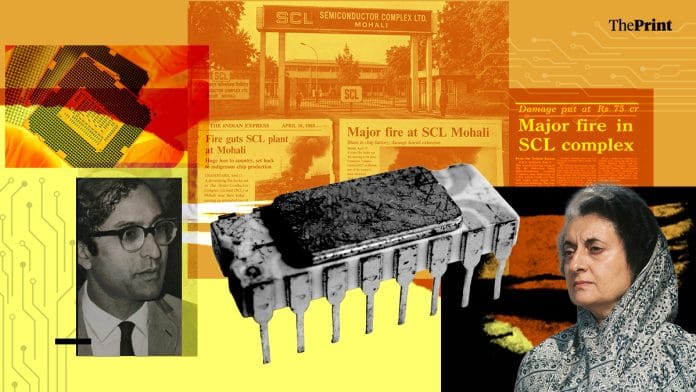
On a cold night in the suburbs of Mohali in Punjab, a massive and mysterious fire ripped through the Semiconductor Complex Limited (SCL) – India’s state-of-the-art chipmaking facility. The unit was gutted, leaving behind a trail of questions.
What caused the fire? Was it an accident? Or sabotage? Or was there a foreign hand in play? The questions have refused to entirely die — nearly four decades on.
But perhaps the more pressing question was: did India miss the semiconductor bus that night?
What preluded it was a dream – a dream of a modern, prosperous and self-reliant India. And it all began in a very different India — younger, poorer and hungrier. India was eyeing a tryst with technology, building on what Jawaharlal Nehru called the “temples of modern India” — made of concrete, steel, silicon and codes.
Somewhere in that quest for atmanirbharta, a bold idea took root – could India make the tiny pieces of silicon that would power the future?
Tryst with technology
It was a time of India’s quest for technological modernity.
Computers arrived on Indian soil as early as 1955 when Calcutta’s Indian Statistical Institute installed an HEC-2M (Hollerith Electronic Computer 2M) It took two months to install and was reputed to be Asia’s only computer outside Japan, wrote Shankkar Aiyar in Accidental India. The 1960s brought the Homi Bhabha and Narasimhan committees, charting grand roadmaps for electronic self-sufficiency. The foundations of the Department of Electronics followed in 1971.
But in the wake of the disastrous 1962 war with China, India’s technological requirements morphed into a strategic imperative too — electronics was far too vital to rely on foreign imports.
And somewhere in this ferment, India’s semiconductor story began.
In the 1960s, a handful of Indian companies were already making germanium semiconductors. After the 1962 war, Bharat Electronics Limited (BEL) set up a fab to manufacture silicon and germanium transistors, wrote Andreas Kuehn and Trisha Ray in Cutting-Edge Technologies in Developing Economies: The Case of India’s Semiconductor Industry.
Then came India’s first tragic “what might have been” moment.
In the early 1960s, long before Taiwan or China were on the global tech map, Silicon Valley pioneer Fairchild Semiconductor eyed India for its very first Asian assembly plant. But the opportunity slipped away. Fairchild eventually chose Malaysia.
Whatever it was — bureaucratic lethargy, a paranoia of foreign technology, or an overt pride in atmanirbharta — the result was a tragic missed opportunity.
While the world buzzed with these microchip wonders, India was watching closely.
Ashok Parthasarathi, scientific adviser to Indira Gandhi, recalled in Technology at Core that there was already an understanding within the department that microchips would soon become the “basic building blocks of all electronic hardware.” The coming decade, they realised, would belong to highly sophisticated large-scale integrated (LSI) circuits.
India could either prepare or be left behind.
India had some pieces already. At the Tata Institute of Fundamental Research, Professor K.V. Ramanathan was leading R&D on LSI circuits. At CSIR’s lab in Pilani, scientists were pushing similar frontiers. But these were still laboratory-scale efforts. And the leap from laboratory to industry would not be easy.
By mid-1975, the DOE took the proposal straight to the Cabinet that – India needed a dedicated government-backed enterprise for chip manufacturing and R&D. But there was a caveat – India could not do this alone. It desperately needed foreign technology and know-how.
Prime Minister Indira Gandhi acted. And in 1976, the Cabinet approved the creation of SCL.
Against all economic logic, a fragile, cash-strapped nation was about to enter the silicon race. The grand puzzle pieces were finally falling into place.
But first, it had to answer a deceptively simple question: where?
Also read: What it really takes to build an Indian Silicon Valley
The battle for Mohali
For a facility this sophisticated, even dust mattered. The site needed technical talent, a surrounding orbit of universities, R&D institutions and the right environment. To find this mythical site, the Department of Electronics set up a high-level committee chaired by BEL chief C.R. Subramaniam.
After deliberations, two contenders remained: Madras and Mohali.
On technical grounds, Madras was the clear favourite.
However, this high-tech national project was about to become entangled in a domestic political tug-of-war: where, exactly, would this symbol of technological ambition take root?
The file was sent to the PM’s Office. But weeks passed, and no response came. Finally, Parthasarathi went to see Indira Gandhi himself. She had already read the file. But there was a problem.
“I know all that you are telling me. I have read the note carefully and also thought about it, but Zail Singh is putting a lot of pressure on me to locate the plant in Mohali,” said Gandhi. Having said that, Gandhi sent Parthasarathi to plead his case with Giani Zail Singh, the future President of India.
In Punjab, Parthasarathi made his case. SCL was highly capital-intensive, he argued, but would create little local employment, even among skilled workers. Its senior scientists and engineers would have to be recruited nationally, some even brought back from abroad.
If Punjab needed jobs, he suggested, build a television-receiver assembly plant instead.
Zail Singh was unmoved. His argument was almost the reverse – put a major high-technology company in Punjab, and other high-technology companies would follow.
Defeated, Parthasarathi returned to Delhi. Gandhi then tried to make one last attempt and said, “Let me see if I can persuade him to be reasonable.”
A fortnight later, however, the file came back from the PMO. A decision was made. Madras lost to Mohali. SCL would be built in Mohali, Punjab.
For Punjab, it was a crown jewel – and its pride soon crossed party lines. The Shrimoni Akali Dal in Punjab under the new Chief Minister, Parkash Singh Badal, was one of them.
On 2 March 1979, speaking in the Punjab Vidhan Sabha, Badal took a fiery jibe at the Congress government that had ruled the state for three decades.
“How many big industries have you set up in Punjab?” he challenged the “Congress brothers”.
Then he unveiled “his” crown jewel.
“We are setting up a semiconductor complex factory in Mohali at a cost of Rs 16 crore.” And to anyone still doubting the project, Badal replied, “I want to tell Sardar Umrao Singh ji that that factory is not going anywhere and that factory is standing in Mohali.”
Just as for Zail Singh, for Badal too, SCL was more than a factory. It would bring new technology to Punjab and, he said, “the wave of industry will spread in villages and cities.”
However, in 1977, the Janata wave swept Indira Gandhi out of power. And SCL, along with India’s semiconductor ambitions, slipped into a two-year hiatus. Only when Gandhi returned to power in 1980 did the dormant project stirred again. And this time, India was ready to look beyond its borders.
Also read: Why India’s manufacturing-first approach to semiconductors is unsustainable
The search for a partner
The idea was to find a partner, learn from those who had already got their hands dirty with the booming technology, and bring that know-how home.
After months of homework and preliminary studies, three countries and six companies made the cut. Telexes flew out. Four companies responded, and three were eventually shortlisted: Hitachi of Japan, American Microsystems Inc. (AMI) of Silicon Valley and Solid State Devices Ltd. of Boston.
In August 1980, a delegation led by Ashok Parthasarathi and Virendra Mohan landed in Japan to pitch Hitachi’s head of semiconductors, Ishikawa Asano. India’s ask was simple, yet bold – a 5-micron LSI manufacturing line for watches, clocks, and telecom chips.
Asano listened patiently, then smiled and said, “Those are ambitious targets for a company and that too for a company in a developing country to aim for.”
What followed were three gruelling days of negotiations.
Hitachi kept adding conditions. One step at a time – became the rhetoric. Telecommunications chips were off the table. The price: $10 million, plus a 5 per cent royalty on sales for ten years.
Parthasarathi pushed back and said, “You underestimate us, Mr Asano. The senior-most member of our team, Mr Virendra Mohan, has fifteen years of experience in the semiconductor area.”
It did not change Hitachi’s position and Asano didn’t budge. So, the next stop was California.
American Microsystems Inc, already boasting a $300-million turnover, proved far more receptive. On the very first day, AMI offered SCL access to any number of circuits from its portfolio of around 100, and proposed joint development of new LSI circuits.
It was almost exactly what India wanted. By the second day, the two sides had signed a comprehensive MoU for technology licensing.
But there was one more thing on Indira Gandhi’s wishlist: bring home Indian semiconductor talent from Silicon Valley. Following secretive hotel-room interviews across Silicon Valley, five Indian scientists agreed to return home and build their homeland’s silicon future. Gandhi was thrilled.
Also read: 6 scientists, 120 research papers, 1 big bet—this IISc startup aims to put India on GaN map
The dream came alive
For a project that had begun as a bold idea on paper, things were suddenly moving. And it was not going to be a cakewalk. Back in Delhi, the first hurdle came in the form of cost escalations. The costs had ballooned from the original Rs 16 crore estimate to Rs 55 crore. On 10 October 1980, the Cabinet approved the revised estimate and the AMI tie-up.
The next big task was obtaining a US export licence – in the looming clouds of cold war politics.
American reluctance to share sensitive technology with India was hardly new. Kuehn and Ray wrote that the suspicion ran both ways. As US ambassador Stephen Grady put it, “Indian friends seemed to think American know-how can be shipped to them in sealed cases laid down at Indian ports.”
But the geopolitical winds were shifting. Indira Gandhi was seeking to “start afresh” with Ronald Reagan’s America, while India was recalibrating its relationship with Moscow after the Soviet invasion of Afghanistan. India’s ambassador to the US, Shankar Bajpai, was asked to make the case directly to the American side. And the gamble paid off.
On 15 November 1980, the export licence for AMI was issued.
What followed was a sprint. In just 20 months, a state-of-the-art facility rose in the Mohali countryside – a 4-inch wafer fab, mask fab, assembly, testing systems, and dedicated R&D wings. Much of the equipment came from the US.
By October 1983, the unthinkable happened. SCL Mohali was finally alive. A dream that began in committee rooms and cabinet notes now found a physical address – and India was about to make its own chips.
And it was surprisingly good at it.
The first microchip rolled out of SCL was a five-micron CMOS chip for telephone dialling, made with technology licensed from AMI. By 1982, SCL was designing and producing a full family of LSI chips for analogue clocks and watches. By July 1984, two dedicated production plants were humming inside the complex, assembling Electronic Circuit Blocks (ECB) for watchmakers – HMT and Allwyn.
Then came chips for the DRDO, BEL and Bharat Dynamics, and computers under the CLASS programme.
At this moment, India was no longer playing catch-up. It entered the semiconductor race and was in fact – not far behind the world’s best. Through in-house R&D, its engineers moved from five-micron technology to three, two and then 1.2 micron. The world’s leading fabs were only one generation ahead, at 0.8 micron.
Taiwan’s TSMC had barely begun its operations in 1987. And China was far from the race. At this moment, India, in fact, seemed ready to become Asia’s semiconductor powerhouse.
Until the night of 7 February 1989.
Also read: India began manufacturing chips in 1984. Modi wants to rewrite yet another history for applause
A dream in flames
Without warning, the sky over Mohali turned blood-red hue. It was at 11:40 pm.
By morning, India’s most ambitious semiconductor experiment lay gutted. The Tribune’s 9 February front page carried the grim verdict: “Major Fire in SCL Complex. Damage put at 75 crores.”
The scale of the blaze was overwhelming. The Indian Express reported that 15 fire tenders from the Army, Air Force and neighbouring districts battled the flames. The fire was brought under control only around 7 am. The complex, however, continued to smoulder.
So did the questions. When SCL CMD Virendra Mohan was asked whether it could have been sabotage, he replied, “Nothing can be said at present.”
On 1 March, Science and Technology Minister KR Narayanan told Parliament that the fire had caused extensive damage to the device manufacturing facility and R&D area. The administration and computer-aided design buildings had survived. There were no casualties. But of SCL’s roughly 850 employees, nearly half had been affected in terms of employment.
The government scrambled to keep its highly trained engineers from scattering. SCL even had to import semiconductor devices worth Rs 3 crore to meet existing commitments.
And then came the question everyone wanted answered: what had caused the fire?
An inquiry was constituted under Major General SA Mohile. But the cause was never publicly settled. Parthasarathi later wrote that the “fire started somewhere in the mezzanine floor possibly due to an electric short circuit which spread all across the plant…”
And then there were questions of sabotage. Former Union Minister Jairam Ramesh told ThePrint that many in the strategic community harboured deep suspicions.
“There were a lot of people in government who believed that the possibility of deliberate setting fire to SCL cannot be ruled out 100 per cent.”
These suspicions, however, had fertile ground. Punjab was then in the grip of militancy, violence and administrative breakdown.
Whatever the truth, the damage was real. Years of investment, political capital, painstaking technology transfer, indigenous R&D and the astonishing climb from five-micron to 1.2-micron technology had been reduced to ashes in a matter of hours.
Several recovery attempts were made. In June 1990, The Indian Express reported Cabinet approval of a Rs 180-crore reconstruction project. Parthasarathi later put the eventual approved outlay at Rs 332 crore. While waiting to rebuild, SCL outsourced its foundry operations to M/s Austrian Mikro Systems (AMS) in Austria to fabricate Indian designs abroad.
The rebuilt VLSI facility was finally inaugurated by Prime Minister IK Gujral on 17 December 1997; commercial production began in 1998 – eight years after the fire. But in a rapidly evolving industry, eight years is an eternity.
But semiconductors wait for no one. By then, the world had moved on. And India somewhere, missed the bus.
SCL never quite regained its old momentum, or its glory. Its role narrowed, serving strategic and defence needs, with ISRO emerging as its foremost customer. In 2006, it was moved under the Department of Space and rechristened Semiconductor Complex Laboratory.
Also read: What is ISM 2.0 launched by Sitharaman to boost India’s semiconductor sector?
The decade India lost
India had started early. By 1989, SCL was only a couple of generations behind the world’s leading fabs. But keeping pace in a technology that evolves continuously requires huge capital and constant upgrades. India had neither in abundance.
“We did not have a very well-crafted policy like ISM 1.0 where everything was black and white,” says Dr Satya Gupta, president of the VLSI Society of India. International companies wanted certainty, but India’s case-by-case negotiations offered little of it. And the private sector was not yet ready for the plunge, says Gupta.
The result was a chain of missed opportunities.
India’s semiconductor story was never short on ambitions, says Jaswinder Ahuja, MD, Cadence Design Systems, India, and adviser to the India Semiconductor Mission. The problem, however, was that ambition repeatedly ran into an industry that was changing faster than India’s policy could keep up.
“None of those policy frameworks or incentive frameworks were good enough,” says Ahuja. Early policies expected private players to shoulder the entire cost. Later the government offered support, but largely as reimbursement. “For an industry where projects take years to become viable, it was hardly enticing.”
And while SCL smouldered through reconstruction, bureaucratic delays and indecision, another technology was quietly offering India a much easier way in – software.
“We lost a decade, you know, almost a decade,” says Jairam Ramesh. “But it was that decade in which we were having extraordinary success in software. So, we didn’t feel the urgency on the hardware front, on the FAB front.”
The geopolitical climate didn’t help. This was the era of strict export controls and equipment transfer denials. In the mid-1980s, Washington denied India the supercomputer it wanted. Rajiv Gandhi’s government responded by establishing C-DAC in 1988, eventually producing the PARAM 8000.
Hardware was simply harder. Licensing restrictions, technology-transfer controls and astronomical costs stood in the way. Software had far fewer barriers.
“The barriers to global entry on software were much lower than the barriers to entry in hardware production,” Ramesh says. “Software was a relatively low-hanging fruit to pluck.”
And India had all the right ingredients: skilled workforce, competitive wages and a useful time-zone advantage.
“America was sleeping, India was working. So, we were situated in a very good time zone,” Ramesh recalls. When tech giants Texas Instruments and GE arrived in Bangalore in 1987-88, India’s IT story began to take off. Even as liberalisation arrived in 1991, India continued exploring semiconductor possibilities.
“Intel was one of the companies that we were in touch with in the 1990s,” Ramesh says. AMD was also in the conversation. India, however, was already falling behind Asian manufacturing.
“We had a combined handicap,” says Ahuja. “No technology, no capital, and the lack of an ecosystem.”
Then the world changed. COVID-era supply-chain disruptions and intensifying geopolitics turned semiconductors from an industrial ambition into a strategic necessity.
“Nothing will work without semiconductors,” says Gupta – from defence and aerospace to automobiles and AI.
That urgency finally produced ISM 1.0: a policy architecture bringing manufacturing, design and talent development under one umbrella. Through initiatives such as Chips to Startup, more than 400 Indian academic institutions now have access to state-of-the-art EDA software, says Gupta.
That, Ahuja argues, was the wake-up call. It finally acquired the urgency – and a policy framework willing to share the risk.
But there is no pretending the old dependence has vanished. “Today, for example, we are fully reliant on foreign partners for technology,” says Ahuja. That dependence cannot simply be wished away. “What they did was relevant at that point in time,” says Ahuja. “We cannot just mimic what they did and expect to achieve success.”
The way forward is not to recreate Taiwan in India. “We have to carve our own strategy and execute on that. And that’s, I think, what’s embodied in ISM 1.0 and ISM 2.0,” says Ahuja.
(Edited by Prashant Dixit)