



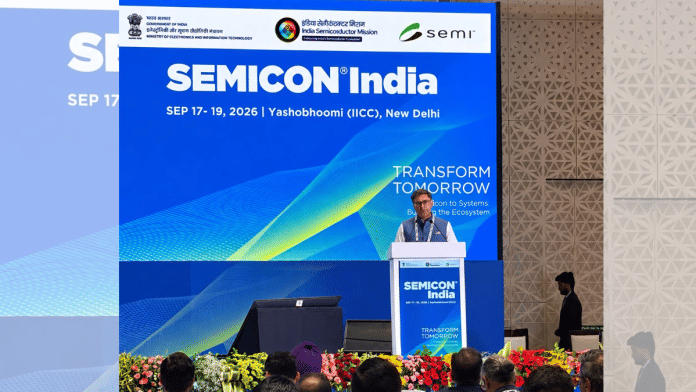
New Delhi: India does not need to control the entire semiconductor supply chain within the country to become self-reliant in semiconductors, Foreign Secretary Vikram Misri said Friday.
“Self-reliance does not mean building everything within our own borders. No nation on earth does that, and no nation should try,” Misri said in a keynote address on international collaboration at SEMICON India 2026. Such an attempt, he said, “would mean higher costs, slower innovation, and a lonelier industrial base”.
The term, “properly understood,” meant “knowing exactly where our capabilities and our capacities must be sovereign and building it with discipline, and where a trusted partnership serves us better and pursuing that with equal discipline,” he said. For India, this called for “an honest audit of both columns” — building indigenous strength in “design, packaging, and the specific manufacturing steps where our advantage is real,” while inviting equipment makers, material suppliers and design houses to build alongside.
Misri was speaking at the fifth edition of the event, being held from September 17 to 19 at Yashobhoomi in New Delhi under the theme, ‘Silicon to Systems: Building the Ecosystem’.
“A handful of countries, sometimes a single one, account for most of the world’s rare earth processing and advanced node manufacturing,” he said. “One credible source is a single point of failure, and therefore an eminently avoidable situation.” Concentration, he added, was “worth diversifying away from, not out of suspicion, but as good industrial practice”.
China announced its first round of export restrictions on heavy rare earth elements and permanent magnets in April 2025, disrupting defence, semiconductor and automotive supply chains, and expanded the controls in October before agreeing to a one-year suspension.
It refines an estimated 85 percent of the world’s rare earths and produces the bulk of high-performance magnets. No other country currently has the capacity to replicate its integrated supply chain. Advanced-node chip fabrication remains concentrated in Taiwan.
“The race to the technological frontier is now a shared national project, an opportunity for companies, not just a contest between states,” Misri said, citing the US’ commitment of over 50 billion dollars through its Chips Act, China’s sustained investment in domestic capability, and Europe’s ambition to capture a fifth of global manufacturing capacity.
Micron opened a semiconductor assembly and test facility in Sanand, Gujarat, in February. presenting its first made-in-India memory modules to Dell. The Tata Electronics fab in Dholera, built with Taiwan’s Powerchip, is targeting first silicon by late 2026 at a plant designed for 50,000 wafers a month on 28-nanometre technology.
As of July 2026, 12 manufacturing projects had been approved with investments exceeding Rs 1.64 lakh crore, and the government committed a further Rs 1,27,500 crore under Semicon 2.0 to widen support into design, equipment and materials.
Equipment, speciality chemicals, wafers, gases and design technologies, continue to be sourced from abroad, and Indian engineering talent remains concentrated in services rather than product-level intellectual property. “We still depend on imported equipment and imported materials and must build fluency across regulatory environments,” Misri said.
“Look for complementarity, not duplication,” he said, urging companies to weigh predictability as heavily as price, since a slightly higher cost with a steady, predictable partner often beats the cheapest option today. He also advised firms to “invest in the relationship before you need it,” pointing to joint research, shared training and people who had worked together earlier.
(Edited by Tony Rai)
Also Read: 200 startups, 1 lakh technicians, $12 billion investment: Vaishnaw lays out Semicon 2.0 roadmap