



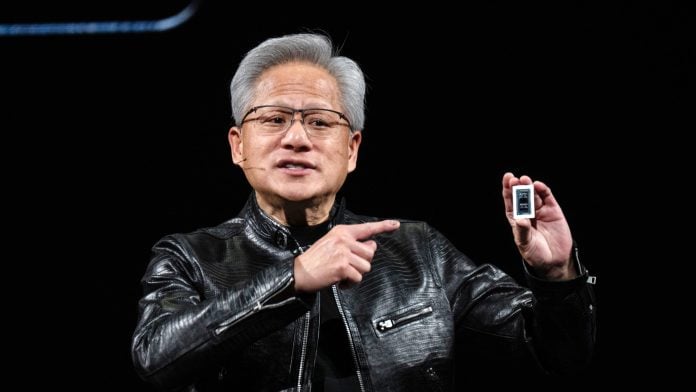
The Chinese government has signaled it may allow companies such as Alibaba Group Holding Ltd. and ByteDance Ltd to buy Nvidia Corp.’s new RTX Pro 5500 chips, The Information reported, citing people familiar with the matter.
The Ministry of Industry and Information Technology recently asked some companies to report on their plans to purchase the high-end graphics processor released this month, including how many and what they would use the product for, the Information said. The ministry told some of the firms it intends to approve the purchases, it reported.
Washington bars Nvidia’s most powerful accelerators from China, concerned they would propel the country’s AI efforts and aid the military of a geopolitical ally. The RTX Pro 5500, however, is a processor intended mainly for graphics and simulations, though it can also support AI services. Unlike Nvidia’s top-of-the-line accelerators such as the GB300 series, it’s built on older-generation processes and is designed to provide workstation computation at scale.
While Chinese AI developers rely on Nvidia for training frontier large language models, they’re grappling with a persistent shortage of capable AI chips. They often employ a mix of semiconductors from both foreign and local suppliers. On Monday, stocks in AI chip firms including Shanghai Biren Technology Co. and Cambricon Technologies Corp. fell on fears that an influx of foreign product may dent local demand.
“China has been pushing quite hard towards domestic chip self-sufficiency, so Beijing potentially allowing Alibaba and ByteDance to buy another Nvidia chip suggests pragmatism,” said Charu Chanana, chief investment strategist at Saxo. “Domestic chips are improving quickly, but there are still gaps in performance, supply and the broader AI ecosystem that Nvidia can fill.”
The US administration recently lifted restrictions on some Nvidia chips, though the products tend to be older-generation chips that have been sold in small quantities.
–With assistance from Mayumi Negishi, Jeanny Yu and Vlad Savov.
Disclaimer: This report is auto generated from the Bloomberg news service. ThePrint holds no responsibility for its content.