





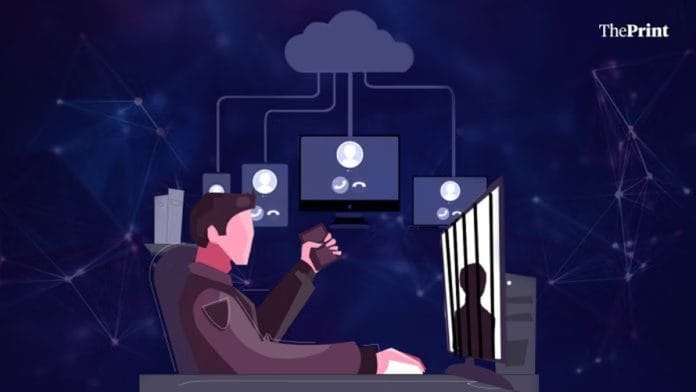


New Delhi: WhatsApp has agreed to share the details of accounts it has banned, along with its repository of law enforcement logos used to detect impersonators, with the Indian Cyber Crime Coordination Centre (I4C)—even as it has told a Supreme Court-monitored committee that an automatic ‘kill switch’ to cut off prolonged video calls used in digital arrest scams “is not an effective intervention”.
WhatsApp also submitted its own findings of its own investigation into digital arrest scams, which show that “about 1 in 3” victims place the calls themselves.
The submissions, several of which are marked confidential, are annexed to the fourth status report filed before the Supreme Court 3 August by I4C, in the suo motu proceedings on digital arrest scams. The ‘confidential’ ones include WhatsApp’s written submission of 13 March 2026, and action taken reports dated 1 May 1 and 22 May.
A bench of Chief Justice of India Surya Kant, Justice Joymalya Bagchi and Justice V. Mohana passed fresh directions in the digital arrest case Tuesday.
Regarding the measures it has agreed to, WhatsApp told the committee it was on track to implement a SIM-binding mechanism—tying an account to a verified SIM—ahead of a December 2026 deadline; that device-based risk-detection systems flagging suspicious behaviour were “already operational”; and that it would share both the banned-account details and its logo ‘photobank’ with I4C.
It is on two points that WhatsApp marked the limits of what it will do. On rules requiring the identification and labelling of ‘Synthetically Generated Information’—deepfakes commonly used in digital-arrest video calls—it submitted that it “is not feasible to implement those rules with respect to end-to-end encrypted content”, because messages and calls are private and “no one outside the conversation, not even WhatsApp, can read, listen to, or share them”, adding that its measures operate only on “unencrypted surfaces”.
The committee, in turn, sought a technical note on reflecting a caller’s location in video calls received from unknown numbers, including privacy and legal considerations.
The submission to the committee also set out a three-layer artificial-intelligence system Whatsapp uses to detect scams. The first layer matches accounts against a maintained database of known scam-related names, logos and images—profile photos using police badges, uniforms or court seals tied to agencies such as the Mumbai Police, Delhi Police or the CBI, and names impersonating Indian law enforcement.
The second layer looks not at what an account calls itself but at how it behaves, flagging combinations of suspicious signals—where user reports are coming from, signs that an account is posing as law enforcement, common phrases used by scammers, and patterns linked to coercive activity—so that a scam can be caught “even when scammers slightly change their names, profile photos, or messaging to avoid exact-match detection”.
The third layer uses language models to read across profile text, images and reported messages and catch newer tactics, including “adversarial variations and evasion techniques”, lookalike logos, and slightly altered language designed to bypass keyword matching.
Whatsapp told the committee it also runs media OCR (optical character recognition) keyword matching on images, and uses an “enforce against the network” method—treating government tip-offs and reported accounts as seed inputs to map and disrupt entire scam clusters rather than banning accounts one at a time.
The OCR keyword matching method, the submission shows, produced results. WhatsApp said an investigation that began with 17 accounts—drawn from about 3,800 flagged in Section 79 takedown requests in January—expanded, via shared IP addresses “many of which traced back to scam compounds in Southeast Asia” into a network of about 9,400 accounts it banned over 12 weeks.
It described detecting impersonators through business names such as “Delhi Police Headquarters”, “CBI” and “ATS Department”; and “About” section keywords such as “Emergency Portal 24/7”. The material was marked “proprietary and confidential”, with a request that it “not be disclosed publicly without prior consultation with WhatsApp”.
It is on the ‘kill switch’ that Whatsapp has dug its heels in. The measure—a time cap or automatic termination of video calls, so that scammers cannot hold victims on the line under coercion—was proposed by the court’s amicus curiae, senior advocate N. S. Nappinai.
ThePrint has texted Meta spokesperson on text for comment. This report will be updated when and if they respond.
At a meeting on 4 May, WhatsApp said no such feature existed and none was under development, and was asked to revert within 10 days with a timeline for building it. Its 22 May ATR set out its considered position: A time-based ‘kill switch’ “does not address the underlying coercion; it merely interrupts the technical session”.
A victim coerced into believing they face imminent arrest, it argued, is likely to reconnect or accept a follow-up call, and “a sudden disconnection could cause the victim more stress and panic, causing them to call back”.
Whatsapp backed this with findings on how these networks operate: Scammers instruct victims at the outset not to disconnect “under any circumstance”; run multi-account clusters so they can “immediately reconnect” from an alternate number if a call drops; and use scripts that anticipate technical interruptions.
In its analysis of calls over an hour involving confirmed victims, more than 30 percent were placed by the victims themselves. Given these realities, it concluded, “there is no evidence that a kill switch—whether it is for 1-2 hours or longer—would meaningfully curb digital scams”.
WhatsApp paired the objection with a defence of long calls, submitting that “over 99 percent of the calls lasting longer than one hour are legitimate”, and that a ‘kill switch’ would automatically disconnect every video call that exceeds the set duration—even if it is engaged in “legitimate activity”.
It listed users who rely on such calls—women taxi drivers who keep family on video as a night-shift safety measure, telemedicine and mental-health patients, students studying overnight for JEE, NEET and UPSC, and members of the Indian diaspora watching over elderly relatives. The amicus argued that any such mechanism “should operate independently of the victim’s volition”—precisely because a coerced victim cannot be relied on to end the call.
Despite the 22 May filing, the committee did not treat the matter as closed. In the minutes of its fifth meeting on 14 July, it “requested the Ministry of Electronics and Information Technology to furnish the pending action taken report regarding the proposed ‘kill switch’ mechanism for platforms offering services of audio/video calls”—routing the demand through the ministry and recording the response as still outstanding nearly two months after WhatsApp’s submission.
The SC bench has directed that the proposal on time-based restrictions on audio and video calls be examined, with a note on feasibility, usage, safeguards and alternatives placed before it. The matter is listed for 16 September.
(Edited by Viny Mishra)
Also read: What’s in a WhatsApp username? Privacy, fraud fears & govt’s power over apps