



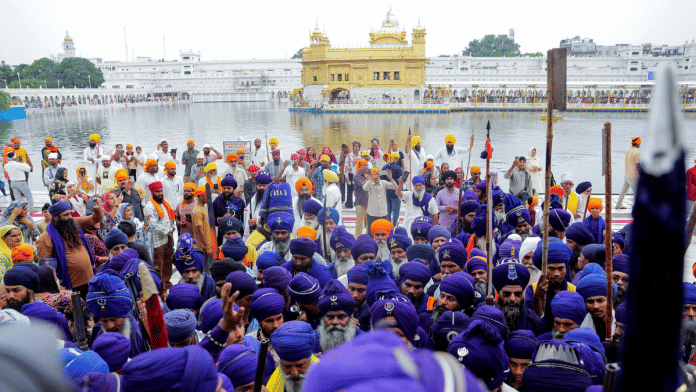
Chandigarh: Thursday’s attack on Shiromani Akali Dal president Sukhbir Singh Badal, allegedly by a ‘nihang’ at a gurudwara in Nanded Sahib, Maharashtra, has brought the focus back on this Sikh order which has been at the forefront of the Sikh martial tradition for more than 300 years.
The ‘nihangs’ with their distinctive blue attire, wearing prominent decorated turbans, are generally heavily armed and trace their origins to the tenth guru of Sikhs, Guru Gobind Singh, claiming to be “guru di ladli fauj” (the guru’s favourite army).
On Thursday, Jaspal Singh, a former advocate from Pune who had joined the ‘nihang’ order one and a half years ago, allegedly attacked Badal with a khanjar (dagger) severely injuring his right arm. Jaspal Singh was immediately overpowered by Badal’s security men. The Maharashtra police has registered a case of attempt to murder against Jaspal Singh.
Badal, along with his family, was on a two-day visit to Nanded Sahib to pay obeisance at Hazur Sahib, the gurudwara built to mark the final resting place of Guru Gobind Singh.
After visiting Hazur Sahib Thursday morning, Badal, along with his family went to another gurudwara Mata Sahib Devaji in village Mugat, almost 20 kilometres from Hazur Sahib.
“This gurudwara is not under the administrative control of the Hazur Sahib Board. It is run independently by the ‘nihang’ order for the past three decades,” said retired Maharashtra IAS officer Vijay Satbir Singh, administrator of the Hazur Sahib Board talking to ThePrint Friday.
Giani Gurpinder Singh, spokesperson of the ‘nihang’ order that controls the Mata Sahib Devaji gurudwara, told ThePrint that what happened Thursday was unfortunate.
“Jaspal Singh belongs to a highly educated family from Pune. His daughter and son-in-law are also advocates. He is very fond of discussions about the Sikh religion. He had come to visit the gurdwara one and a half years ago and was wearing a black pagdi, which was probably a part of the uniform worn in the courts. We objected to that and he decided to start wearing the blue attire. Since then he shifted to the gurdwara and has been in the service of Baba Teja Singh ji who heads the ‘nihang’ order here,” said Giani Gurpinder Singh.
Giani Gurpinder added that Jaspal Singh was on duty at the counter where siropas and parsaad are distributed. “He is the one who gave the siropas and parsaad to Badal at the counter. I have been told that he started having some discussion with Badal and started walking with him leaving his own counter. We really do not know what happened after that. Maybe he did not get the correct response from Badal and got angry and took out his dagger to attack him.”
Giani Gurpinder added that other than Jaspal Singh, no other ‘nihang’ tried to attack Badal. “Whatever Bibi Harsimrat Kaur is saying about others also being involved in the attack is wrong,” he said.
While it is not yet clear why Jaspal Singh attacked Badal, it is not the first time that a ‘nihang’ order is in the news for the wrong reasons.
In June, a dispute involving ‘nihang’ pilgrims in Uttarakhand’s Karnaprayag escalated into allegations of an armed assault on locals. Four ‘nihangs’ were arrested. The confrontation then spilled over into a dramatic standoff at a gurdwara in Nagrasu, Rudraprayag, where a group of armed ‘nihangs’ occupied the rooftop for three days and allegedly held a Sikh devotee hostage while demanding the release of those arrested.
The standoff eventually ended after negotiations, but the episode involved a heavy security presence and even deployment of the Army.
Even at the recent student agitation in Delhi, some ‘nihangs’ went to Jantar Mantar to express solidarity with the protesting students and provide support, but there was a confrontation between the ‘nihangs’ and some of the protesters.
Who are ‘nihangs’?
Sikh scholar Amrit Pal Singh ‘Amrit’ who has researched ‘nihangs’ writes that the word ‘nihang’ has been used in the Guru Granth Sahib as well as other Sikh texts. Though the word has been used with different meanings, he says it translates to “one who is fearless and unrestrained”.
The ‘nihangs’ are armed Sikh warriors entrusted to defend the Sikh faith and preserve its martial ethos or shastra vidya. It is believed that they originated from the Akaal Sena, a band of soldiers of the sixth guru of the Sikhs, Guru Hargobind.
Later this Akaal Sena metamorphosed into the Khalsa fauj of Guru Gobind Singh and Anandpur Sahib, where Guru Gobind Singh created the Khalsa in 1699 is their main centre. They wore a distinct attire and were always armed.
Through the eighteenth century, the Khalsa fauj in various forms and part of different jathas (groups) remained involved in several battles that took place in Punjab before the consolidation of the Sikh empire under Maharaja Ranjit Singh. Since they repeatedly chanted the words “akaal akaal” during battles, they came to be referred to as “Akali”.
Nawab Kapur Singh, the jathedar of the Akal Takht brought all the jathas together under a single confederacy, the Dal Khalsa in 1730. It was divided into two groups, the Budha Dal and the Tarna Dal. The Budha Dal was considered to be the body of older, experienced warriors while the Tarna Dal was considered to be the younger fighting force. The Tarna Dal was itself divided into five jathas.
The Budha Dal gained prominence historically and served as a “Chalda Vaheer” or moving encampments wherein ‘nihangs’ would move from one historical shrine to another. Their temporary resting place was called “chhavni” or cantonment. The head of the Budha Dal or its jathedar is given the honorific title of “96 Crori” (960 million), traditionally associated with the professed strength of the Khalsa army that is destined to uphold righteousness, signifying an infinite, indomitable spiritual force that cannot be crushed by worldly regimes.
Under Ranjit Singh, ‘nihangs’ enjoyed an extraordinary position in Sikh religious life. Akali Phula Singh was the commander of the Akali contingent in the Sikh army and also the jathedar of the Akal Takht, the highest temporal body of the Sikhs.
Multiple historical accounts exist about the role of ‘nihangs’ following the conquest of the British in 1849. Budha Dal became a custodial and religious institution and its claim to authority was associated particularly with the Akal Takht and important Sikh shrines.
Budha Dal legacy continues
Over the years, the Budha Dal remained the principal institutional survivor, with the Tarna Dal becoming hugely fragmented. However, the legacy of the Budha Dal has been marred by a bitter war of succession after the death of the 13th Jathedar, Baba Santa Singh.
In the final years leading up to Baba Santa Singh’s death in 2008, a severe rift emerged between his nephew, Baba Balbir Singh, and other prominent ‘nihang’ leaders including Baba Surjit Singh and Baba Man Singh. While Baba Balbir Singh claimed he was officially sworn in as the 14th jathedar by his predecessor, loyalists of Baba Surjit Singh vehemently contested this, asserting that an ailing Baba Santa Singh had actually chosen Surjit Singh in 2005.
Rival factions accused Balbir Singh of leveraging political influence from the Shiromani Gurdwara Parbandhak Committee (SGPC) and the Shiromani Akali Dal (SAD) to forcibly seize control of the organisation’s vast institutional assets and headquarters.
In September 2007, Baba Uday Singh, accompanied by supporters and Baba Surjit Singh, went to the Budha Dal premises in Patiala where Santa Singh was staying. Contemporary reports say they wanted to see the ailing Santa Singh, but Balbir Singh’s supporters prevented them from entering, saying that Santa Singh was too ill to meet anyone. The situation escalated into an armed confrontation leading to the killing of four family members of Baba Balbir Singh.
Following Baba Santa Singh’s death in 2008, Baba Balbir Singh maintained recognised control over the official Budha Dal Administration, but a parallel, highly influential faction refused to accept his legitimacy. This splinter group appointed Baba Surjit Singh, followed sequentially by Baba Prem Singh, Baba Joginder Singh, and Baba Man Singh as their leaders.
“The Budha Dal has over 740 chhavnis, over 20 schools and more than 25,000 acres of land,” said Giani Gurpinder Singh who added that the gurdwara at Nanded Sahib is with the Baba Surjit Singh group.
Distinct lifestyle
Since weapons are an inherent part of the ‘nihangs’ persona, they are generally armed, not just with modern firearms but also traditional weapons. These include bracelets of iron worn around the wrist which are called ‘jangi kara’ and they have a ‘chakram’ or steel circle worn around the turban on the head.
They also carry two swords or kirpans and small handheld daggers. When they are fully armed, they also have a buffalo hide as a shield at the back and a ‘chakram’ and iron chains around the neck. Usually they are seen carrying long spears in their hands.
They wear blue long frocks and leather shoes called ‘jungee moze’, with a sharp metal fitting at the toe, which can be used as a weapon. The most conspicuous part of the attire is the turban called ‘dumalla’. The size is a matter of pride, and some ‘nihangs’ wear turbans several times bigger than their heads, decorating them with ‘khanda Sahib’.
The ‘nihangs’ have their own deras and a specific way of life. Those who are married are given the charge of taking care of the deras while the others move around the state. The deras have weapons, licenced firearms, horses and everyone undergoes martial training.
They have a calendar of events which they attend over the year and this includes all important religious ‘melas’ starting with maghi, vaisakhi, rakhar punia, Diwali, and jor mela. They have been known to be traditional consumers of ‘bhang’ or some other intoxicant which is consumed orally but never smoked.
Increased association with crime
For a martial order whose historical identity is rooted in defending the Sikh faith, the ‘nihangs’ have, over the past two-three years, increasingly found themselves in the news for reasons that have little to do with their traditional role.
“The pattern is particularly striking because the blue robes, towering dumalas and traditional weapons that once symbolised Sikh martial tradition have increasingly become visual shorthand for aggression and vigilantism in news reports and viral videos. It is important, however, to distinguish the historic ‘nihang’ tradition from individuals or groups who invoke that identity while committing crimes,” says Prof Manjeet Singh, formerly of the department of sociology, Punjab University, Chandigarh.
In March 2025, a ‘nihang’ was among three arrested after two migrant workers were allegedly attacked with swords in Ludhiana district. The same month, ‘nihang’ Amritpal Singh Mehron claimed responsibility for the murder of social media influencer Kanchan Kumari, popularly known as Kamal Kaur Bhabhi, for what he considered obscene online content.
In January 2024, a ‘nihang’, Ramandeep Singh alias Mangu Math, allegedly killed a young man inside a gurdwara at Phagwara after accusing him of coming there to commit sacrilege. The accused even recorded a video of the victim before the killing and subsequently made his own purported confession.
In July 2024, there was an the extraordinary daylight attack on Shiv Sena leader Sandeep Thapar in Ludhiana. Four men dressed in ‘nihang’ attire were seen on CCTV attacking Thapar with swords in the middle of the city. Around the same period, a shopkeeper in Tarn Taran was allegedly killed by ‘nihangs’ in a monetary dispute.
In November 2023, a policeman was killed and others injured in a gunfight between police and ‘nihangs’ during a dispute over control of a gurdwara in Sultanpur Lodhi, Kapurthala.
On 15 October 2021, a 35-year-old labourer named Lakhbir Singh was brutally lynched and killed at the Singhu border during the nationwide farmers’ protest. His mutilated body, with a severed hand and foot, was tied to a police barricade. Members of the ‘nihang’ Sikh sect claimed responsibility, alleging the victim attempted sacrilege of a holy book.
In another shocking incident in April 2020, a group of ‘nihang’ Sikhs from a dera in Patiala, drove through multiple barricades around a wholesale vegetable market in Sanaur, when they were stopped by the police for violating curfew norms. When the Punjab police tried to stop the moving vehicle beating it with sticks, the angry ‘nihangs’ got out of the vehicle and attacked the police with swords. In the melee that followed, a ‘nihang’ chopped off the hand of an assistant sub-inspector of the police.
(Edited by Viny Mishra)
Also read: Sukhbir Badal’s attacker in custody, PM Modi dials Harsimrat