



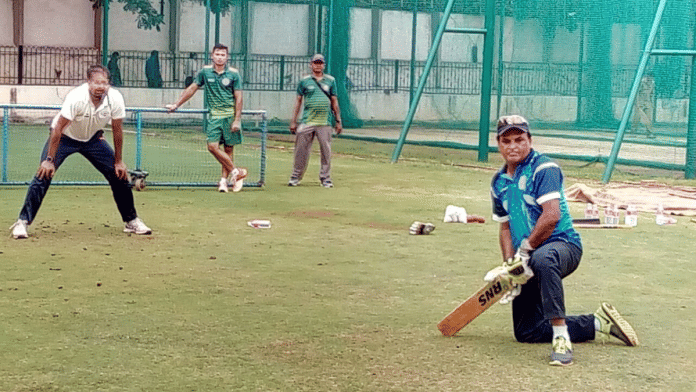
New Delhi: Jacob Martin had amassed more than 1,000 runs in the 1998-99 Ranji Trophy season and was selected to play for the national team during an ODI series against West Indies in Canada in 1999.
The absence of the then skipper, Sachin Tendulkar, due to recurrent spondylitis, had left the men in blue without a star batter in the line-up, and Martin had a fair chance of making a mark in the side led by Sourav Ganguly. He could not produce his usual outstanding batting numbers in the two opportunities he had, but did not harm his chances either, as India won the series 2-1.
Seven more cricket matches came and went, but Martin failed to seize his moment in the blue jersey. The story of an Indian batter producing a mountain of runs in domestic cricket but failing to live up to expectations on the international stage was not unique, and Martin’s case was no different from several others.
However, the rest of Martin’s life trajectory is very different.
Out of international reckoning, Martin remained a name to reckon with in domestic cricket, leading Baroda to a prestigious Ranji title in 2001, but it was after that that the setbacks began.
Three years later, the Delhi Police booked one Naemesh Kumar Manu Bhai Patel upon his deportation from the United Kingdom on the grounds that the UK home stamp on his passport was forged. The Delhi Police lodged a case in 2004 under offences of cheating and took Patel into custody. Seven years later, the police arrested Martin on the grounds that he was the one who facilitated the forged UK Home Office stamp and took nearly 3,000 pounds from Patel for the job.
But in June this year, a Delhi court acquitted him of all charges.
“I lost everything due to this case. I got some odd jobs, but the ghost of this case stigmatised and brought shame to me for years,” Martin told ThePrint over a phone call. “I lost my job in the Railways and lost all the respect I had earned as a hard-working man, besides the difficulty I faced in running my family and managing my legal expenses,” an emotional Martin said.
Replacing Tendulkar at the crease to Tihar jail
The impressive run of form in domestic cricket continued for several seasons, and Martin also led Baroda to the Ranji Trophy championship in 2001. However, the triangular series in South Africa later that year turned out to be his last outing in Indian colours. In his last ODI against Kenya, Martin batted at the number three position and came out to bat early in the innings after the dismissal of Tendulkar. His 36 could not stem the batting collapse, and India lost the game by 70 runs. Martin never played for India again
Having accumulated 8,563 runs at a decent average of 48.10 from 127 matches, with 23 centuries and 44 half-centuries on the domestic circuit, Martin hung up his boots in 2007 on the brink of the Ranji Trophy season that year.
By then, he was working in the Indian Railways and also represented the services side in the domestic circuit. But the ghost of the 2004 case kept haunting him, and he was arrested in April 2011. He spent more than a month in Delhi’s Tihar jail before securing bail.
The Delhi Police had reached Martin’s doorstep when Nimesh Patel allegedly revealed during questioning that he had contacted an agent named Raju Bhai Bhikhu Bhai Patel, who had assured him of help in arranging his settlement abroad and asked for Rs 7 lakh. He also allegedly revealed that Raju Patel told him that Jacob Martin used to arrange travel abroad for people by representing them as cricket players, and that this was how he allegedly arranged a meeting between Nimesh Patel and Martin.
The Delhi Police also arrested Raju Patel, and during questioning, he allegedly revealed that Martin had assured Nimesh Patel he would be sent abroad on the pretext that he was a member of the Vadodara-based Ajwa Sports Club.
According to the plan outlined by the Delhi Police in the charge sheet presented in court, Martin allegedly facilitated Nimesh Patel’s journey to the UK along with others linked to the club, and later Nimesh parted ways from them on Martin’s instructions. He later met an agent named Janak, whom he allegedly paid 3,000 pounds for the fake stamp, but was caught with it and deported.
The prosecution went on to claim that Martin himself had disclosed during custody that he prepared his own team and used to send them abroad on the pretext of being part of the Ajwa Sports Club. In this particular case, the prosecution alleged that Martin formed a team under his club’s name to play a match in the UK in 2003 and arranged Nimesh Patel’s participation.
None of these charges stood at trial, and the prosecution’s entire case fell flat.
Observing that the entire case of the prosecution was based on “surmises and conjectures”, a Delhi court in June pulled up the investigating officer for not producing even the basic requirement to prove the case.
“No substantial, direct and convincing evidences were produced. Some of the evidences despite being available were not obtained by the investigating officers such as ownership documents of Ajwa Cricket Club. No evidence whatsoever was produced to prove that the accused Jacob Martin was the owner of Ajwa Cricket Club despite the prosecution levelling this allegation since the beginning,” Additional Chief Judicial Magistrate Pranav Joshi observed in the judgment. In fact, the court said, one prosecution witness testified that the club owner was Shirish Sirkay Ajwa, not Martin.
“None of the witnesses except PW16 could identify the accused Jacob Martin. It is not the case of the prosecution that the accused Jacob Martin stayed in England with Nimesh Kumar so that he could have played any role in providing the fake stamp,” the court further said.
The court also highlighted that the primary accused in the case—Nimesh Patel—had last left India in August 2004—and not in 2003 with the group of 30 players with Martin as alleged.
“This fact clearly proves that there was no relation whatsoever with the journey of Nimesh Kumar with accused Jacob Martin in 2003 and the alleged fake stamp in question,” Judge Joshi further observed.
In his statement towards the end of the trial, Martin told the court that an acquaintance Chetan Kale, who was Baroda skipper at the time, had come to his house and asked him to join a team of 15 players from Ajwa Sports Club that was going to the UK to play in 2003.
“It is not in dispute that the visa of Nimesh Kumar on which he went to the UK was genuine and the same was valid for six months. There is no evidence to suggest that accused Jacob Martin introduced Nimesh Kumar to agents Janak Panchauli and Ashwin Patel and took part in the conspiracy for arranging a fake stamp for Nimesh Kumar. Further, there is no evidence that the accused, Jacob Martin, received payment from Nimesh Kumar and his family members,” the judge observed, acquitting Martin of all charges.
Other accused in the case, Nimesh Patel and Raju Patel, were already convicted by the court in July 2011 and June 2014, respectively.
‘Burden off my shoulders, want my life back’
Two months after his acquittal, Martin continues to coach young cricketers in Vadodara—a job he took on after retirement but was never without controversy. He was appointed coach of Baroda in 2016, a move that came under immense scrutiny.
However, he kept making news as Baroda’s cricket coach, as the Pandya brothers (Hardik and Krunal), who represented Baroda, made headlines with their superlative performances.
He joined the Indian Railways and was working as a chief ticket inspector when he was arrested, leading to his dismissal from the service.
After his acquittal, Martin said he had written to the Railways Minister Ashwini Vaishnaw, Western Railways and the Railway Board to get his job back.
“This case took the life out of me and my career,” Martin further said. “The acquittal has taken the burden off me of this false case, but I need my job back, and hence I have written to the concerned authorities.”
Martin said that while he was never jobless, even during the pendency of cases, and was working as a coach for Baroda’s Ranji team, he was under severe financial strain during this period.
Martin suffered a life-threatening accident in December 2018 and was on life support for several days, requiring financial assistance. His Indian skipper, Sourav Ganguly, who had by then risen to the post of BCCI chief, sanctioned Rs 5 lakh for his treatment.
“Martin and I have been teammates, and I remember him as a quiet, introvert-type of person. While praying for Martin’s speedy recovery, I’d like his family to know that they don’t stand alone,” Ganguly had said in the Telegraph.
Funds for his treatment poured in from several cricketers, but Martin lamented that he was on his own to defend himself before the Delhi Police and the court during proceedings in the case.
“I played with all the superstars of the game, but when I faced humiliation and character assassination in the media and all quarters, there were no words even advocating patience till the entire facts come to light,” Martin said. “No top cricketers with whom I played and shared experience for a very long time spoke in favour of me or checked on me to find out the circumstances of the case.”
(Edited by Viny Mishra)
Also read: Ex-India cricketer Jacob Martin caught on wrong foot, held for drunk driving in Vadodara