





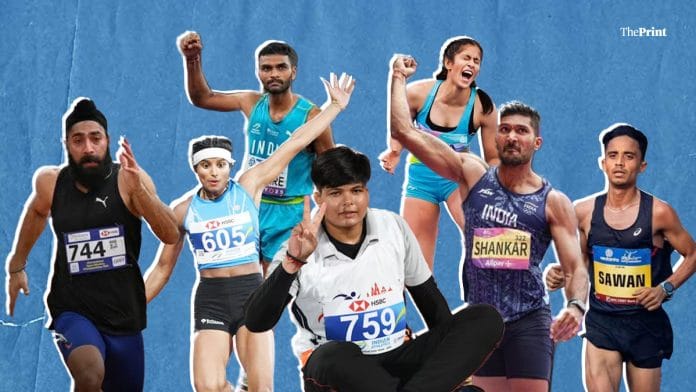


New Delhi: India has won 39 medals so far in the 2026 Commonwealth Games (CWG) in Glasgow, sitting fourth in the medal table as of Sunday afternoon.
Distance runner Gulveer Singh’s silver in the 10,000 metre event, and long jumper Murali Sreeshankar’s second podium finish have been among the highlights in track and field events, besides a double-podium finish in men’s javelin throw and triple jump.
Within the first six months of 2026, Indian athletes rewrote the national records, breaking more than 24 of them in track and field events. Many of these records stood for decades with one staying put for 48 years.
India’s CWG performance, however, is not just an isolated success but a continuation of the transformation unfolding over the last few years.
Also Read: Indian track athletes are also Instagram stars. Endorsing sunscreen, protein powder, cars
A season of records
The transformation in Indian athletics performance is most visible in a quick look at record books. In the first six months of 2026 Indian athletes broke more than 24 national records, some of which had stood for several years, and in some cases, for nearly five decades.
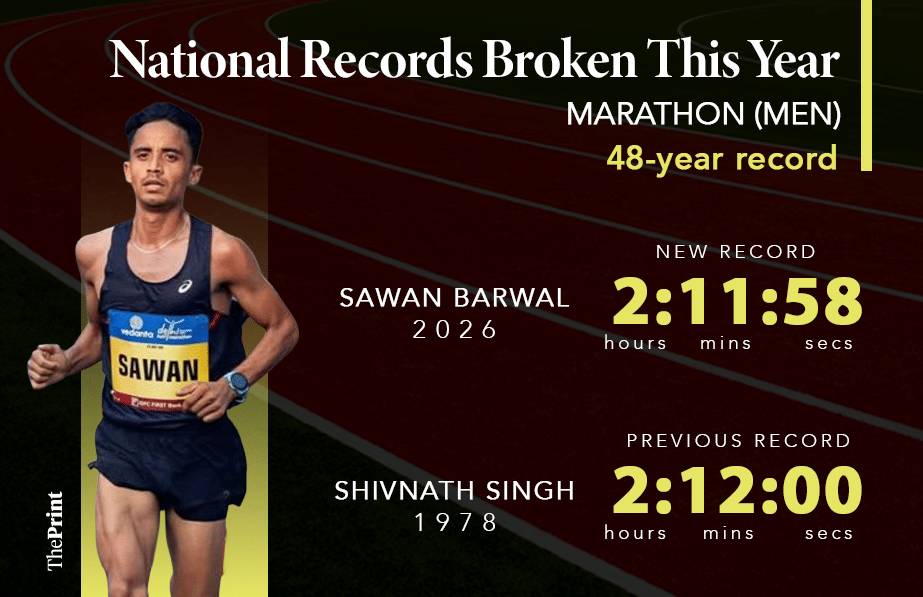
Marathon runner Sawan Barwal clocked 2:11:58 in Rotterdam in April, ending a 48-year national record.
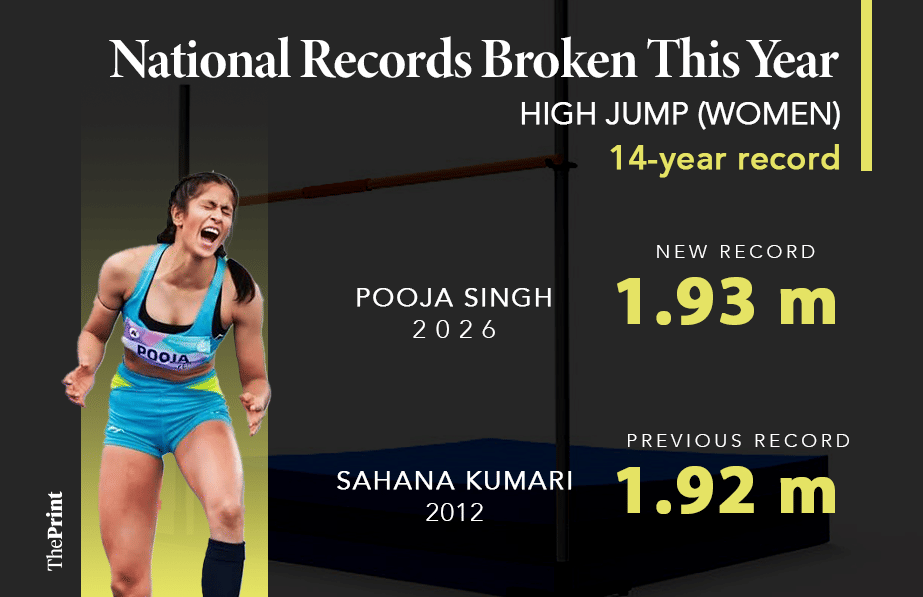
Meanwhile, high jumper Pooja Singh cleared 1.93 metre the next month in Hong Kong, breaking another national record that stood for 14 years.
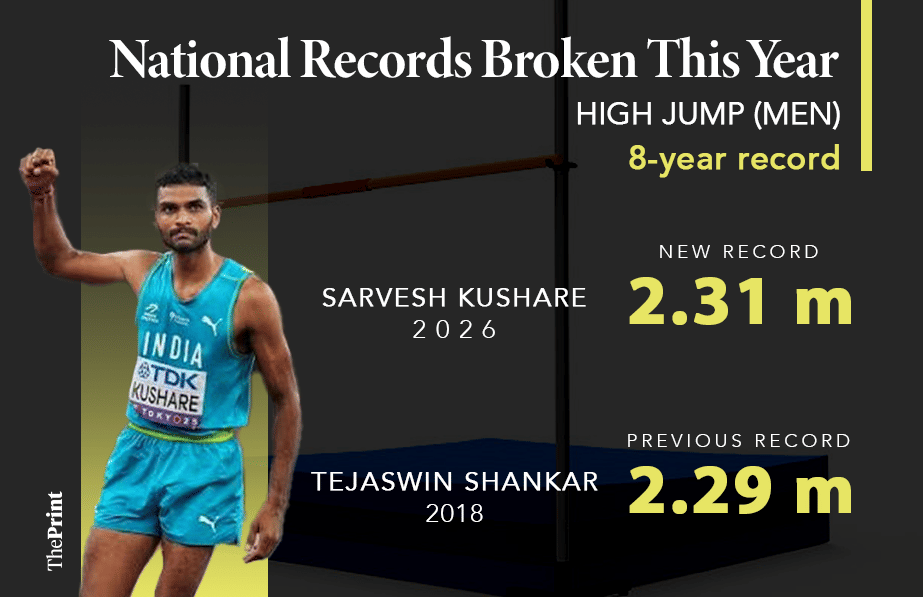
In June, high jumper Sarvesh Kushare became the first Indian man to clear 2.30 metre, surpassing an eight-year record. Kushare continued his fine form at the CWG, clinching a historic silver medal in Glasgow. He cleared 2.25 metre to come second. In the process, the 31-year-old became the first Indian to clinch a silver medal at the event.
Field events have seen similar breakthroughs. Long jumper Ancy Sojan leaped 6.88 metre, bettering Anju Bobby George’s 22-year-old record.
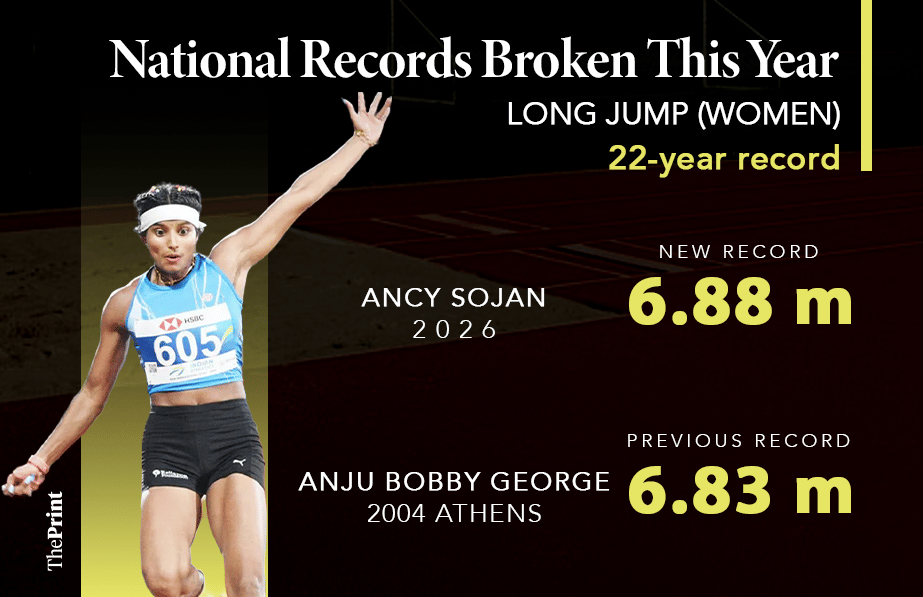
Anushka Yadav, 18, broke the women’s hammer throw record after nine years with a sensational 67.02 metre throw.
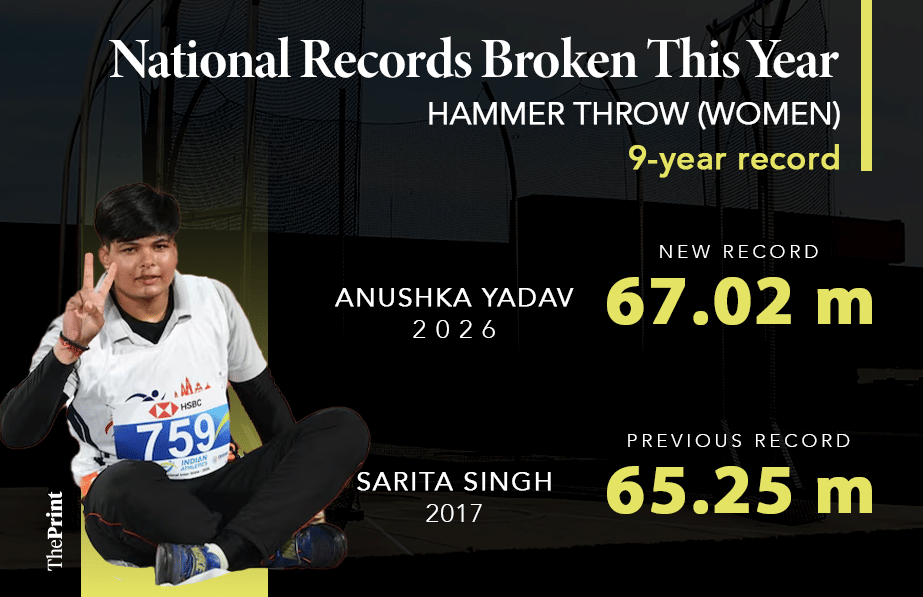
Anushka, Ancy and Sarvesh scripted the records at the same event: 65th National Inter-State Athletics Championships in Bhubaneshwar.
At the same time, sprint events have become more dramatic. Indian men’s 100-metre national record was broken three times under 24 hours in May during the Federation Cup in Ranchi. It started with sprinters Gurindervir Singh and Animesh Kujur who kept improving each other’s timings before Gurindervir finally clocked 10.09 seconds, making him the first Indian to run under 10.10 seconds. That said, the sprinter from Punjab failed to make it to the semis in the 100 metre heats in Glasgow.
The records were broken not just in sprints, but also in other events. Pole vaulters Kuldeep Kumar, Dev Meena, Baranica Elangovan and Sindhushree G. have all bettered national records.
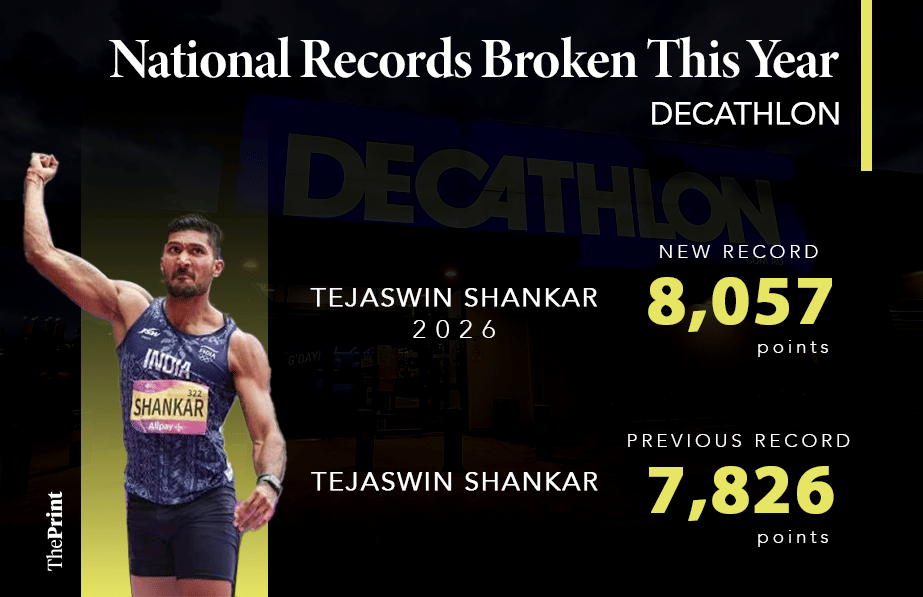
Meanwhile, decathlete Tejaswin Shankar became the first Indian to cross the 8,000-point mark in the Federation Cup. The 27-year-old also won a historic bronze in the 2026 CWG.
This was his second bronze as he had finished third in the men’s high jump at the quadrennial’s 2022 edition.
What stands out is that it is not just the number of records broken but also the events in which they are being scripted, spanning both field and track events.
Building an ecosystem
The performances unfolding this season are not just the result of any one training camp or overnight changes. Those involved in Indian athletics say the improved performances are the culmination of years of investment toward building a better ecosystem for Indian athletes.
“Our approach is centred on the athlete, with every reform aimed at empowering sportspersons to perform at their highest potential,” Union Sports Minister Mansukh Mandaviya told ThePrint.
The Khelo Bharat Niti, according to him, has provided a long-term roadmap for nurturing sporting excellence, while investments in world-class infrastructure, coach development, sports science, and high-performance support are creating an ecosystem that enables athletes to compete with the very best in the world.
India has over the past decade focused on expanding grassroots sports programmes through Khelo India, which helps in identifying athletes early on and providing them with additional support to maximise their potential as their skills develop.
“Any good performance is the outcome of a process,” Mayank Srivastava, deputy director general of Khelo India at the Sports Authority of India (SAI), told ThePrint. Instead of just focusing on medal winners, officials say the emphasis has now shifted to creating pathways that support athletes all the way from talent identification up to elite competition.
The rise in the number of national records broken is a sign, according to officials, that the investments have finally started to pay off.
Athletics Federation of India (AFI) president Adille Sumariwalla said this was possible because the focus moved beyond individual athletes and instead centered on the system itself.
“You need a whole ecosystem. It doesn’t happen with one athlete, one coach or one thing,” Sumariwalla told ThePrint.
The federation, he said, spent many years working towards expanding the base of Indian athletics instead of just focusing on the national team. At the same time, the AFI widened its domestic competition calendar, improved coach education, and moved away from a centralised training model.
“Go train where you want, run from where you are. Whoever is supporting you, let them get the credit for it. We don’t need the credit for it,” said Sumariwalla.
Sumariwalla added that the federation’s decision to decentralise has given athletes more choice to select the centers that work best for their performances and development.
Together, these changes created an environment where improved performances are no longer viewed as isolated breakthroughs but as the outcome of a system that has gradually matured over the past decade.
Also Read: Hockey India defends saffron jersey decision after backlash over replacing iconic blue
A new way of training
If better coaching structures have created an improved ecosystem, they have also changed how Indian athletes prepare. Until a few years ago, the majority of elite athletes trained in centralised national coaching camps, AFI chief coach Radhakrishnan Nair told ThePrint, adding that the centralised approach has now given athletes far greater freedom.
“Now it is the athlete’s interest where he or she wants to train and with whom they want to train,” said Nair.
Earlier, Nair added, the national coaching camps would run for nearly 300-320 days and a limited number of athletes received regular attention and support. But now, athletes have the choice of whom they want to train with and who will be best suited for the training.
The federation, too, has been tracking the progress of around 2,500 to 3,000 athletes with a coordinated monitoring and planning system. According to Nair, this shift has played a very important role in the recent improvement of performances. “Records are to be broken. It is all the policy of decentralising the national coaching camps.”
This, he said, enables coaches to plan training for athletes more effectively for a larger group instead of just focusing on a few selected ones.
The changes are not just structural. “The main issue was our athletes didn’t want to come out of their comfort zone, but that scenario has changed now,” said Nair.
Greater flexibility in training, however, is only one part of the transformation.
“Everything is different, the way athletes are trained today is vastly different from what it was a decade ago,” Inspire Institute of Sport president Manisha Malhotra told ThePrint.
Today’s elite athletes just don’t focus on coaching but work along with experts to build up strength and conditioning. They have constant access to nutritionists, physiotherapists and recovery specialists, which is an important part of their training.
“If they’re going through some mental distress, they now have access to sports psychologists and mental health support. None of this was widely available ten years ago. It’s a completely different world now,” said Malhotra.
An Olympian herself, she cautioned that these benefits are not uniformly distributed. “Only around 300 or 400 athletes receive this level of consistent support.”
While overseas exposure and world-class facilities have undoubtedly improved the performances, the next challenge for India is to be self-dependent. “The next step should be to strengthen our domestic ecosystem, which includes our facilities, competitions and talent pipeline, so that athletes don’t have to rely solely on training abroad,” she added.
Progress, but not the finish line
While the changes have successfully improved the performances of Indian athletes, sports journalist and author Sundeep Misra has a word of caution.
“I’m not a great fan of celebrating national records,” Misra told ThePrint.
For him, these domestic records do show athlete progress, but they should not be seen as the benchmark definition for Indian athletics. The real measure of success, he said, will come when Indian athletes consistently reach the finals and semifinals of the Olympics and the World Championships. “The first step should be to make finals and semifinals at major global competitions. I’m not saying winning a global medal is easy. It’s extremely difficult. But after this national record-breaking phenomenon, that should be our next goal.”
Misra gave the example of middle-distance runner Sriram Singh, who reached the 800m final in the 1976 Montreal Olympics, despite never being trained on a cinder track. The real test will happen when Indian athletes keep up their performances in the global and international level, he added.
Looking ahead, Misra believes that India should keep working on improving its high performance ecosystem while also promoting greater participation from specialised organisations to keep improving results.
“If the government opens up the sector and allows more organisations like Reliance and JSW to build High Performance Centres, you’ll see results.”
(Edited by Tony Rai)
Also Read: Indian athletes are turning to DNA playbook to find their champion gene, but policymakers must catch up