



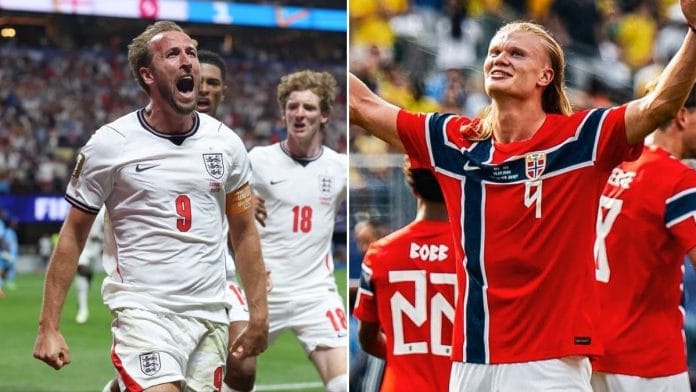
New Delhi: As the quarter-final battle of England versus Norway inches closer, the world gears up to settle a debate of who is a better number 9—Harry Kane or Erling Haaland. A typical number 9 possesses goal-scoring abilities, excels at target-man play, has a strong physical presence, and can execute high-intensity pressing. And, both Kane and Haaland can dominate matches, but they execute the role in fundamentally different ways.
Few individual battles in world football carry this much contrast: England’s captain against Norway’s most devastating goalscorer, a striker who creates as much as he finishes, against one who has made finishing an art form.
But that framing misses the larger story. Kane and Haaland represent two different answers to football’s oldest attacking question.
What should a No. 9 actually do?
For much of the past decade, football appeared to have moved away from the traditional centre-forward. The game celebrated versatility, movement and positional interchange. The striker was expected to press like a winger, drop down and create like a midfielder, as well as score like a forward.
Then Haaland arrived and reminded everyone that there was still extraordinary value in a player whose primary job was to put the ball in the net.
Kane, meanwhile, showed that the No. 9 could evolve rather than disappear.
The World Cup quarter-final between England and Norway is therefore a meeting between two competing philosophies of the modern striker.
Kane represents the ultimate complete, playmaking number 9. Operating as a deep-lying centre-forward, Kane seamlessly bridges the responsibilities of both a traditional number 9 and a creative number 10. Rather than simply pinning opposition centre-backs, he frequently drops into midfield to shield the ball, turn under pressure, and create world-class long passes that unlock space for overlapping wingers like Bukayo Saka.
This heavy involvement in the buildup phase dictates his high work rate, as he routinely sacrifices his position inside the penalty box to organise the team’s press and actively construct the attack.
In stark contrast, Haaland embodies the archetype of the ultimate penalty box assassin. He functions as a pure, hyper-vertical, and devastatingly efficient focal point for his team. Instead of dropping deep to link play, Haaland utilises his explosive acceleration and immense physical presence to bully defenders, stretch the pitch vertically, and make devastating runs behind the defensive line.
While he executes high-intensity pressing within his tactical system, his primary objective is to maintain maximum efficiency, often touching the ball as few times as possible outside the box to focus his energy entirely on lethal, one-touch finishing.
Also read: Martin Odegaard’s World Cup numbers show why Norway can trouble England in quarter-finals
Head-to-head comparisons
At the 2026 FIFA World Cup, the head-to-head metrics for Kane and Haaland highlight a tactical divide between the “complete playmaker” and the “box assassin”. While Haaland is marginally more efficient at maximising fewer touches in front of goal, Kane acts as a primary conductor for England’s entire attacking unit.
Haaland leads the goal-scoring charts with seven goals at a rate of 1.8 goals per 90 minutes, outperforming Kane, who has recorded six goals at a rate of 1.2 goals per 90 minutes. Haaland’s ruthlessness inside the penalty area is further emphasised by his superior 39 per cent shot conversion rate and a stellar shooting accuracy of 80 per cent, whereas Kane operates at a 32 per cent conversion rate with 53 per cent shooting accuracy.
Meanwhile, Kane dominates the creative and playmaking metrics outside the box. Kane acts as a vital bridge in midfield, executing a significantly higher volume of 72 attempted passes with a sharp 76.7 per cent passing accuracy, and he has already provided one assist for the Three Lions.
In contrast, Haaland is kept strictly isolated to stretch defences, attempting just 47 passes with a much lower passing accuracy of 57.4 per cent, recording zero assists.
Despite their vastly different roles, both strikers impact their teams with nearly identical ball volume, with Kane averaging 25.4 touches per match and Haaland averaging 25 touches.
The managers standing behind these two players must now make those contrasting identities work.
Thomas Tuchel’s England will look to Kane’s intelligence, creativity and leadership to unlock Norway’s defence.
Stale Solbakken’s Norway will look to create the conditions where Haaland’s greatest strengths become impossible to contain.
The England versus Norway quarter-final in the 2026 FIFA World Cup offers a rare, high-stakes collision of two distinct tactical eras.
(Edited by Saptak Datta)