



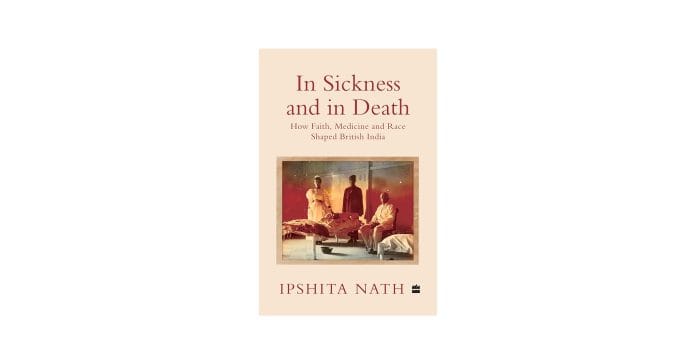
New Delhi: Ipshita Nath’s In Sickness and in Death: How Faith, Medicine and Race Shaped British India looks at a side of colonial India that is often reduced to statistics and epidemics: the everyday fear of falling ill and the ways disease shaped the lives of those living under British rule. When the British arrived in India, they were confronted by diseases they struggled to understand and control. Fevers that appeared routine could turn fatal, while army cantonments, Civil Lines and European settlements offered little protection from the illnesses spreading across the subcontinent.
Drawing on medical and historical research, Nath traces how disease gradually became a problem not just of health but of governance. The book explores how the colonial state studied and managed illness, how ideas of race and medical knowledge shaped its response, and how repeated health crises exposed the limits of imperial power. From smallpox and other deadly infections to the broader anxieties surrounding the ‘diseased body’, In Sickness and in Death shows how medicine became intertwined with faith, race, power and politics. It also asks why these questions remain relevant in a post-pandemic world, where access to healthcare, fear of disease and the politics surrounding public health continue to shape societies.
Ipshita Nath has a PhD in English Literature and is a Postdoctoral Research Fellow at the Department of History at the University of Saskatchewan, where she researches disease and healthcare in colonial India. She was previously an Assistant Professor of English at a constituent college of the University of Delhi and has also held a LIAS Fellowship at the University of Leicester. Her earlier book, Memsahibs: British Women in Colonial India, was published in 2022 and was nominated for the Sahitya Akademi Yuva Award, while her short-story collection The Rickshaw Reveries was published in 2020.