





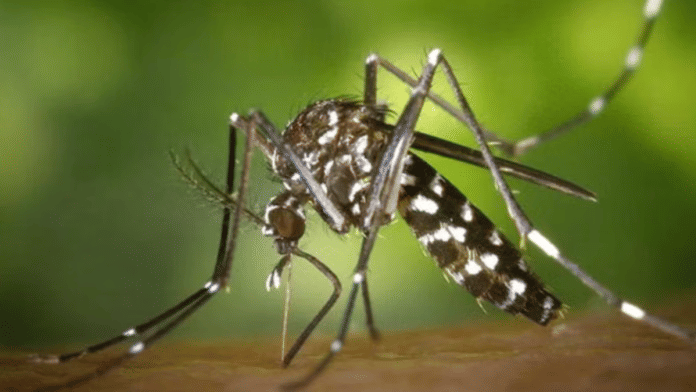

Lucknow: Why do mosquitoes seem to target some people more than others? Researchers at the Indian Institute of Technology (IIT) Kanpur are trying to answer this question by studying how mosquitoes identify humans through smell and what changes take place in their brains before and after feeding on human blood.
The research, being conducted at the Mehta Family Centre for Engineering in Medicine at IIT Kanpur, could eventually offer new insights into controlling mosquito-borne diseases such as dengue and chikungunya.
According to the researchers, a person’s body odour and chemical cues may play an important role in determining whether mosquitoes are attracted to them. Mosquitoes are known to detect carbon dioxide released through human breath, along with various skin odour molecules and other chemical signals.
Researcher Kartik Raut, who is working under the supervision of senior professor Nitin Gupta, is studying the Aedes aegypti mosquito, a species associated with the transmission of diseases such as dengue and chikungunya.
Raut’s research focuses on how mosquitoes recognise human odours and how their brains change before and after consuming blood. He began thinking about the question during the COVID-19 lockdown: how exactly do mosquitoes locate and reach humans?
Using ‘CRISPR-Cas9 technology’, the research team is marking certain mosquito nerve cells with specialised fluorescent markers to observe and study their functioning. The team has so far succeeded in developing a transgenic mosquito line which is being used for further research.
Also read: Don’t scratch mosquito bites. Here is how to deal with itching, redness
Study still at an early stage
The study is still at an early stage. However, researchers believe that a better understanding of how mosquitoes process smell and respond to humans could eventually open up new possibilities for preventing mosquito-borne diseases.
According to the National Center for Vector Borne Diseases Control (NCVBDC), India reported 1,21,824 dengue cases and 131 deaths in last year.
Speaking to ThePrint, Prof. Nitin Gupta said the study was still underway, but the researchers had found that “smell plays an important role in attracting mosquitoes”.
“If a person applies certain chemicals or products on the body, such as perfumes, deodorants or other substances that alter the body’s natural odour, the chances of mosquito bites may be lower,” he said.
He also added that they are not claiming that one should use perfume & deodrants to avoid mosquitoes, but some chemicals could help in avoiding mosquitoes.
As of now, the researchers have also found that only female mosquitoes bite humans, as they need blood for the development and nourishment of their eggs, Prof Gupta told ThePrint. Male mosquitoes, on the other hand, feed primarily on plant nectar, he said.
The research is particularly focused on understanding what happens inside the mosquito’s brain after it feeds on human blood and whether these changes influence its behaviour, including how it identifies and seeks its next host.
While speaking to ThePrint, Raut added that for a country that continues to battle seasonal outbreaks of dengue and chikungunya, understanding the mosquito’s behaviour at a neurological level could potentially help scientists develop more targeted methods of disrupting its ability to locate humans and spread disease.
“It will take some more time to release the final report on this topic, but very interesting topic we are researching as of now. From mosquitoes’ behaviour to their mind reading, it’s interesting to find out.”
(Edited by Ajeet Tiwari)
Also read: Mosquitoes now feed more on humans than animals. Brace for newer, more dangerous diseases