



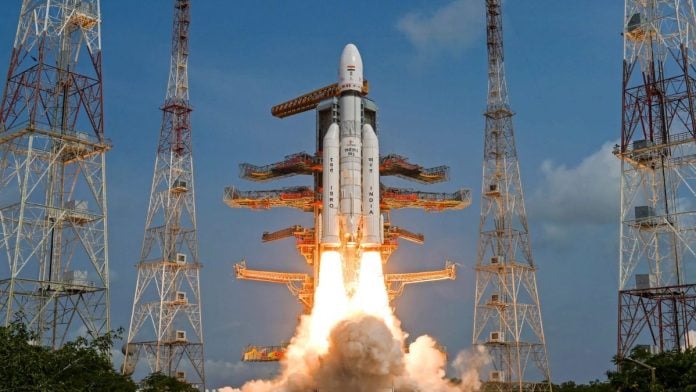
New Delhi: The Indian Space Research Organisation’s NVS-03 satellite launch on Friday night is an important step towards restoring India’s independent navigational system. The satellite, which launched successfully at 11:51 PM on 30 October from the Sriharikota Space Centre, is the third in ISRO’s second-generation navigation series known as NavIC, or Navigation with Indian Constellation.
NVS-03 is ISRO’s third launch this year, and its success is also essential because it could revive the NavIC programme, which is currently defunct.
“We already have three functional satellites, but with this satellite we have the minimum satellites needed to restore NavIC’s Positioning, Navigation and Timing services,” said V Narayanan, ISRO Chairman, in a press conference after the launch.
The NavIC programme originated in the aftermath of the Kargil War in 1999, when India felt the need to develop an independent, regional navigation system as an alternative to the United States’ Global Positioning System. During the war, India had sought access to US GPS data over the conflict zone to track Pakistani troop movements. But it was denied, exposing the risks of depending on foreign-controlled navigation systems during a military conflict.
By 2006, the Indian Regional Navigation Satellite System (IRNSS) was approved by the government as a seven-satellite constellation — three in geostationary orbit and four in inclined geosynchronous orbit. While geostationary orbits are positioned around 35,000 kms above the Earth’s equator, inclined geosynchronous orbits are tilted and match the Earth’s rotation.
ISRO launched the first satellite, IRNSS-1A, in July 2013, followed by six more satellites between 2014 and 2016, completing the initial constellation.
NavIC has both civilian and strategic applications, including vehicle tracking, maritime navigation, disaster management and providing safety-related information to fishermen operating offshore. The system also provides two types of services: a Standard Positioning Service for civilian users and an encrypted Restricted Service for authorised users, including the armed forces.
Also read: ISRO launches third next-gen NavIC satellite after NVS-02 setback
Why was NVS-03 important?
While IRNSS satellites’ installation was complete by 2018, not all of the satellites remained as they were in space, and needed to be replaced soon. To replenish the constellation and improve its capabilities, ISRO began developing a second generation of navigation satellites, designated the NVS series.
The new NVS satellites have indigenous atomic clocks and introduce the L1 frequency band alongside the existing L5 and S bands. The additional L1 signal is particularly important because it is widely used by civilian navigation systems and could improve NavIC’s compatibility with smartphones and other consumer devices.
The first NVS satellite, NVS-1, was launched in May 2023 aboard GSLV-F12. NVS-02 followed in January 2025 but experienced an anomaly that prevented it from reaching its intended operational orbit.
Even as the NVS satellites were replacing the ageing INRSS ones, NavIC gradually lost its ability to provide independent positioning services. IRNSS-1A, for instance, lost all three of its onboard rubidium atomic clocks between 2016 and 2017, restricting its use primarily to messaging services.
On 13 March 2026, ISRO announced that the onboard atomic clock on IRNSS-1F had stopped functioning, three days after the satellite completed its 10-year design life. This brought the number of satellites providing PNT services down to three: IRNSS-1B, IRNSS-1I and NVS-01.
A navigation receiver needs signals from at least four operational satellites to calculate its three-dimensional position and correct for errors in its own clock. When the number of functional NavIC satellites providing positioning, navigation and timing (PNT) services fell below four, the system could no longer provide standalone positioning.
The launch of NVS-03 aboard GSLV-F18 on 30 October 2026 is therefore really important, as it could restore the PNT services of NavIC with four functional satellites again. Meanwhile, NVS-04 and NVS-05 are also in the pipeline and will be launched soon, according to ISRO.
(Edited by Janaki Pande)