





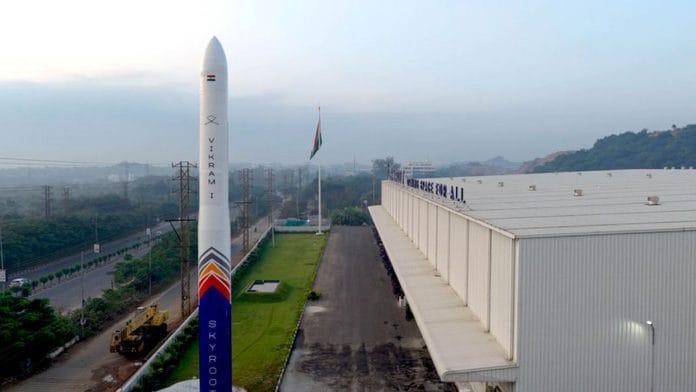


New Delhi: Hyderabad-based Skyroot Aerospace is ready to launch India’s first privately made orbital rocket from Sriharikota sometime in the next few weeks, said CEO Pawan Kumar Chandana. In an exclusive conversation with ThePrint, Chandana explained the eight-year-old start-up’s journey to a billion-dollar valuation, and future plans for their indigenous rocket, Vikram-I.
The Vikram-I launcher is a four-stage rocket that can carry up to 300 kg to low Earth orbit (LEO), and has a 3D-printed liquid engine. The rocket is currently undergoing testing and integration at ISRO’s space port in Sriharikota, Andhra Pradesh, and is expected to launch in a few weeks, although the exact date is yet to be determined.
“It will be a test flight, but we do have multiple payloads on this rocket – both domestic and international,” said Chandana. “Everything has reached Sriharikota, and we’re in the final stages.”
The launch will mark an important milestone in India’s private space sector’s journey, with Skyroot becoming the first company after the Indian Space Research Organisation to be able to launch rockets. After the first Vikram-I launch, the company has multiple other test flights planned in 2026.
Ahead of the Vikram-I launch, the CEO also spoke about learning from launch failures, such as the recent failure of ISRO’s PSLV-C62 mission.
“In the rocket industry, failures are actually progress. When a rocket fails, you get to learn things to make it better, and it is the only way you learn,” said Chandana. “Even the largest rocket company, SpaceX, has had failures. I’m sure they (ISRO) will bounce back from PSLV soon too,” he added.
After more test flights, Skyroot plans to ready Vikram-I for commercial launches in 2027. According to Chandana, around 80 per cent of their payload customers will be global. From communications to Earth observation, the rocket will cater to all use cases for the low Earth orbit and the Sun-synchronous orbit.
Skyroot also has the Vikram-II rocket in the works, which will have a cryogenic engine with a larger payload capacity of 900 kg. However, the Vikram-II test flight will not happen before the end of 2027.
Also read: IIT-Madras, IISc solve 70-yr-old riddle to understand boron. It’s a chemical breakthrough
Billion-dollar valuation and plans
Before even launching Vikram-I, Skyroot Aerospace in May 2026 became India’s first space-tech unicorn, after being valued at $1.1 billion. This valuation came after the startup raised $60 million in its latest round of funding, months after inaugurating its expansive ‘Infinity’ campus in Hyderabad to scale up manufacturing of rockets.
“We usually don’t take valuations to mind because they are temporary, fleeting numbers. But what’s good is that it indicates investor confidence in Skyroot and in the sector,” said Chandana.
The Infinity campus will have the capacity to manufacture one rocket a month, to match Skyroot’s plans to eventually scale up their launches to a regular, sustainable cadence.
A former ISRO scientist, Chandana, also spoke about the journey of building a space-tech company from scratch, and finally being so close to the launch milestone. Before this, in 2022, Skyroot had also achieved India’s first private sub-orbital launch, with the Vikram-S rocket.
“It has been extremely challenging because it was a path not taken before. We had to build a lot of talent because we didn’t have many people trained specifically in the space sector,” said Chandana. “But there was an ecosystem, and 60 years of it, thanks to ISRO.”
However, Skyroot considers its market to be fundamentally global, seeing the need for a rocket company in a burgeoning space sector with an increasing number of satellite companies and launches.
“The entire world needs more launch cadence – not just India. There’s very few companies right now that can provide that cadence, and we hope to be one,” he said. “We want to create a significant impact in launches and the overall space economy.”
(Edited by Aamaan Alam Khan)