





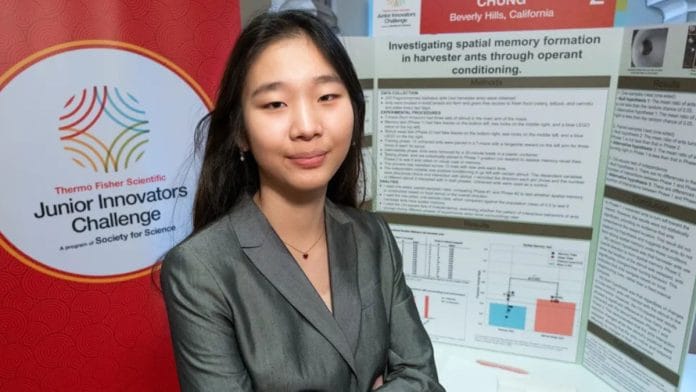


New Delhi: Most eighth graders ignore the thousands of ants that exist around them, but not Seungah Cheung, a student of the Beverly Vista Middle School in Beverly Hills. Her fascination with ants led her to becoming the finalist of the 2025 Thermo Fisher Scientific Junior Innovators Challenge, a prestigious STEM competition for middle school students in the US.
“One day, I watched them break into my house and steal food from the kitchen and bring it back to their colony. Since that day, I started enjoying studying ants’ behaviour,” Cheung told Society for Science.
Ants have only 250,000 neurons compared to the 80 billion in humans. And yet, they have an incredible memory. Before her most recent project, Cheung also studied whether ants could build maps of their environments when they hunted for food. This time, she wanted to probe into their sense of direction.
“What fascinates me is how they manage to do this (explore new environments) with such small brains, while mammals rely on much larger, more complex systems,” Cheung said.
She designed a ‘T’ shaped arena where she put obstacles such as leaves, a rock, and a lego block, to see how ants would find their way to the reward — a tangerine kept on the other end. Putting 15 ants at a time into the maze, Cheung let them explore the maze for 30 minutes and then put them back in one at a time later.
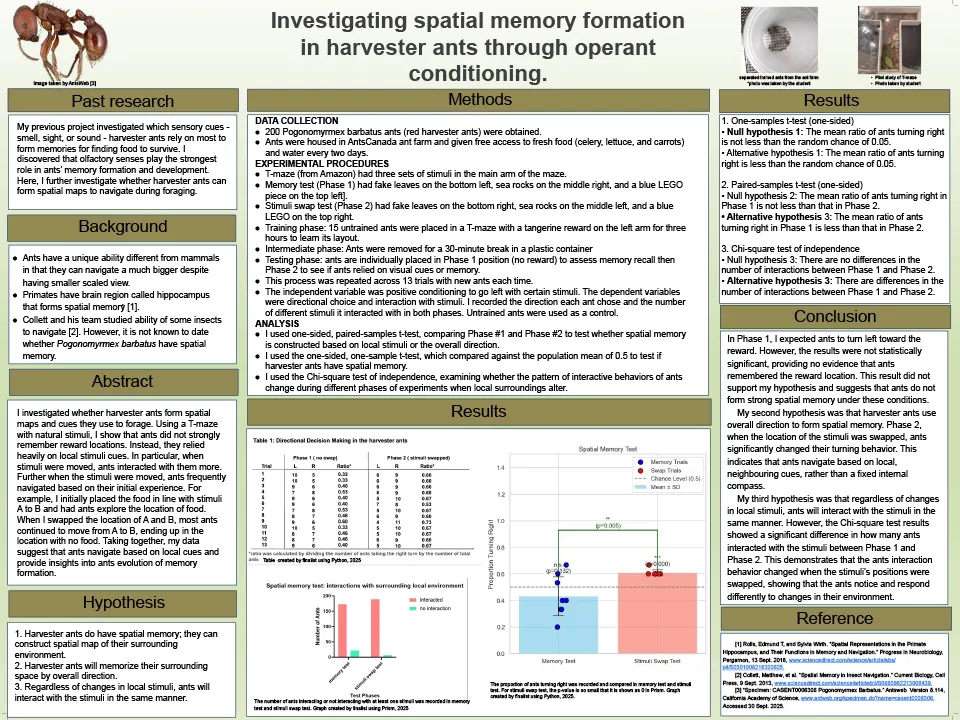
She found that while the ants did not remember the location of the rewards very well, when she moved the obstacles around, most ants got disoriented. This proved that ants don’t have a general sense of direction and instead use landmarks to navigate.
“It will be interesting to investigate if organisms with a simpler neural system than ants can also perform math in their nervous system,” said Cheung who hopes to one day become a microbiologist and find ways to combat infections once “antibiotics resistance takes over”.
Also read: ICAR has made the world’s first complete map of pigeonpea genome. Big in pulse research
Ant research in India
While Cheung has only just begun exploring the world of ants, at the Indian Institute of Science Education and Research, Annagiri Sumana, a professor in the department of biological sciences, has spent 15 years studying ant relocation. Sometimes, she packs the little ants and carries them back to her laboratory where she marks them with different colours, and releases them into a controlled environment where she can observe their behaviour and problem solving skills.
“My team and I have spent the past decade studying three things about ants: their history, their reproduction, and their methods of relocation,” Sumana explained. Relocation is an activity that all humans are familiar with, “But we can pack up our luggage into cardboard boxes and get it shipped to a new location, but ants can’t,” she says. They must travel significant distances, carrying extremely fragile luggage, their larva, their eggs, and their pupa, from which future generations of ants shall emerge.
At the Institute of Mathematical Sciences (IMSc) Shakti N Menon too studies the coordinated movement of ants and other species through simulations. While Sumana’s research makes observations based on experiments, Menon’s research looks at the real-life patterns of ants and then tries to understand and mimic them by creating mathematical explanations and theories for those movements.
Sumana’s research began with ant relocation and has now progressed to other related questions about the cognition and communication of ants.
“In my optimism, I thought a few years would be enough to understand and solve this. Now, 15 years and eight PhD students later, there are so many more questions waiting to be answered. We are just knocking at the door,” she said, convinced that there are enough questions to keep her occupied for at least another two decades.