



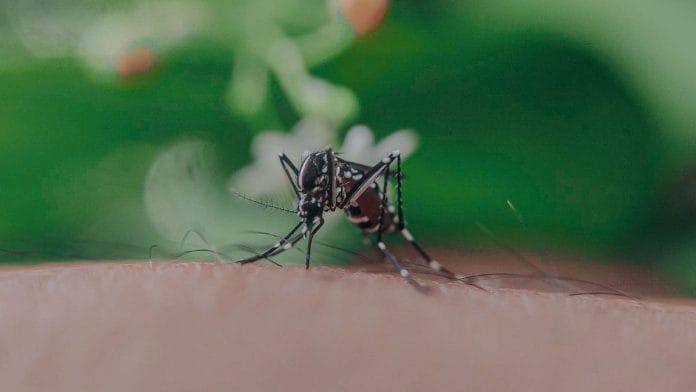

New Delhi: For the first time, researchers have built a “toilet” for mosquitoes, and the trace amounts of insect waste paint a picture of the virus ecosystem.
The idea is not new but the experiment certainly is. Often, the best place to find evidence of diseases and viruses circulating in an area is to look for their genetic evidence in wastewater. In a recent study published in Microbiology Spectrum, Dana Price, an entomologist at the Rutgers—New Brunswick School of Environment and Biological Sciences, applied this theory to mosquito waste.
“When mosquitoes feed on sugar, they excrete material that contains genetic traces of viruses and other organisms. Using specially designed collection devices and modern genetic sequencing, we show that mosquito excreta can reveal a wide range of viruses and parasites while also identifying the mosquito species present,” read the study.
The device that Price and his colleagues built is a 3D-printed funnel coated with a water-repelling material that slowly lets droplets of waste slide into a collection tube at the bottom.
“What we did, colloquially, was build a mosquito toilet,” Price said in a statement.
The team then used genome sequencing to analyse the mosquito waste and found evidence of the West Nile virus, a Hedwig-like virus, and several other types of viruses which have not been documented in the Americas yet. The method also allowed Price to identify the species of mosquitoes and other parasites in the air.
Also read: Ancestry might explain why some melanoma patients have more immunotherapy side effects
A new surveillance tool?
This is not the first time researchers have used mosquitoes as a surveillance tool. However, usually the process involves capturing thousands of mosquitoes, sorting them by species, and grinding them up before lab tests. While this mixture does contain secretions that might have trace amounts of viruses it is mainly made up of mosquito tissue. In comparison, researchers found it much easier to find viral material in mosquito waste.
They collected two groups of wild culex mosquitoes and placed each group in a container over the funnel. The mosquitoes were then fed a sugar solution and their waste was collected in a tube.
“Many infectious diseases (nearly 30 per cent) that affect people and animals are spread by mosquitoes and other biting insects, and the number of these outbreaks is increasing. Detecting pathogens in mosquito populations early can provide a critical warning before human cases begin, allowing health officials to act quickly,” read the study.
While researchers warn that such a device is still in its early stages, they are trying to build a field-ready trap that can capture mosquitoes and collect their waste even outside a lab setting.
“The pie-in-the-sky idea is a device that we place in a forest somewhere, and it’s constantly just beaming back data to us,” Price said.