



Studies on similarities between humans & members of the animal kingdom have revealed some stunning secrets.
When headlines appeared recently announcing that scientists had given the party drug ecstasy to octopuses, it wasn’t clear whether the more noteworthy behavior was on the part of the marine invertebrates or the humans. But there was a scientific reason for this small pilot study, which suggested that the drug has a similar effect on both species: making us friendlier.
While the brains of octopuses look very different from ours, and we have been diverging for more than 700 million years, we and these intelligent invertebrates share some of the same genes and molecular mechanisms for transporting signals around the brain and nervous system. We share, for example, a nearly identical version of a gene called SLC6A4, which codes for a protein that transports serotonin around the brain. This system, in us, is critical for regulating mood and social behavior, and is the target to which the drug ecstasy binds. In humans, ecstasy, or MDMA, decreases inhibition and increases social behavior.
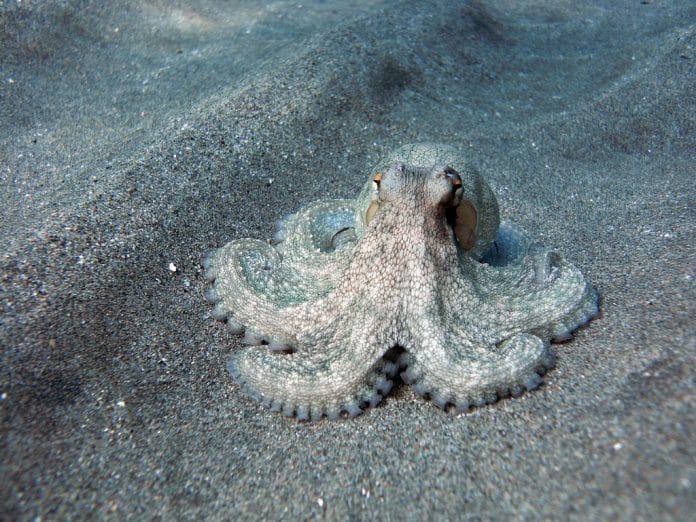
As a way to probe the similarity between species, researchers soaked octopuses in a bath containing the drug, and observed their behavior in a three-chambered enclosure. Two spaces contained toys and the other, a male octopus.
When not on the drug, the animals avoided the male and went for the toys. The species studied, the California two-spot octopus, is not particularly social in the wild, and both sexes are particularly averse to hanging around with males. When on the drug, however, they preferred a male octopus to the toys.
The difference in size and form of humans and octopuses is deceiving, because on a molecular and chemical level, there’s a lot of similarity in all life, and particularly all animals. Scientists studying fruit flies have discovered similar mechanisms to ours for governing sleep and memory. Studies on the effects of drugs revealed that fruit flies become inebriated when exposed to ethanol, and can become addicted to alcohol. They also respond to stimulants such as cocaine. Science keeps reinforcing the commonality noted in Jonathan Weiner’s book on fruit flies, “Time, Love, Memory.” The ability to track time and form memories appears throughout the animal world.
The new paper’s authors point out that social insects such as ants and honeybees have lost the SLC6A4 gene, so they must have evolved their social behavior through some independent mechanism.
As for love, if we can be generous with the definition and include any behavior that benefits others at one’s own expense, then it’s been observed in bacteria, giving it the deepest roots of all – Bloomberg