



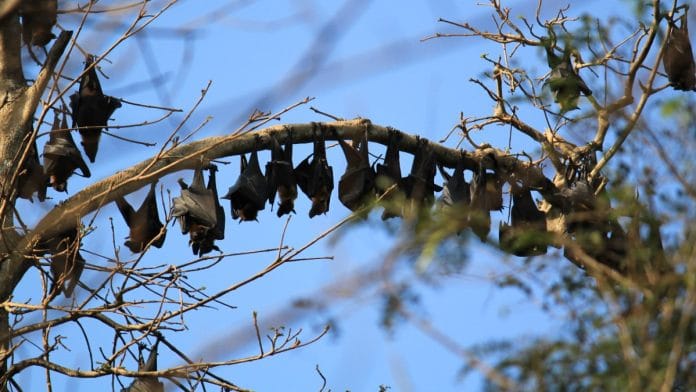
New Delhi: Bats likely originated in Europe around 65 million years ago, rather than in Africa, Asia or North America as earlier theories had suggested, according to a new study published in Nature on 23 September. The research also suggests that two of bats’ defining abilities, powered flight and echolocation, came very early.
The findings redraw the evolutionary history of bats and offer a new framework for studying their development.
The study was conducted by a team of 137 researchers from 64 countries working through the Bat1K consortium, an initiative to build high-quality genome sequences for living bat species.
Scientists from various institutions, co-led by Stony Brook professor Liliana M. Dávalos, contributed to the work.
The team combined genetic information from living bats with evidence from fossil bats to reconstruct the animal’s evolutionary history. The study examined genomes from 103 bat species and 44 fossil bat species.
“The approach we used to model the evolution of fossil and living bat species together can do what other methods cannot: identify the oldest group of fossil bats while taking the genomic data into account and uncover when and where bats originated,” Liliana M. Dávalos said.
How did researchers determine where bats came from?
To trace the origins of bats, the researchers first gathered the largest set of bat genome assemblies and fossil samples through DNA sequencing and computational methods.
They combined DNA data from living species with physical evidence from fossil bats. Further, they used evolutionary models that analysed when the fossils lived and how the continents and landmasses changed over time.
This approach allowed the researchers to trace relationships between different bat groups and also estimate where their earliest ancestors lived.
The analysis placed the ancestor of modern bats in Europe during the Late Paleocene, roughly 65 million years ago, refuting earlier theories which referred to Africa, Asia, the Americas, or Australia as the place of origin.
Also Read: Bats are hanging out at India’s protected monuments. And ASI doesn’t know what to do
Flight and echolocation evolved early
The study also examines how bats acquired two of their defining abilities: flight and echolocation. Researchers placed an ancient bat called Vielasia on the oldest branch of the bat family tree. Its physical features suggested that it was capable of echolocation, indicating that the ability appeared very early.
These early bats also had features of powered flight, which led researchers to suggest that both abilities emerged very early in bat evolution.
“Our analysis, here at Stony Brook, shows that the oldest branch of bats already had species that unambiguously echolocated. Therefore, based on the tree with these fossils, bat echolocation evolved shortly after mammalian flight did,” Liliana adds.
With more than 1,500 bat species worldwide, bats form one-fifth of all living mammal species. They play a key role in maintaining healthy ecosystems by pollinating plants, dispersing seeds, and consuming insects.
The new findings give scientists a detailed understanding of how such a diverse group emerged and adapted over millions of years.
Edited by Maryam Hassan