





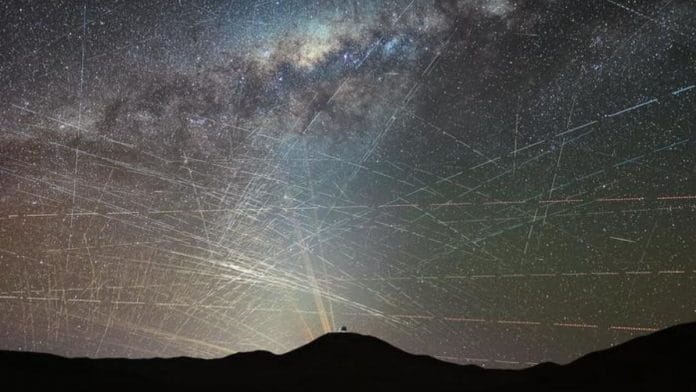


New Delhi: A new study by the European Southern Observatory has found that the plans to launch over 1.7 million more satellites into the Earth’s orbit could have “devastating consequences for astronomy”.
The study, titled “Large or bright satellite constellations: Effects on observations, including background sky brightness”, was published in Astronomy & Astrophysics on 29 June. It was conducted by Olivier Hainaut, a researcher who has been working on ways to reduce the impact of satellites on astronomy.
“Sending thousands of satellites has implications: economical, ecological, and astronomical. My job is astronomy, so I quantify the effects on astronomy. I hope others will evaluate the other impacts in their field of expertise,” Hainaut said in a press release.
According to the study, since 2019 the number of satellites orbiting the earth has risen to over 14,000 or 32,000 including debris and non-functional satellites. This number is likely to rise exponentially with SpaceX planning a million more satellites and Reflect Orbital proposing to launch 50,000 mirror satellites to reflect sunlight into the Earth at night.
“The FCC (Federal Communications Commision) received over 1800 comments regarding Reflect Orbital and nearly 1500 comments on the application by SpaceX. The ball is now in the FCC’s court, and we wait to see the determinations they make on both filings. For optical astronomy, this is an existential threat, and we hope that the regulators will share that view,” Betty Kioko, ESO Institutional Affairs Officer said in a press release.
Hainaut explains that Earth-based astronomy is heavily dependent on space photography but satellites lead to bright streaks in the sky which ruin images taken by telescopes. The study creates simulations of what space-imagery might look like in the future and predicts that nearly 28 per cent of the field of view could be affected by satellites. Hainaut notes that the Vera C Rubin Observatory could spend hours every night taking photographs which would have no academic value. The study highlights that Reflect Orbital’s mirror satellites would be even more dangerous since they could appear nearly four times brighter than even the full moon.
The study recommends that the number of satellites in the sky be limited to 100,000 and their brightness should be controlled in such a way that they remain invisible to the naked eye.
Beyond just the implications to astronomy, the study also highlights that an excess amount of satellites would make the night sky brighter, and the increased light pollution could disrupt ecosystems and biological clocks. The study also warns that the rise of satellites could lead to more atmospheric pollution caused by rocket launches and satellite re-entry into the earth.
“Low Earth orbit is a celestial seashore that provides immense value to modern life, from global connectivity to our clear access to the Universe. However, we must manage the footprint of mega-constellations — from the light pollution affecting astronomy to the atmospheric effects of satellite re-entry — to ensure this resource remains pristine and accessible for future generations,” Hainaut said in a press release.