





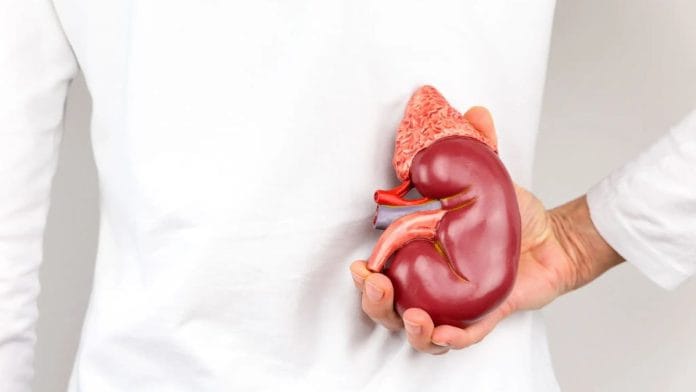

New Delhi: Using AI to catch diseases early is a growing trend in modern medical science. Now, IIT Madras and CMC Vellore have also joined in. Researchers from the two institutions are developing AI tools that will help flag kidney diseases and even recreate a ‘digital twin’ of a kidney which will predict how a kidney disease is likely to progress.
The project included professor GL Samuel from the department of Mechanical engineering, Jennifer Delighta, a PhD student at IIT madras, and professor Santosh Varughese, a nephrologist at CMC Vellore. The team wanted to create an intelligent system which would allow clinicians to make more informed decisions about kidney diseases.
Kidney diseases often go unnoticed in their earlier stages. Many of the symptoms appear only after significant damage is done. In such cases, an early warning system could potentially reduce expensive interventions like dialysis.
One of the highlights of this research is what the team describes as a “digital twin” of the human kidney.
“I am basically a mechanical engineer, and I have worked on creating digital twins for machines, robots, and even autonomous mobile robots. Now we’ve managed to create a digital twin of a kidney. Through this I’ll be able to feed in data about the patient and predict whether the kidney has a tumour and how it might grow,” Samuel told ThePrint.
Also read: 17 days, 14 demands. How Pune tribal students made Maharashtra listen
A ‘digital twin’
To create a digital twin, the essential element is data which will allow researchers to better understand the kidney and how it works. Much of this data come from CT scans that researchers have procured from CMC Vellore. While they have trained the initial AI models on about 12,000 CT scan images, Samuel highlights that finding open records of patients is extremely difficult in India.
“Usually hospitals don’t reveal patient records. In many other countries, they have made patient records public so create tools like the one we are working on. But India does not have such a repository. So we are still trying to speak to AIIMS and other hospitals to gather more data,” Samuel said.
The team’s findings are still at a preliminary level and Samuel said that even with technology moving at a fast pace these days, it will take them at least another five years before their devices might be routinely used in hospitals.
“Eventually we would also like to build a small device, like a patch that can be attached to the skin of a patient. This patch will be able to analyse the body fluids of a patient and indicate the progress of kidney disease,” said Samuel.