





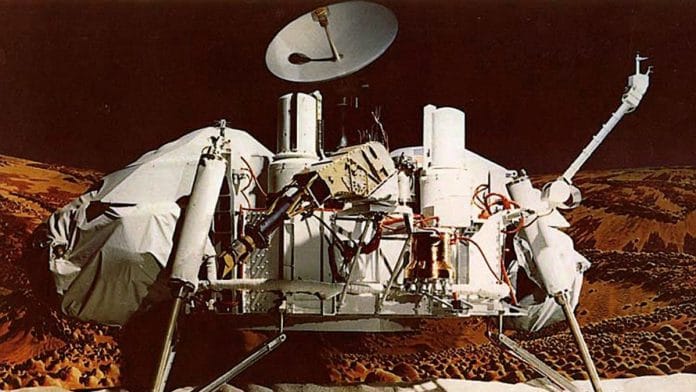


New Delhi: Fifty years ago today, NASA’s Viking 1 became the first spacecraft to successfully land on Mars. Five decades later, the achievement remains among the greatest landmarks in planetary science, a model for every rover and orbiter sent to Mars since.
Viking 1 was a two-spacecraft mission, including an orbiter and a lander designed to capture pictures of Mars in unparalleled detail, analyse its atmosphere and geology, and conduct experiments searching for signs of life.
Even in 1976, the landing was historic since it coincided with the seventh anniversary of the Apollo 11 moon landing. The lander touched down at 7:53 am EDT in Chryse Planitia, and Earth found out 19 minutes later once the signal had travelled 212 million miles (341 million km). Through its journey, the Viking spacecraft captured more than 52,000 pictures of Mars.
The spacecraft was launched from Cape Canaveral in Florida on 20 August 1975. The orbiter finally stopped working on 11 November 1982.
NASA had sent a command to update battery-charging software, which led to the software of the lander’s communication system being overwritten. The mission was officially terminated in 1983.
The Viking 1 is still where it landed half a century ago. Being exposed to constant sandstorms and wind as well as dramatic changes of temperature, the spacecraft has become a permanent monument.
A dream destination
Mars continues to be among the most difficult destinations to reach in Earth’s neighbourhood. According to where the planets are at any moment, it can be as close as 53 million km or as far as 400 million km away. Temperatures vary from -140°C to 20°C, and its atmosphere consists of about 96 per cent carbon dioxide, and is less than one per cent the density of the Earth’s atmosphere. The gravity of Mars is about 38 per cent that of Earth. The day is 37 minutes longer, and the year almost twice as long.
The harsh conditions continue to influence how engineers plan missions to the planet. The dust storms that cover the entire planet can last for months, reducing the usefulness of the solar panels, making nuclear energy sources more efficient for future missions.
NASA has already begun preparations for this future. In 2023, the agency began its first Crew Health and Performance Exploration Analog (CHAPEA), a 378-day Mars habitat simulation at Johnson Space Center in Houston. The experiment studied how astronauts might live and work during future manned missions to the Red Planet.
Mars also remains one of the busiest destinations in space exploration, with NASA having launched 17 missions since the first flight of the Vikings.
NASA’s latest Mars mission, ESCAPADE, launched twin orbiters, Blue and Gold, in November 2025. They will study how solar wind interacts with the Martian atmosphere. After using Earth’s gravity for a slingshot manoeuvre in 2026, the spacecraft are expected to arrive in 2027.
The mission cost $75 million and is managed by the Space Sciences Laboratory at UC Berkeley. Key partners include Rocket Lab and Blue Origin.
Other countries have also shown an interest in Mars. India’s Mars Orbiter Mission, or Mangalyaan, launched in 2013 and reached Mars in 2014. Designed as a six-month mission, it continued operating until 2022, becoming one of the world’s most cost-effective interplanetary missions. ISRO is now working on Mangalyaan-2, which aims to achieve a soft landing on the Martian surface around 2030.
China’s Tianwen-1 mission entered Mars orbit in 2021, successfully deploying the Zhurong rover, which carried instruments capable of probing beneath the surface for signs of water ice. The rover even contained a radar that could detect pockets of water beneath the surface which may contain life. But the rover entered a sleep state after nearly a year on Mars. Chinese officials suspect it may have been due to the solar panels on the rover being blocked by dust.
The United Arab Emirates’ Hope orbiter, which also arrived in 2021, continues to study the Martian atmosphere and climate to better understand how the planet evolved from one that once had flowing water into the cold desert seen today.
Thanks to such missions, scientists now know that there was a time when there was liquid water on the Martian surface. But after the planet lost its magnetic field, the solar wind gradually stripped away much of its atmosphere, leaving behind the dry, frozen world explored by Viking 1 and the missions that followed.
(Edited by Theres Sudeep)