





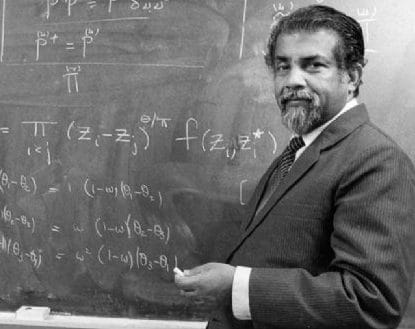

His most notable contribution was the Sudarshan-Glauber quantum representation of light, for which the Nobel was infamously given to Glauber only.
Bengaluru: Theoretical physicist Ennackal Chandy George Sudarshan passed away in Texas in the United States Monday. Popularly known as E.C.G. Sudarshan, he had made notable contributions to the field of quantum optics.
He had been nominated for the Nobel Prize nine times. He was the recipient of the Dirac Medal (2010), Padma Vibhushan (2007), The World Academy of Sciences (TWAS) Physics award (1985), Bose Medal (1977), Padma Bhushan (1976), and the C.V. Raman Award (1970).
Sudarshan had been a professor at the department of physics at University of Texas, Austin.
Early years and Nobel snub
Born in Kerala, Sudarshan was famously influenced to become a physicist when he found his older brother’s high school textbook at home. After reading the book end to end, he stumbled upon the sentence “the derivation of the formula for the period of a simple pendulum was beyond the scope of the book”. Young Sudarshan set out to hunt for a book that actually would show the derivation of the formula, and found a life-long love in the process.
He graduated from the Madras Christian College in 1951, and worked as a research assistant to Homi Bhabha at Tata Institute of Fundamental Research (TIFR), Bombay, before obtaining his Ph.D. from the University of Rochester in 1958. He did his post-doctoral studies at Harvard University, and was one of the first few scientists to propound the theory of the Vector-Axial interaction of the weak force, one of the four fundamental forces in physics.
His most notable contribution was in the quantum representation of light, known as Sudarshan-Glauber representation, for which the Nobel Prize was infamously given to Glauber only.
This was perhaps Sudarshan’s greatest legacy: He was a living example of the Nobel committee’s openly flawed bias towards European and American male scientists. Following Glauber’s win, several physicists had written to the committee in criticism, noting that the bulk of the work on it had been done by Sudarshan and merely co-opted by Glauber.
Sudarshan was also famous for proposing the existence of the hypothetical particle called tachyon, which he purported could move faster than light. It was eventually proven that such a particle could not exist in reality as it would defy the laws of physics. However, the term is still used today as a placeholder for an imaginary particle with a quantum field and plays a crucial role in theoretical physics.
Sudarshan also proposed the paradox known as Quantum Zeno Effect — the more frequently we measure a system, the less it changes.
Religion versus science
Born into a Syrian Christian family, Sudarshan renounced his religion as he was unable to reconcile the Church and physics. He practiced Vedanta, and delivered several lectures on the Vedantic school of philosophy.
He was deeply interested in Malayalam literature and spoke in a vivid Kottayam accent as he went all over the world. He was deeply intrigued by Indic studies, and read classical Indian texts avidly in conjunction with philosophical treatises.
He authored six textbooks on theoretical physics and taught at the University of Rochester, Harvard University, Syracuse University, the Institute of Exact Sciences (Switzerland), the Indian Institute of Science, and was the former director of Indian Institute of Mathematical Sciences in Chennai.
He is survived by his wife and three children.