



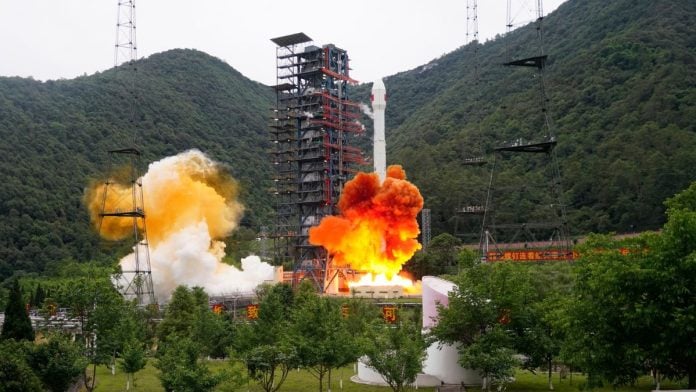
New Delhi: China has taken satellite spying to a new level. In June, it launched Shijian-31 into an expanded version of a Cold War-era Soviet orbit — one that now gives Beijing an unprecedented vantage point to watch every satellite in the Geostationary Earth Orbit (GEO).
On June 16, China launched Shijian-31 on board its Long March 3B rocket from Xichang spaceport. The satellite is part of the Shijian series, which has tested technologies, conducted orbital experiments and surveyed the space environment.
But this satellite is doing something no predecessor, Chinese or Russian, has done before.
COMSPOC, a US firm that provides commercial software for space situational awareness, called Shijian-31 “a satellite with an orbit we have never seen before.”
“What China has managed is an orbit that periodically looks down on the entire GEO belt from above, at an angle, on a rotating schedule, rather than fixating on one target,” it said.
Indian experts say the satellite should not be read in isolation — it’s part of a deliberate, well-built, mother-of-all surveillance network.
What makes the orbit unusual
While the Soviet Union largely used this orbit for satellite communciation and missile early-warning detection, China has taken it a step further to spy on other assets in space—mapping their capabilities, technology and even communications.
Shijian-31 is flying a derivative of the Molniya orbit, first created by the Soviet Union in the 1960s to provide reliable communication and surveillance coverage over its high-latitude regions — especially Russia and the Arctic — which traditional geostationary orbits could not reach.
An analysis by Integrity ISR, a US-based firm specialising in C4ISR, space, cyber and targeting, found that Shijian-31 sits in a highly elliptical orbit with an inclination of about 63.4 degrees and an eccentricity of 0.69, which is consistent with a Molniya-type orbit. (Eccentricity measures how far an elliptical orbit deviates from a perfect circle.)
The satellite has a perigee — its closest point to Earth — of about 1,993 km, and an apogee, its farthest point, of 39,896 km. This combination lets it watch every object in GEO while making it extremely difficult for any other satellite to work out its own payload and capabilities.
The original Soviet Molniya satellites, launched between 1965 and 1974 — about 40 of them — had a much lower initial perigee of around 500 km, at the same 63.4-degree inclination. That inclination isn’t arbitrary: at this angle, the Earth’s uneven gravity stops the orbit’s argument of perigee (the angle marking where the orbit’s closest and farthest points sit) from slowly rotating — keeping the satellite’s apogee fixed over the desired region. The orbit takes its name from these Soviet communication satellites — Molniya, meaning “lightning.”
China’s version goes further. Shijian-31’s apogee sits over the equatorial region instead of the high latitudes the Soviets were targeting, letting it make repeated sweeps of the geostationary belt. While a conventional Molniya orbit takes about 12 hours to complete a revolution, Shijian-31 takes 12.5. These extra 30 minutes shift its apogee by roughly 15.7 degrees in longitude with every pass. Over successive orbits, this allows the satellite to move its viewing position around the GEO ring, sweeping the entire belt in about 23 days. Its apogee, at 39,896 km, also sits above the geostationary belt itself, giving it a vantage point looking down on the ring from above, rather than sitting among the satellites it’s watching.
Also read: Pakistan’s spy satellite network watching India has grown faster than ever in just 16 months
How experts are reading it
Greg Gillinger, senior vice-president for strategy and development at Integrity ISR and among the first to flag the orbit, said China has released little information on Shijian-31 beyond describing it as being for “space environment detection.”
“With SJ-31, Chinese space operators have displayed orbital mechanics mastery and more than a little creativity,” he said in his analysis for Integrity ISR. “While Molniya orbits are well understood, this specific orientation — and its resulting relationship with GEO — is not typical. SJ-31’s orbit, and its evolving relationship with the GEO belt, is mandatory viewing.”
Former ISRO scientist and space technology expert Radha Krishna Kavuluru explained that China has been developing increasingly sophisticated capabilities through its Shijian series, including the ability to track, approach and operate around other satellites. Recent Shijian missions have demonstrated rendezvous and proximity operations in geostationary orbit, including activities involving Shijian-21 and Shijian-25.
The geostationary belt is strategically important because it hosts a large number of critical spacecraft, including commercial and military communication satellites, weather satellites, and satellites involved in missile warning and other strategic missions. Some large geostationary communication satellites cost several hundred million dollars, with individual spacecraft in some cases reaching the $400–900 million range.
“This is what we broadly call space domain awareness. Earlier, much of this tracking and monitoring was performed from the ground. Increasingly, countries are putting sensors and spacecraft into orbit to observe the space environment from space itself,” Kavuluru said.
He explained that this is important because the GEO region is not simply a collection of stationary satellites. Spacecraft regularly perform station-keeping, orbit-raising, relocation and other manoeuvres, and countries are increasingly demonstrating sophisticated rendezvous and proximity operations around GEO spacecraft. The Shijian-21 and Shijian-25 activities in 2022 and 2025, for example, involved multiple close approaches and apparent docking-related operations in geosynchronous orbit, he said.
“In a future conflict, the ability to know where another country’s satellites are, understand what they are doing and potentially approach them becomes extremely important. Space domain awareness therefore isn’t just about making a catalogue of satellites anymore. It is increasingly about being able to observe and understand the behaviour of spacecraft in orbit.”
Kavuluru added that the broader lesson is the growing importance of space domain awareness and space-based intelligence.
“We have seen in recent conflicts that information and networks are enormously important. The same principle increasingly applies to space. Knowing where every important spacecraft is, understanding its behaviour and being able to detect unusual manoeuvres can become strategically important. China and the US have been investing heavily in these capabilities, and India will also need to develop much stronger space-domain-awareness capabilities as the number and importance of satellites continues to grow.”
Other Indian experts also agreed that China’s surveillance network extends beyond Shijian-31. It is building a spy network in space.
Ajey Lele, deputy director general at the Manohar Parrikar Institute for Defence Studies and Analyses (MP-IDSA), said that while ordinary GEO satellites sit at a fixed point, China’s network, which now includes Shijian-31, is designed to manoeuvre around the orbit and even monitor the technical design, capabilities and data recorded by other satellites.
“The only disadvantage these satellites would have is that because they are moving around the orbit, they will probably use up more fuel and would not have as long a life as a regular satellite would, which is about 10-15 years,” Lele said. “But to solve that problem, they are placing more satellites so that when one retires, the other immediately takes over.”
Also read: How a Hyderabad pharma firm built a satellite that can spy on foreign assets in space
A wider network
Shijian-31 isn’t China’s first move in space surveillance. Between 2021 and 2026, China launched four other satellites into highly elliptical orbits arranged to provide overlapping, near-continuous coverage: Shiyan-10 01 (2021), Shiyan-10 02 (2022), Tongxin Jishu Shiyan-13 or TJS-13 (2024), and TSJ-21 (2025).
These follow a “two-ball” configuration — pairs of satellites positioned at two different points in an orbit, so that when one moves away from a surveillance target, the other immediately takes over. This is especially useful for missile warning, since an infrared sensor can spot the heat signature of a launch against the dark background of space, and the orbit provides a longer dwell time over a region of interest.
China also runs the Yaogan reconnaissance system, with surveillance coverage over at least a third of the Earth’s surface, alongside the Gaofan and Ziyuan series of high-definition 3D imagery and multispectral satellites — together giving it round-the-clock coverage.
Sudhir Pillai, a former flag officer of the Indian Navy, said ground telescopes can also track GEO satellites but are limited by cloud, haze, daylight, atmospheric distortion and the horizon.
“An orbiting sensor avoids many of these constraints,” he wrote in a blog post. “It does not look through the atmosphere, is unaffected by clouds, and is not tied to darkness at a particular ground site. A carefully shaped orbit can also provide changing angles over the GEO arc.”
Pillai was careful to note the limits of what the orbit alone tells us: it shows Shijian-31 is positioned to contribute to space-domain awareness — what objects are present, where they are, how they move, and when their behaviour changes — but not what it actually carries or watches.
“Shijian-31’s orbit tells us what its geometry permits, not what payload it carries or which satellites, if any, it is intended to observe,” he wrote.
Also read: India will soon have its own satellites to monitor spy satellites. How the technology works
What it means for India
India has 31 satellites that currently fall within Shijian-31’s GEO belt. These include the GSAT series, an advanced network of indegeniously developed communication satellites designed to meet India’s needs for internet services, digital broadcasting and millitary communications; the INSAT series, India’s network of meteorological satellites; and NavIC, India’s navigation satellite system, developed as an Indian alternative to the US’ GPS and China’s BeiDou.
“India and other countries will have to keep monitoring the movements of these surveillance satellites. If you don’t, they will keep moving at their convenience and extracting key information. That is the only way to keep some check,” Kavuluru said.
India, for its part, has not been a passive player when it comes to bending orbits to non-standard purposes, though its own experiment has been aimed at imaging Earth, not watching other satellites.
On September 4, India launched its Earth Observation Satellite-05 (EOS-05), also known as GISAT-1A, on board the GSLV-F17 rocket. Unlike most observation satellites, which sit in low-Earth orbit — between 160 km and 2,000 km — to get a consistent view of a fixed patch of ground, EOS-05 was placed in a geosynchronous orbit roughly 36,000 km above Earth. India’s GSLV Mk-II first placed the satellite into a sub-geosynchronous transfer orbit — an intermediate orbit that falls short of a conventional GTO’s altitude and energy — before it moved to its final position.
EOS-05 is the first Indian imaging satellite designed to operate from geosynchronous orbit, giving it a wider, more persistent view of India and its neighbourhood. It’s a different tool for a different job, but just a reminder that India, too, is willing to depart from conventional orbital playbooks.
(Edited by Prashant Dixit)