



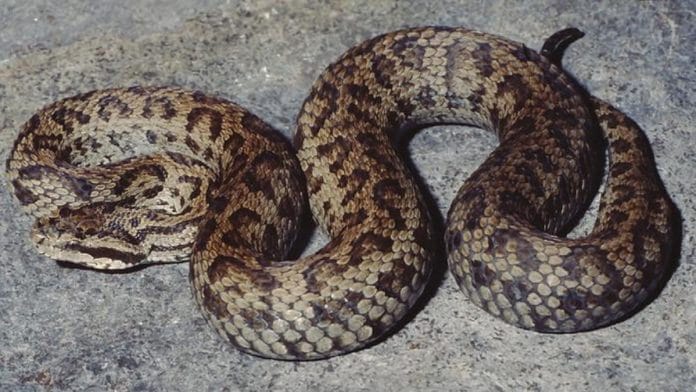
New Delhi: The most elusive and venomous Himalayan pit viper is now understood to be five distinct species, three of which have never been documented before, states a recent study.
“This study emphasises the urgent need for conservation of these narrowly distributed and potentially regionally threatened mountain snakes,” it added.
The study, published in the open-access journal ZooKeys, used a combination of fresh and historical DNA, skeletal anatomy, and ecological observations to discover the new species of snakes. Until recently, researchers believed that the Himalayan pit viper, discovered in 1864, was a widespread and yet little-studied species in the Himalayan range.
However, a team of international researchers found the Himalayan pit viper, the Gloyfius chambensis, first discovered in 2022, and three other species in different regions of Pakistan and Nepal.
“These mountain systems still harbour overlooked vertebrate diversity and hold important clues to the biogeography of Asia,” the lead author of the study, Daniel Jablonski of Comenius University Bratislava, said in a press release. Jablonski and her team have been studying the biodiversity of Pakistan and Afghanistan for several years.
Also read: The ‘third eye’ exists. It’s hidden in the brain, say Sussex scientists
Unchartered territory
Researchers admit that the higher regions of the Himalayan and Hindu Kush regions are one of the least biologically explored regions of Asia. This is due to several reasons—the rugged terrain, the lack of road access, and the complex socio-political relationships, especially with countries like Pakistan and Afghanistan.
The study also highlights the importance of research into herpetofauna, or the snakes, reptiles, and amphibians of a region, because of their significant role in the ecosystem. Such creatures help researchers study the ecological condition of an area. Snakes are both predators and prey within food chains.
Pit vipers are highly sensitive to temperature, humidity, the availability of prey, and the vegetation in an area. If research someday shows that a Himalayan pit viper is found at high altitudes, it may help scientists understand how warming temperatures are altering mountain ecosystems.
Similarly, if the population of pit vipers declines sharply, it could indicate a lack of amphibians or rodents for them to prey on, or some form of pesticide contamination in the area, or even a change in the moisture of forest floors.
(Edited by Saptak Datta)