





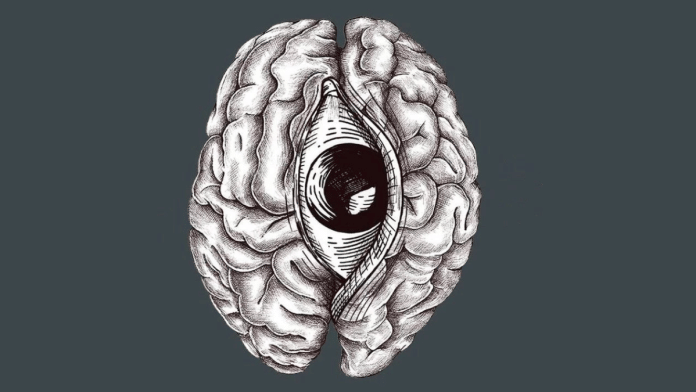


New Delhi: Scientists have discovered that while humans have two eyes now, the remnants of a third eye might still be a part of our physiology.
The findings were published in a study titled “Evolution of the vertebrate retina by repurposing of a composite ancestral median eye” in the journal Current Biology.
Researchers at the University of Sussex began with the need to explain the origins of a small pea-sized gland inside the human skull—the pineal gland. This gland, found in nearly all vertebrates, produces melatonin, the hormone that regulates sleep and waking. Researchers found the strange little gland interesting because it is in charge of the body’s response to light in the dark.
In trying to deduce the evolutionary journey of the pineal gland, scientists came up with a sweeping new hypothesis: What if the gland was once a third eye?
The puzzling eyes of vertebrates
In antiquity, there were two types of light-detecting cells—ciliary photoreceptors, which make up the rods and cones in the retina of vertebrates, and rhabdomeric photoreceptors, which are found in insects. The study explains that the first type of cell could sense light and regulate the circadian rhythm. The second was better for fast responses, movements, and navigation.
Most animals have eyes that evolved out of rhabdomeric photoreceptors. However, vertebrates—fish, reptiles, birds, and humans—have complex eyes that the study calls “chimeric”.
Vertebrate eyes are built from ciliary photoreceptors, and yet, these cells are wired into neurons that resemble rhabdomeric cells. Until now, there was no explanation for why vertebrate vision would fuse two different mechanisms to enable sight.
As researchers wondered what the original vertebrate eye could have looked like, they travelled back to study a long-lost relative of vertebrates—deuterostomes. Deuterostomes, are bilaterian animals, which crawled along the shallow seafloor nearly 600 million years ago. Scientists propose that this ancestor had two eyes for navigation, and a third to track levels of light.
The study suggests that at some point, this ancestor decided to bury its head into the ground and feed off the particles floating around. As the creature lost the need to navigate, its two lateral eyes became useless and were eventually discarded in the evolutionary process. What remained was the “third eye,” which could tell day from night and up from down.
Eventually, when this ancestor decided to leave the burrow, the need to be able to navigate arose once again. Researchers have proposed that the creature then rebuilt its capacity to see using the one eye that still remained. What was once a “third eye” divided itself to create two new eyes and then retreated into what we now know as the pineal gland.
The study’s findings are still hypotheses, but perhaps research into the evolution of vertebrate eyes may still have mysteries to reveal. Another Nature study from January 2025 suggested that the ancestors of vertebrates could have, at some point, even had four eyes. Perhaps three were just not enough.
(Edited by Insha Jalil Waziri)