





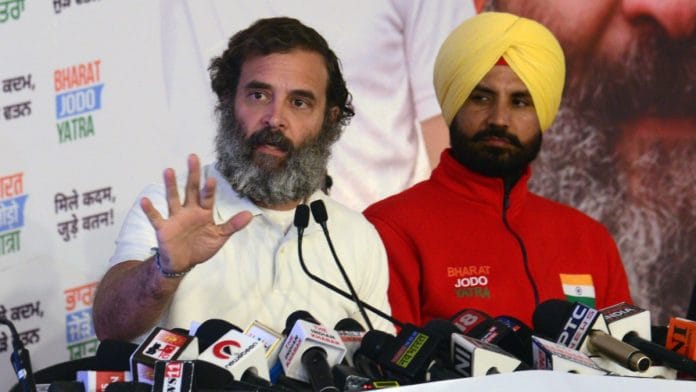


New Delhi: For much of the past three years, Amarinder Singh Raja Warring has struggled to achieve the very objective for which Rahul Gandhi chose him—to rebuild a Punjab Congress battered by electoral defeat and years of infighting.
The party organisation in Punjab remains divided, rival camps continue to pull in different directions and the Congress’s disappointing performance in recent local body elections has only reinforced the view among many state leaders that the party has failed to recover from its crushing defeat in the 2022 Assembly polls.
Yet, even as former Chief Minister Charanjit Singh Channi, former Deputy Chief Minister Sukhjinder Singh Randhawa and several other leaders have openly questioned Warring’s leadership, the Congress high command has refused to reconsider its decision.
Gandhi’s continued backing of Warring is no longer merely about the future of one Pradesh Congress Committee (PCC) president. It has become a test of the authority of the Congress leadership itself.
That message was reinforced this week when AICC general secretary in-charge of Punjab Bhupesh Baghel met leaders from rival camps in an attempt to defuse the growing crisis. According to Congress leaders familiar with the discussions, the meetings were intended to restore organisational cohesion rather than reopen the question of Warring’s continuation.
Also Read: Manish Tewari controversy reignites Congress debate. Does high command ‘punish’ independent voices?
A question bigger than Warring
Senior Congress leaders say Delhi no longer sees the crisis purely through the prism of Warring’s performance. Instead, the larger concern is the authority of the high command itself.
“The issue is no longer just Raja Warring. If the leadership changes a PCC president because a section of leaders publicly campaigns against him, every PCC across the country will believe Delhi’s organisational decisions can be overturned through pressure. That is a precedent the leadership does not want to create,” a senior Congress leader told ThePrint.
That explains why Baghel’s outreach has focused on reconciliation rather than leadership change. According to party leaders, the central leadership believes organisational appointments cannot become negotiable every time rival camps mobilise against one another.
The lessons of Punjab’s recent past
The high command’s thinking is also shaped by its experience during the conflict between Captain Amarinder Singh and Navjot Singh Sidhu.
For months, the Punjab Congress remained consumed by an internal power struggle that overshadowed governance and organisational work, eventually culminating in the party’s worst Assembly election defeat in years.
“What happened during the Captain-Sidhu phase damaged the Punjab Congress enormously. The organisation spent more time dealing with internal battles than preparing for elections. Nobody wants to repeat that experiment,” another senior Congress leader said.
Having watched the Amarinder-Sidhu conflict spiral into a leadership crisis and later witnessed tensions between Sidhu and Channi ahead of the 2022 polls, the Congress leadership believes another change at the top could deepen rather than resolve factionalism.
Why Rahul Gandhi still trusts him
Congress leaders say Rahul Gandhi’s confidence in Warring is rooted not only in loyalty but also in the Congress leader’s long-term project of building a younger generation of organisational leaders.
When Gandhi began reshaping the Congress organisation, he pushed for internal elections in the Youth Congress and NSUI to bring new faces into leadership instead of relying solely on established political families and regional satraps. Warring is widely seen within the party as one of the successful products of that experiment.
After beginning his political career in the Punjab Youth Congress, Warring rose through the organisation before being handpicked by Gandhi to contest the 2012 Assembly election from Gidderbaha. He defeated Manpreet Singh Badal on his home turf and retained the seat in 2017, later serving as president of the Indian Youth Congress between 2014 and 2018.
A three-time MLA from Gidderbaha, Warring later served as Transport Minister in the Channi government and is now the Lok Sabha MP from Ludhiana.
During the leadership upheaval that led to Captain Amarinder Singh’s exit from the Congress in 2021, Warring emerged as one of Amarinder’s strongest critics and firmly backed the decisions of the Gandhi leadership.
“The leadership remembers who stood with the organisation during one of its most difficult phases. Raja’s rise has been through the organisation, not because he inherited a political faction. That makes him someone the leadership believes it can trust,” a senior Congress leader said.
Leaders close to Gandhi also describe Warring as one of the party’s more articulate campaigners in Punjab, capable of aggressively taking on both the BJP and the Aam Aadmi Party in public while remaining organisationally aligned with the central leadership.
His appointment as Punjab Congress president after the party’s 2022 Assembly defeat was widely viewed as part of Gandhi’s effort to reduce the influence of the state’s entrenched power centres and promote leaders whose authority flowed from the organisation rather than factional backing.
For the Congress leadership, replacing Warring now would not simply mean changing a PCC chief. It would amount to abandoning that organisational experiment under pressure from rival camps.
The caste equation
Punjab’s caste arithmetic also figures in the Congress’s calculations.
Warring belongs to the Jat Sikh community, which has historically exercised considerable political influence in the state, particularly across the Malwa belt.
At the same time, the Congress continues to view Dalit voters—who constitute nearly a third of Punjab’s population—as central to its electoral strategy, a calculation reflected in its decision to make Channi the state’s first Dalit chief minister in 2021.
Congress leaders say retaining Warring allows the party to project a prominent Jat Sikh face while balancing competing social and regional interests.
Rahul’s Punjab calculation
A professor at Panjab University and political analyst, Ashutosh Kumar, believes another factor may explain Rahul Gandhi’s reluctance to replace Warring.
“One line of thinking is that Punjab is among the few states where Rahul Gandhi himself could become the principal face of the Congress campaign. His personal image in Punjab remains relatively intact compared to several other states,” Kumar told ThePrint.
“If Rahul intends to lead the campaign himself, he may prefer a state president whom he trusts organisationally rather than another regional satrap,” he added.
Kumar also believes the current rebellion, though politically significant, is not entirely unusual for the Congress.
“Factional fights have always existed in the Congress. The party has historically accommodated multiple power centres. Defiance of the high command is no longer unusual. The only difference this time is that senior leaders have made their opposition to Warring unusually public,” he said.
(Edited by Sugita Katyal)