



Lucknow: Union Minister and Lok Janshakti Party (Ram Vilas) chief Chirag Paswan has stepped up political activity in Uttar Pradesh ahead of the 2027 Assembly elections, with the party preparing to expand its footprint in the state.
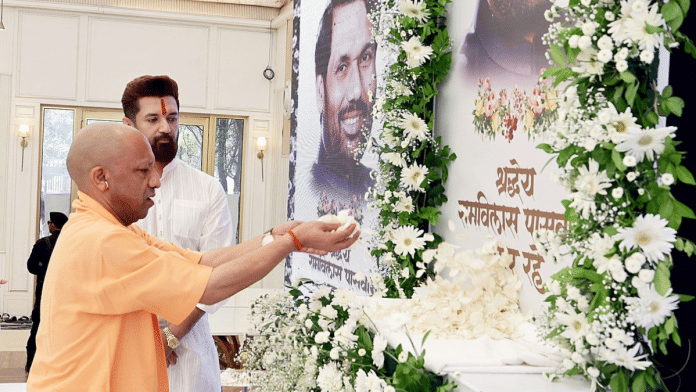
Paswan recently organised an event in Lucknow to mark the death anniversary of his father, Ram Vilas Paswan. Chief Minister Yogi Adityanath, Governor Anandiben Patel, Union Minister Anupriya Patel and several other leaders attended the programme. It was the first major event organised by the LJP (Ram Vilas) in Lucknow ahead of the Assembly elections.
Paswan has said the party is preparing to contest all 403 Assembly seats in the state. Senior party functionaries, however, say that it is likely to explore an understanding with the Bharatiya Janata Party (BJP). This could take the form of a formal alliance or an arrangement under which the LJP (Ram Vilas) contests a limited number of seats separately.
Party sources said around 100 Assembly constituencies in the Awadh and Purvanchal regions with sizeable Pasi populations have been identified for focused organisational work.
Arun Bharti, Member of Parliament and the party’s Uttar Pradesh in-charge, said the party was currently preparing for all 403 seats, while the final decision on the number of constituencies it would contest would be taken closer to the elections.
Bharti said Chirag had recently attended three programmes in Uttar Pradesh, two in Lucknow and one in Prayagraj. The Prayagraj event, held 27 September under the banner ‘Youth Bole Toh’, was aimed at young voters, particularly Gen Z.
Similar programmes are planned in Varanasi, Gorakhpur and Kanpur, which Paswan is expected to attend. The party is also planning a major event at Lucknow’s Ramabai Ambedkar Maidan.
The state unit has drawn up plans for a ‘Pasi-Paswan Samman Shaurya Yatra’’, Dalit chaupal meetings and a Brahmin conference. A major Brahmin outreach programme is also planned in Lucknow.
Bharti said the party was attempting to reach out to all communities and that its strategy should not be viewed as being limited to the Pasi community.
The party has divided its Uttar Pradesh organisation into four regions: Purvanchal, Awadh, western Uttar Pradesh, and Bundelkhand, each with a separate regional president. Bharti also added that LJP did not contest in 2024 LS polls and the 2022 Assembly elections in Uttar Pradesh, but in the 2002 contest it had won two seats when Ram Vilas Paswan was leading the party.
Paswan has said that the party’s role in the 2027 Uttar Pradesh elections has not yet been decided, given that it is a constituent of the National Democratic Alliance (NDA).
While the state unit is preparing organisationally, the party is keeping its options open, including the possibility of contesting independently if required.
The party is planning at least 20 rallies and programmes involving Paswan ahead of the 2027 elections, with a particular focus on districts in Purvanchal. Through these events, it hopes to build a political presence among Dalit communities and young voters.
Also Read: Chirag adds sheen to NDA’s win in Bihar, delivers another blockbuster with 19 seats
Why the Pasi vote matters
The LJP (Ram Vilas) outreach comes at a time when the Dalit vote is emerging as an important factor in Uttar Pradesh’s changing electoral equations.
The Pasi community accounts for an estimated 9 percent of the Uttar Pradesh electorate and constitutes at least 15 percent of voters in central parts of the state and Purvanchal, making it a significant constituency for parties seeking to expand their Dalit support base.
The Bahujan Samaj Party (BSP) led by Mayawati, has traditionally been a key political force among Dalit voters. Its poor performance in the past decade has intensified competition among parties seeking to attract sections of the community.
According to CSDS-Lokniti, the BJP’s share of non-Jatav votes declined from 50 per cent in the 2019 Lok Sabha elections to 41 per cent in the 2022 Uttar Pradesh Assembly elections and around 29 per cent in the 2024 Lok Sabha polls. The figures indicate a decline in the BJP’s support among non-Jatav Dalit voters.
The shift assumed significance in 2024, when the Indian National Developmental Inclusive Alliance (INDIA) bloc won 43 of Uttar Pradesh’s 80 Lok Sabha seats. The BJP faced setbacks among sections of non-Yadav Other Backward Caste (OBC) and non-Jatav Dalit voters, some of whom backed Opposition candidates.
Political analyst and Uttar Pradesh-based professor Kaviraj said that if Paswan succeeds in establishing a distinct identity among Dalit voters in the state, it could potentially affect the INDIA bloc’s support base, irrespective of whether his party contests as an NDA ally or independently.
Voters who were dissatisfied with the BJP in the 2024 Lok Sabha elections had backed INDIA bloc candidates, he said. If Paswan emerges as another option for Dalit voters, some of them could consider supporting his party.
However, the task is not straightforward. A significant section of Pasi voters backed the Samajwadi Party (SP) in the 2024 Lok Sabha elections, Kaviraj added. The SP had fielded Pasi candidates in constituencies including Faizabad (Ayodhya), Kaushambi and Machhlishahr, seeking to consolidate Pasi votes,
According to Samajwadi Party functionaries, the party is also considering fielding Pasi candidates from some unreserved constituencies in the 2027 Assembly elections as part of its efforts to consolidate support among Dalit voters.
Meanwhile, BJP functionaries in Uttar Pradesh appear receptive to the LJP (Ram Vilas)’s plans to expand its presence in the state. A senior BJP leader told ThePrint, “There should be some understanding with them (LJP). If they can take away at least 8,000 to 10,000 votes from the SP in 50 constituencies, that would also be beneficial for us.”
(Edited by Nardeep Singh Dahiya)
Also Read: From laptop scheme to support for Cockroach Janta Party, Akhilesh’s playbook for the Gen Z in UP