





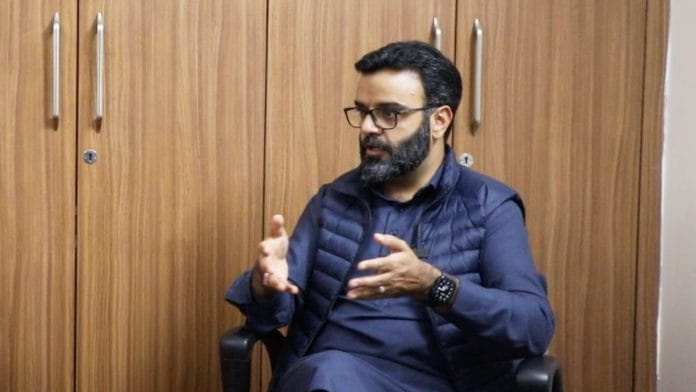



New Delhi: The unprecedented mandate given by the people of Jammu & Kashmir during the assembly polls has been betrayed by the National Conference (NC) leadership by collaborating with the Modi government at the Centre, the party’s Srinagar MP Aga Syed Ruhullah Mehdi has alleged.
In an interview with ThePrint, Mehdi said the National Conference had promised to ‘fight actively against the abrogation of Article 370’ but has failed to deliver since Omar Abdullah took on the reins as the Chief Minister of Jammu and Kashmir.
Referring to the J&K government under Omar Abdullah, Mehdi said, if the idea of maintaining a good relationship with the BJP at the Centre was to facilitate the functioning of routine governance in Jammu and Kashmir or to get more funds, then they should have opened the doors for BJP to win the elections in Jammu and Kashmir.
“If it was about the restoration of statehood only, we should have made ways open for the BJP to form the government in Jammu and Kashmir. They could have, and they would have restored statehood if they had their own government in Jammu and Kashmir. But we do not believe in that. We believe in the fact that if we stop our political fight at the restoration of statehood only—if we stop our fight or turn our agenda into routine governance—that amounts to legitimising the status quo, and that’s not our mandate,” said Mehdi.
The Srinagar MP has been at loggerheads with his own party leadership over several issues including the new reservation policy.
In December last year, he had openly defied the party when he led a protest by Kashmiri students outside Abdullah’s residence. The NC’s Budgam candidate Aga Syed Mahmood is Mehdi’s relative. Ahead of the assembly elections in Jammu and Kashmir, the party had promised to restore statehood as well as repeal the Public Safety Act, apart from restoring Jammu and Kashmir’s special constitutional status under Articles 370 and 35A.
Mehdi maintained that he has not spoken personally against anyone and is merely raising issues that are of concern to the people of J&K. He said the NC had always maintained that anyone who talks about routine governance in these situations is speaking for the BJP and taking the BJP’s line because they want to legitimise the new normal—‘the degraded status’.
“We didn’t want the status quo to be legitimised and normalised, and that’s why we said other political players in Jammu and Kashmir were acting at the behest of the BJP. We said we’ll challenge the status quo actively. And for the last 1.5 years—after our election in the assembly of Jammu and Kashmir—I think we didn’t fight institutionally enough to qualify for the implementation of the promises or the fightback, as we call it, against the abrogation of Article 370,” he said.
Mehdi said his expectations were that the party would have the will and a roadmap of how to deliver on their promises.
“I, as an individual, do have a roadmap for how to go for the restoration of rights and protections. The problem is the willingness and intent in my own organisation—which helps the government at the same time—is missing. If the intent and willingness were visible, I could have deliberated. I get cornered or attacked for saying that I want my party to deliver upon the promises. My party never approached me asking, What is the roadmap? How should we fight? What kind of roadmap should we make?”
Mehdi further said he has only been talking publicly about the policies and approach towards the agenda and the policies of the National Conference, as well as the implementation of the promises.
The Srinagar MP said the most important promise they made to people was that the party would fight actively against the abrogation of Article 370 and fight for its restoration and that this would be the core agenda.
“We didn’t base our political campaigning on normal promises for routine governance,” said Mehdi.
When it was pointed out that restoring Article 370 was the domain of the Centre and not in the J&K government’s purview, and to claims that Omar Abdullah was forging good relations with the Centre for the development of the region, Mehdi argued that there were several states which were “fighting”, even at the cost of routine governance, such as Tamil Nadu and West Bengal.
“They are fighting the central government, and the Constitution allows states to function normally while having their ideological fight with the central government, whoever the central government may be,” he said.
“So this surrender—this talk of restoration of statehood or getting more funds in return for having a cosy relationship or easing up with the BJP—amounts to, in my understanding, surrendering the political agenda and the political mandate of the people of Jammu and Kashmir, and that’s a betrayal of the people of Jammu and Kashmir,” he argued.
Mehdi said he had raised these issues within the NC but got no response. “Ultimately, it resulted in me not being invited to the formal meeting, which takes place in the shape of the working committee—a very important forum of our party,” Mehdi said.
The Lok Sabha MP said the party seems to have decided to toe a line which is the exact opposite of what the party promised to people before the elections and anything that reminds them of anything outside that line is an irritant.
“The party feels that it is an irritation, and I’m an irritant. They want to take that line which we campaigned against in the elections. They want to take the exact opposite of what we promised to the people, and that’s how it is. So they don’t feel the need to discuss and do the course correction. I can’t do anything—I can’t help in this situation… There are many people who agree with me and with what I say, but how many of them would want to talk about it and take a strong line on it? I’m not sure about that,” he said.
Mehdi said the people of J&K were not happy after the removal of Article 370. He further claimed that the argument that doing away with constitutional arrangements in Jammu and Kashmir enjoyed would impact militancy has proved to be incorrect.
“Militancy is still there. In fact, you have acts of terrorism worse than ever before. You may remember Pahalgam, which is one of the worst kinds of acts of terrorism. But before Pahalgam, we had incidents in the regions of Jammu which earlier didn’t have much militancy or violence or terrorism-related incidents. These took place in the regions of Jammu which were untouched before the removal of Article 370,” he added.
“If anything, Article 370 was the argument against secessionism or terrorism,” he added.
(Edited by Viny Mishra)
Also read: NC’s Aga Ruhullah walked out of working committee meet after clash with Omar. Here’s what happened