





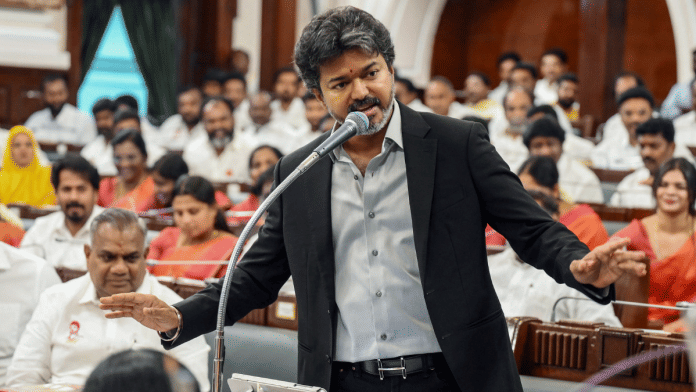

Chennai: Chief Minister C. Joseph Vijay levelled a series of corruption allegations against the previous DMK government, citing an Enforcement Directorate (ED) document and the decades-old Sarkaria Commission report.
Speaking in the Assembly, Vijay vowed zero tolerance for crimes against women and children, and drug menace, stating that strict action would be taken. “Whoever the wrongdoer is, whichever party they belong to, action will be taken, we believe that everybody is equal before law,” Vijay said in the Assembly.
He also said personal attacks and comments with double meaning against women should stop, noting that people were observing such things. “Before speaking about women in a double entendre, think about the women in your own homes,” he said.
His comments come after DMK leader Udhayanidhi Stalin’s remark, allegedly against actor Trisha, and the online comments about Industries Minister Keerthana over a look alike. Vijay also referred to past attacks on former chief minister J. Jayalalithaa in the Assembly.
Vijay said the DMK had challenged him to open files from three departments he had earlier described as corrupt under the previous regime.
“Before I open the said files, I want to read the Sarkaria Commission report on the DMK government’s corruption in 1988. The Sarkaria Commission, in its report, has highlighted and accused former chief minister Karunanidhi of abusing his official position as chief minister. The Enforcement Directorate has also accused the DMK of corruption through party funds. The ED mentioned that during the last regime, former chief minister M. K. Stalin, former deputy chief minister Udhayanidhi Stalin, and former minister Senthil Balaji collected money in the name of party funds,” he said.
He referred said the Sarkaria Commission recorded demands for commissions, including a reported 2.5 percent “party fund” linked to a tender.
He read portions of an ED document sent to the previous DMK government which stated that 7.5 to 10 percent of contract values in departments such as Municipal Administration and Water Supply had been collected as “party funds,” which he characterised as bribes taken in instalments “like EMIs on a loan”.
Vijay added that ED had described Stalin senior, Stalin junior and Balaji as direct beneficiaries. He stressed that these were not his personal allegations but those contained in the ED papers.
He also questioned the involvement of Ratheesh, a close associate of DMK leader and Leader of the Opposition Udhayanidhi Stalin. He has been named in Enforcement Directorate (ED) investigations related to alleged irregularities in the Tamil Nadu State Marketing Corporation (TASMAC) and other matters, including references in documents concerning “party funds” and municipal administration contracts during the previous DMK regime.
Vijay also questioned why Ratheesh was “hiding” in Dubai and what was his connection with the previous government.
After repeated allegations by DMK on poor law and order management in the state since the TVK government came to power, the Chief Minister stated that crimes reported in the past three months were largely driven by past enmities and revenge rather than a sudden breakdown under the current government.
Replying to the debate on the police department demands of grants, Vijay outlined plans to reform the police, describing them as protectors of people rather than a power centre. He said the police should be friends to those who abide by the law and foes to those who violate it.
He also informed the Assembly that 36 people had been arrested in connection with the murder of a college student in Coimbatore.
DMK members protested over Vijay’s allegations in the House by surrounding the Speaker’s podium and staging a sit-in protest. Speaker J. C. D. Prabhakar initially declined to allow an immediate response, stating that the Opposition had interrupted the chief minister.
Vijay indicated that the Speaker should permit the Opposition to speak, and later he requested that they be allowed. The Speaker, however, maintained that permission could not be granted under the circumstances, after which DMK members walked out.
Outside the Assembly, Leader of Opposition Udhayanidhi Stalin held a press interaction. He accused Vijay of diverting attention from questions on law and order and the government’s performance in its first few months, saying the chief minister had spoken in “dialogues and reels-style” and focused on events from the 1960s and 1970s rather than current issues.
He questioned Vijay’s knowledge of the Sarkaria Commission and the Maintenance of Internal Security Act, describing the ED references as mere allegations that had not prevented the DMK from returning to power multiple times after the report.
“We are asking about things happening today, but he is going back to the 1960s and 70s, with baseless allegations. Someone has written these dialogues and given them to him, and he is delivering them here. There is nothing in the Sarkaria Commission report, and everyone knows it. Where are the answers for the recent murders and law and order incidents?” Udhayanidhi said.
Udhayanidhi also said the Speaker had not allowed the Opposition to respond and suggested external pressure may have influenced the decision. “CM Vijay seems to think there is still a DMK government in Tamil Nadu. He should be speaking about his government’s last three months and his plans for the future,” Udhayanidhi said.
DMK spokesperson Saravanan Annadurai also alleged that Vijay was attempting to deflect attention from internal coalition issues and other contemporary controversies.
“Vijay is scared of the DMK. He has only 107 seats, and there are already a lot of ripples inside the coalition. One MLA goes and says he was offered so many crores for becoming a minister to support the government. Please take action, find out the truth, what he meant, and whom he meant,” Saravanan told ANI.
(Edited by Viny Mishra)